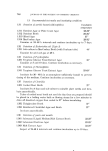
78{3 JOURNAL OF THE SOCIETY OF COSMETIC CHEMISTS Sodium acetate 3.0 g Cysteine hydrochloride 0.5 g Agar 15.0 g Water to 1 000 ml (pH 6.8 approx.) Prepare according to directions given for Oxoid materials. Commercial form: Oxoid Granules CM151 or Tablets CM152. GENERAL REFERENCES Cowan, S. T. and Steel, K. J. Manual for the identification of medical bacteria (Appendix A) (1966) (Cambridge University Press, London). Harrigan, W. F. and McCance, M. E. Laboratory methods in microbiology (Appendix 2) (1966) (Academic Press, London). Cruickshank, R. Medical microbiology 1 lth edn. 760 (1965) (E. & S. Livingstone Ltd., London). The Oxoid Manual $rd edn. (1965) (Oxoid Ltd., London). Alwen, J. and Smith, D. G. J. Appl. Bacteriol. 801t89 (1967). Brown, V. I. and Lowbury, E. J. L. J. Clin. Pathol. 18 752 (1965).

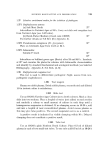
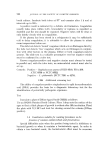
Appendix D 1. MICROBIOLOGICAL EXAMINATION OF PLANT AND EQUIPMENT Control measures for checking plant hygiene, such as the sampling of containers and working surfaces, should be carried out regularly. The following methods are recommended: 1.1 Swab technique (1) 1.11 Apparatus The follo ving apparatus is required: Test tubes, 250/25 mm of heavy borosilicate glass. Stainless steel wire, BS 1554, rust, acid and heat resisting steel wire, 350 mm of 2.64 mm diameter, formed into a loop at one end leaving a straight length of 300 mm and notched at the other end to hold the ribbon gauze. Ribbon gauze, unmedicated, 50 mm wide. 1.12 Preparation of swab The swab should be 50 mm in length and consist of 175 mm of gauze wound round the notched end of the wire, secured with thread. 1.13 Sterilization of swab Place the swab in 25 ml of Peptone Water Diluent in the test tube, plug with cotton wool or suitable rubber closure, cover the plug with aluminium foil or greaseproof paper, and sterilize by autoclaving at 121ø for 15 min. To obtain a final quantity of 25 ml of solution, it is necessary to start initially with a larger amount to allow for evaporation during autoclaving. The actual quantity should be found by trial and error with each individual autoclave. The Peptone Water Diluent should contain sodium thiosulphate or other suitable inactivator. 1.14 Swabbing technique Where possible, examine an area of 1 000 cm2 (approx. lft2). Press the swab with a rolling motion against the side of the test tube to remove excess liquid. Remove the swab and with heavy pressure rub back and forth over the area to be examined so that all parts of the surface are treated twice. Rotate the swab so that all parts of it make contact with the 787
Purchased for the exclusive use of nofirst nolast (unknown)
From: SCC Media Library & Resource Center (library.scconline.org)