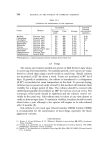
788 JOURNAL OF THE SOCIETY OF COSMETIC CHEMISTS surface under test. Return the swab to the test tube, and insert the cotton wool plug or rubber closure. 1.15 Testing Test the swab samples as soon as possible. After not less than 5 min contact of swab and liquid, mix the sample by twirling the swab vigorously in the Peptone Water Diluent six times. Remove the swab, taking care to express the liquid by pressing against the side of the tube. After thorough mixing by rotation of the tube between the palms of the hands, plate out 1 ml and 0.1 ml quantities of the swab solution using Plate Count Agar and incubate at 30 + 1 o for 72 + 2 h. Carry out the preparation of the dilutions, inoculation, pouring, and incubation of the Petri dishes, and the counting of the colonies as previously described. 1.16 Recording results Record the results as the colony count per 1 000 cm2 of surface tested (colony count per ml X 25 X area factor, if not 1 000 cm2). 1.2 Agaroid sausage technique The principle introduced by Ten Cate (2) is to use an agar-filled plastic casing which, when the ends are sealed, resembles a sausage. The end of the agar and casing is cut off and the exposed agar surface is used to take an impression of the surface to be tested. 1.21 Sampling technique (3) Swab the outside of the Agaroid casing with alcohol in the area to be cut and sterilize a very sharp, broad-bladed knife by swabbing with alcohol and flaming. Cut off the end of the Agaroid approximately 12 mm distal to the coloured band. Do not remove the coloured band it is provided to prevent the agar slipping out of its casing during use. Applying light pressure at the base, push out about 1 cm of the agar column. Sample by pressing the cut end of the agar firmly on the test surface. Cut off a slice 4-6 mm thick and transfer, inoculated side uppermost, to a petri dish by supporting the agar slice on the blade of a knife. Do not put the exposed end of the Agaroid down on a bench or other contaminated surface. Once the plastic casing has been cut, do not re-seal. Incubate the agar slices in closed petri dishes at 37 o for 18-24 h and then count colonies. A petri dish will hold 3 to 4 samples. The area of each sample is approximately 8.5 cm 2.

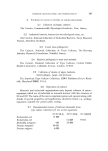
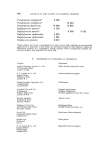
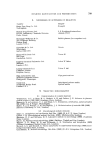
HYGIENIC MANUFACTURE AND PRESERVATION 780 The bacterial flora of the test surface can be determined by examination of the colonies on the agar. 1.22 Type MacConkey Plate count Range of Agaroid media recommended for use Code Application AG7 For the detection and count of coliform bacteria. AG183 General purpose media for the isolation of bacteria. Sabouraud: Maltose Malt extract AG41A For the detection of moulds/yeasts. AG59 For the detection of moulds/yeasts. With the seal intact, the Agaroid has a storage life of six months at 4 ø. Agaroid media can also be obtained with an inactivating agent incorporated. For sampling flat surfaces in particular, the Rodac plate can be recom- mended as an alternative to the Agaroid sausage. REFERENCES (1) British Standard 4285 36-37 (1968). (2) Ten Cate, L. J. Appl. Bacteriol. 28 221 (1965). (3) Bridson, E. Y. "Agar Sausage Sampling Technique" in Shapton, D. A. and Gould, G. W. Isolation methods for microbiologists. Technical Series $ (1969) (Academic Press, London). SUMMARY OF RECOMMENDED STERILIZATION CONDITIONS Various statements appear in this monograph with regard to the sterili- zation of plant, raw materials, packaging components, culture media, etc. and appropriate sterilizing conditions are recommended. In order to achieve satisfactory results, however, it is most important that the general principles underlying the various sterilization techniques should be understood. Vegetative micro-organisms, i.e. those in an active state of growth and reproduction, are comparatively easy to kill with the aid of heat, by irradiation, or by other means. On the other hand, spores are produced in the life-cycle of certain species and some forms of spores are extremely resistant to all forms of environmental stress, including high temperatures. Hence it is often necessary to design a sterilization process capable of destroying heat-resistant spores.
Purchased for the exclusive use of nofirst nolast (unknown)
From: SCC Media Library & Resource Center (library.scconline.org)