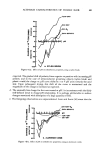
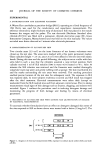
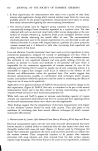
408 JOURNAL OF THE SOCIETY OF COSMETIC CHEMISTS EXPERIMENTAL A. INSTRUMENTATION AND ELECTRODE PLACEMENT A Wayne-Kerr autobalance precision-bridge (#8331), operating at a fixed frequency of 1592 Hertz, was used for the conductance and capacitance measurements. The reference electrode (a triple thickness strip of aluminum foil) was placed in the mouth between the tongue and the palate. The test electrode (Beckman Standard silver chloride #217413) was filled with a potassium chloride electrolyte paste (EC2 Grass Instruments Company, Massachusetts) and was held on the skin manually. The values recorded were those observed at 2 minutes after electrode placement. B. CHARACTERIZATION OF SLS INSULTED SKIN Two circular areas (3.5 cm 2) on the inner forearms of ten human volunteers were chosen as the test sites. The areas were marked with a fine point permanent marker. Glass cylinders (height = 2.5 cm, area 3.5 cm 2) were affixed to the test sites with elastic bands. During this time and the period following, the subjects sat at a table with their arms held in such a way that the cylinders assumed a near-vertical position: Each cylinder received 3 ml of SLS solution (30% in water w/w) heated to 45 c. After 30 minutes the SLS solution was removed and the forearms were washed thoroughly using luke-warm tap water and gently rubbing with a sponge. The skin was blotted dry and the marks surrounding the test areas were renewed. This marking procedure enabled precise location of the test sites for subsequent work. The exposure to SLS was repeated daily. In most subjects erythema occurred and SLS insult was stopped after the third treatment. Electrical measurements were taken daily (except on weekends) from the SLS insulted sites and from adjacent control areas. Prior to taking measurements visual signs of skin damage such as dryness, chapping, and redness were recorded. Figure I outlines the procedure used in inducing detergent damage and monitoring the progress of both damage and healing by means of electrical parameters. C. TREATMENT OF SLS INSULTED SKIN WITH LOTIONS AND QUANTITATION OF DAMAGE BY ELECTRICAL MEASUREMENTS To ascertain whether formulations have an effect on detergent damaged skin some of the sites exposed to SLS as shown above were treated with a lotion (2.Smg/cm2). The MORNING , [ I s,s !! w I z'o[I II s,s II w I o •o MINUTES Figure 1. Sequence of electrical measurements (EM), exposure to sodium lauryl sulfate (SLS), and wash off(w).

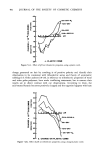
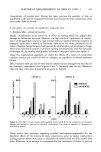
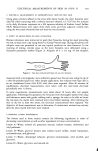
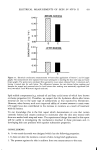
ELECTRICAL MEASUREMENTS OF SKIN IN VIVO.' I 409 treatment was randomized with respect to left and right forearms and with respect to the position of the sites in relation to the elbow. The corresponding contralateral SLS insulted sites were kept as the untreated controls. For example, the treatment scheme used in one subject is shown in Figure 2. JLOTI B•C), (:: A 1 SLS TREATED ( B INSULTED SITES 1 LOT,u.A
.A.
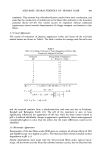
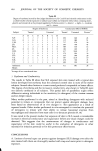
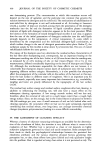
INSULTED C) \ (?'•C UNTREATED [.LOTION (.•D SITE Figure 2. Test site configuration for two lotions (A & B). The regimen of treatment with lotions in relation to the insults with SLS and electrical measurements is shown in Figure 3. Note that both treated and untreated SLS insulted MORNING EVENING INSULTED ! SITES ) FOLLOWING WITH / SLS DAY 1 SITES )FOLLOWING r t t t 5 •0 •0 •0 •PPROXI•T[ TIM[ INT[RV• IN •INUT[S •. Schem• •or •ssessin• •he pro•ecd•e •nd/or he•lin• e•ec•s o• lotions. • = electrical me•s•remems• S•S = e•posure •o sodium buryl •pplic•fion o• lotion •nd immedb•e remo•[• T = •re•men• wi•h lotion. sites had lotion applied just prior to washing. This was done in an effort to equalize the amounts of residual lotion that might be left on the skin after washing. Thus the electrical measurements to follow would be taken under conditions made as uniform as possible.
Purchased for the exclusive use of nofirst nolast (unknown)
From: SCC Media Library & Resource Center (library.scconline.org)