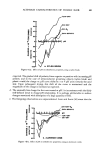
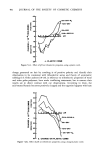
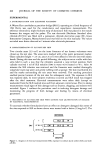
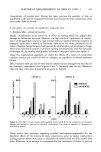
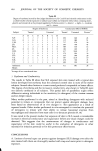
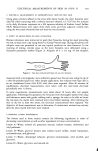
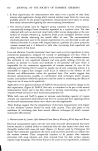
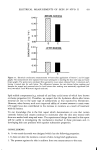
4.0 3.0 2.0 1.0 Cationic compound no, 1 O. 0 Cationic compound no. 2 I i I I I I I it 0.1 0.2 0.3 0.4 0.5 0.6 0.7 0.8 0.9 % Cationic (g/100 ml) Figure 17. Average ranking scores of a panel of five judges scoring tresses treated with two different cationic surfactants solutions and then soiled with artificial sebum. The higher the ranking value, the cleaner is the tress perceived. 0.15 0.10 0.05 X T/•'""•x x + i i i i 4 3 2 1 Clincial examination Least oily • ß Most oily Figure 18. Correlations between subjective hair oiliness and two quantities measured with Differential Scanning Calorimeter (D.S.C.) on sebum samples recovered from hair of subjects with different oiliness perception. Sc/S denotes the ratio of two peak areas in the D.S.C. trace. Tc is defined as the melting point of a characteristic lipid fraction. For details see ref. 30 (Reproduced with permission from ref. 30, Bor(•).

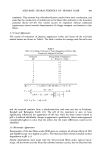
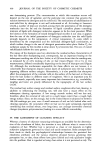
CLEANING OF HAIR 455 cleanliness perception have been carried out, nevertheless it appears that the latter quantity also plays an important role in the consumer perception of hair cleanliness (28). A number of publications have appeared in the literature attempting to relate the physical properties of sebum with subjective assessment of hair oiliness. In a series of papers, Bor• (28-30) established a correlation between the amount of low melting fraction of sebum, as measured by D.T.A., and the clinical assessment of hair oiliness (Figure 18). Dobinson and Petter (31), using a series of hair tresses soiled with oils and waxes (not sebum) of different consistencies, obtained relationships between various rheological properties and subjective judgement of hair oiliness. The visual and tactile assessments correlated well (Figure 19), though only a limited range of lipid 2 1 0 -1 •-2 m -3 •.-4 o '- 1 0 Tactile corr. coefft. = 0.89 f Visual = 0.97 -I-• '=1--- -- -- -- -- •---- 10 '1 1 10 10 2 10 a Viscosity (Nsm -2 ) Figure 19. Sensory perception of oilness of hair tresses soiled with oils of different viscosity: ordinate represents average rank order of perceived oiliness, abcissa objective viscosity (Reproduced with permission from ref. 31). consistency was investigated. Bor• suggested that the oiliness perception of hair depends essentially on two quantities: the amount of sebum on the hair surface, and its physical consistency. His data are not sufficiently conclusive to allow deduction of the functional relationship between these quantities and'the magnitude of oiliness perception (Figure 20). The question of what effect visual and tactile perceptions have on the overall assessment of hair oiliness is also unresolved. Shampooing can affect perception of hair cleanliness in two ways: a) by removing the bulk of sebum and b) by modifying both the hair surface and the consistency of the sebum, possibly by removing selectively some of the sebum components. It is worthwhile to point out in this context that according to Bor& et al. (30) sebum samples recovered from oily and from dry hair showed differences in their unsaturated fatty acid contents. Oily-haired subjects had predominantly 8-octadeca- noic acids whereas the sebum of those with dry-hair contains more 9-octadecanoic acid (Figure 21). The significance of this difference has not yet been fully clarified. Nevertheless, it suggests that minor chemical differences may be important in
Purchased for the exclusive use of nofirst nolast (unknown)
From: SCC Media Library & Resource Center (library.scconline.org)