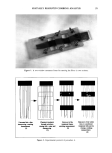
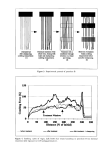
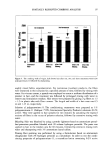
SPLIT-END FORMATION IN HAIR 125 fibers and this will be favored to take place about the major axial diameter of each hair. An initial fracture once formed will tend to be propagated towards the hair tip by the continuous bending and straightening process experienced during the release of the hair from its entrapment. Such a fracture in the plane of the hair's major axial diameter would be entirely consistent with the microscopic form of the primary bifurcation of the split end. It is worth adding that a given combing operation may not give rise to a split end in a particular hair, but it is likely that repetitive combing of tangled hair eventually will cause shear stress fatigue and the amalgamation of localized fractures to generate a macroscopic split end. For a given person, several factors such as the length of hair, the speed of combing, the degree of tangling, and the hair's cross-sectional size and shape will influence the facility with which split ends are formed. There are two further important factors that will influence the propensity towards split ends and that are amenable to modification by the suitable application of hair toiletry products. The first of these is the frictional coefficient of the fiber surfaces. With increasing friction one expects higher forces to be applied in the comb-out of hair tangles and for this to be accompanied by the tighter bending of the hairs over each other and by greater longitudinal shear forces being generated within the individual fibers. Any hair toiletry product that culminates in lubricating the frictional interactions between hairs will serve of necessity to reduce the shear stresses and reduce the incidence of split ends. The second factor concerns the hair's internal plasticity, particularly in relation to the shear stresses imposed on the hair's longitudinal elements and also in relation to the time constants for the bending and straightening processes noted previously. If the components of the hair shaft (they are mainly protein- aceous) do not respond plastically to the imposed shear stresses, then shear fatigue and shear fracture will ensue. Such loss of response is likely to occur in hairs that have been exposed to sunlight, where the protein crosslinking networks have been modified by free-radical attack (8). This would account for why the hairs of persons indulging in excessive exposure to sunlight are particularly susceptible to splitting. Note also that the total radiation dose in given segments will be temporally cumulative with increasing distance along the hair towards the tip. Agents that help plasticize the hair's proteins to stresses of short time constant should reduce the incidence of split ends. It is the author's observation that fewer split ends are formed when hair is combed at high rather than at low relative humidity, indicating that water itself is one such plasticizing agent. As judged by its effect in reducing the brittleness of cold-waved hair (9), glycerol is another plasticizing agent that seemingly also reduces the incidence of split ends. REFERENCES (1) N. Cooper, J. Short, J. Szadurski, and B. Turek, Assessment of the effect of hair care products on hair strengthening, Proc. 14th Con& Intl. Fed. Soc. Cosmet. Chem., Barcelona, 2, 1125-1133 (1986). (2) A. FiSrster and P. Busch, Assessment of the efficacy of preparations for the prevention of hair breakage by correlation analysis, •rtz. Kosmetol., 19, 193-207 (1989). (3) Y.K. Kamath and H.-D. Weigmann, Measurement of combing forces, J. Soc. Cosmet. Chem., 37, 111-124 (1986). (4) C. A. Brown and J. A. Swift, Hair breakage: The scanning electron microscope as a diagnostic tool,,]. Soc. Cosmet. Chem., 26, 289-297 (1975). (5) R.j. Roark and W. C. Young, Formulas j•r Stress and Strain, 5th ed. (McGraw-Hill Kogakusha Ltd., Tokyo, 1975).

126 JOURNAL OF THE SOCIETY OF COSMETIC CHEMISTS (6) J. A. Swift, Some simple theoretical considerations on the bending stiffness of human hair, IntL J. Cosmet. Sci., 17, 245-253 (1995). (7) W. E. Morton and J. W. S. Hearle, Physical Properties of Textile Fibers, 3rd ed. (The Textile Institute, Manchester, 1993). (8) F. G. France and I. L. Weatherall, The effect of light on wool. Proc. 9th Int. Wool Textile Res. Conf., Bid/a, 2, 100-108 (1995). (9) P. Busch and W. HiSfer, Automated determination of the dynamic bending modulus of hair fibers. Parf. •. Kosmet., 72, 632-646 (1991).
Purchased for the exclusive use of nofirst nolast (unknown)
From: SCC Media Library & Resource Center (library.scconline.org)