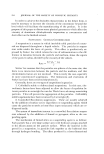
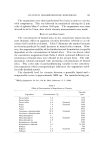
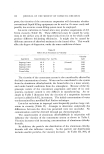
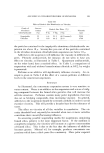
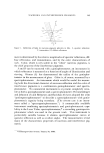
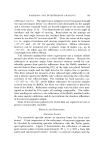
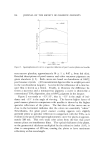
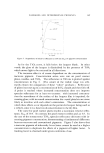
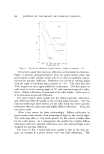
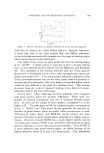
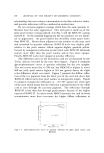
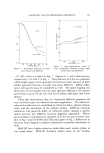
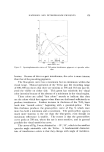
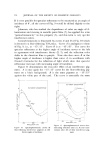
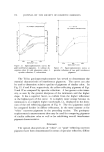
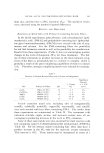
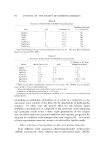
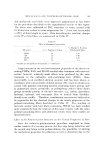
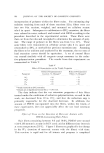
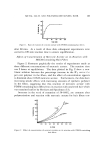
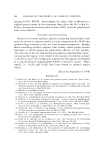
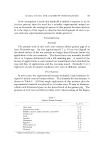
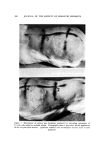
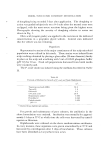
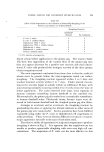
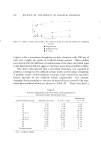
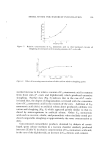
176 JOURNAL OF THE SOCIETY OF COSMETIC CHEMISTS 8 4•0 550 650 W,•,VELENGTH (nm) Figure 12. Spectrophotometric curves for gold interference pigments. A, without ab- sorption color B, with absorption color S, specular reflection T, transmission I/v = -15ø/15 ø PIGMENT CONCENTRATION 450 550 650 WAVELENGTH (nm) Figure 13. Spectrophotometric curves at specular reflection of two gold interference pigments The Trilac goniospectrophotometer has served to demonstrate the essential characteristics of interference pigments. The curves can also be used to determine relative quality of pigments of similar color. In Fig. 13, A and B are, respectively, the yellow-reflecting pigments of Figs. 9 and 12 as compared by specular reflection. A has greater color inten- sity, as seen by the greater sharpness of the minimum and the higher slope. It has a superior luster, as evident from the higher reflectance at the highest part of the curve. It is slightly more orange because its minimum is at a slightly higher wavelength, i.e., displayed in the direc- tion of the red reflecting pigment of Fig. 9. The two pigments could be compared further in diffuse reflectance, in the same manner as for "white" nacreous pigments in the preceding section. The goniospec- trophotometric measurements thus may be used for comparing pigments of similar reflection color as well as for exhibiting overall interference pigment charactertistics. SUMMARY The optical characteristics of "white"- or "pearl"-reflecting nacreous pigments have been demonstrated in terms of specular reflection, diffuse

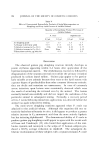
NACREOUS AND INTERFERENCE PIGMENTS 177 reflection, and transmission, using a Leres Trilac goniospectropho- tometer. Nacreous luster is most nearly described by specular reflectance, but the total visual effect of a particular nacreous pigment depends in addition on diffuse reflectance and transmittance. The appearance of one nacreous pigment cannot be duplicated by a chemically different nacreous pigment since the specific combination of these factors is de- pendent on the refractive index. The other properties which determine nacreous behavior are platelet dimensions and the smoothness of the platelet surfaces. Specular reflectance increases with increasing nacreous pigment con- centration up to a certain point. Thereafter, further increase in con- centration leads to a decrease in specular reflectance. The maximum specular reflectance achievable with a given nacreous pigment is a measure of its inherent nacreous luster. Interference pigments are examples of nacreous pigments which are color-producing in addition to having the usual nacreous pigment characteristics. These pigments exhibit two kinds of goniochromaticity, or change in color with varying angles of illumination and viewing: (a) the reflection color, which is seen at specular reflection, moves to lower wavelength with increasing angle of incidence, as was shown by spectrophotometric curves at -- 15 o / 15 o and --45 o/45ø (b) with the pig- ment on a white background, measurement at a specular angle exhibits the reflection color, while measurement at a diffuse or nonspecular angle reveals the complement of the reflection color, or transmission color. (Received October 26, 1970) REFERENCES (1) Greenstein, L. M., Nacreous pigments and their properties, Proc. Sci. Sect. Toilet Goods Ass., 45, 20-6 (May, 1966). (2) Greenstein, L. M., and Miller, H. A., The properties of nacreous pigments, Tech. Pap., Ann. Tech. Conf., Soc. Plast. Eng., XIII, 1121-32 (May, 1967). (3) Greenstein, L. M., Nacreous Pigments, in Encyclopedia of Polymer Science and Technol- ogy, Vol. 10, Interscience Publishers, New York, 1969, pp. 193-211, 215-9. (4) Hunter, R. S., High gloss measurements, Off. Dig., Fed. Soc. Paint Technol., 36, 348-56 (1964). (5) Hemmendinger, H., and Johnston, R. M., Goniospectrophotometric color measurement: use of the Trilac goniospectrophotometer, paper presented at the 1st AIC Cngress, Color 69, Stockholm, June, 1969. (6) Billmeyer, F. W., Jr., and Davidson, J. G., A research spectrogoniophotometer, ]. Paint Technol., 41, 647-53 (1969). (7) Johnston, R. M., Geometric metamerism, Color Eng., 5, 42-7, 54 (1967).
Purchased for the exclusive use of nofirst nolast (unknown)
From: SCC Media Library & Resource Center (library.scconline.org)