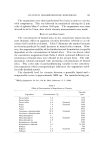
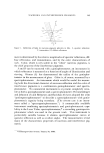
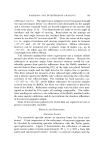
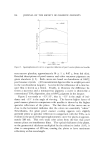
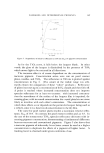
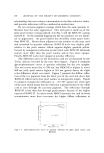
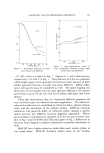
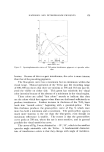
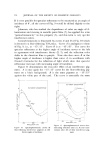
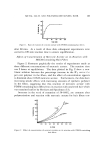
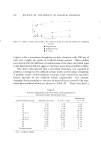
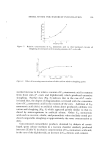
174 JOURNAL OF THE SOCIETY OF COSMETIC CHEMISTS If it were possible for specular reflectance to be measured at an angle of incidence of 0 ø, all the curves of Fig. 9 would be shifted slightly to the right. Johnston, who has studied the dependence of color on angle of il- lumination and viewing in metallic paint films (7), has applied the term "goniochromaticity" to this property (5), and this term is very apt for interference colors. Goniochromaticity is illustrated by curves A and B of Fig. 10 which is devoted to a blue-reflecting TiO.•-mica. Curve A is analogous to those of Fig. 9, i.e., at --15ø/15 ø Curve B is at --45ø/45 ø. The curve for specular reflectance at the higher angle of incidence moves to the left in agreement with interference theory (2, 3), and the reflection color shifts in the direction blue to purple. Note also that curve B at the higher angle of incidence is higher than curve A, in accordance with Fresnel's formulas for the reflection of light which show that specular reflectance increases with increasing angle of incidence. Figure 11 demonstrates the two-color effect of an interference pig- ment. A is once again the --15ø/15 ø curve for the blue-reflecting pig- ment on a black background. B is the same pigment at --15ø/15 ø against the white part of the card. The curve is essentially the same io 8[.. 3% PIGMENT CONCENTRAoiiIIWhite-15ø/45øonCONCENTRATIONPIGMENT5%•o 450 550 650 WAVELENGTH (nrn) Figure 10. Spectrophotometric curves of blue-reflecting interference pigInent at dif- ferent angles of incidence •6 06 o •4 04• 450 550 650 WAVELENGTH (rim) Figure 11. Spectrophotometric curves dem- onstrating reflection color (A, B) and trans- mission color (D) of blue interference pig- In e n t

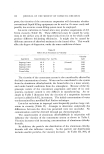
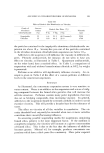
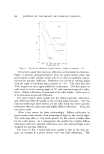
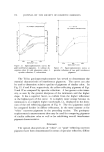
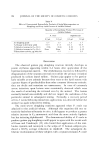
NACREOUS AND iNTERFERENCE PIGMENTS 175 but somewhat higher than that obtained against the black background however, the increase in reflectance at the minimum is indicative of some small diminution in color intensity. At the specular angle, then, the color is relatively independent of background. Diffuse reflectance curves C (black background) and D (white back- ground) at --15ø/45 ø tell a different story. The reflection against black is still blue, although with much lower color intensity than at --15ø/15 ø The reflection against white is now yellow: highest reflectivity is in the yellow-red region, lowest in blue. The light viewed at a nonspecular angle as in this --15ø/45 ø example is reflected from the white back- ground. It is transmitted through the interference platelets twice: first as the incident beam, then as the reflected beam. The color ob- served is thus the transmission color as opposed to the reflection color which is seen at the specular angle. Interference pigments which have no absorption color thus display two colors which are complementary to one another. The two-color effect of the red interference pigment has been utilized in "iridescent" nail enamel. Coated on the curved fingernail, the pig- ment displays a red highlight against a greenish background, and thus duplicates some of the optical characteristics of natural mother-of- pearl. Curves A and B of Fig. 11 establish the similarity of blue specular reflectance against black and white backgrounds. On casual visual observation, however, the color intensity against white always seems •nuch weaker, mainly because the pigment is not observed at the exact specular angle. It is possible to darken an interference pigment, thereby sacrificing the two-color play, to obtain apparent intensification of the reflection color. For example, a yellow-reflecting TiO2-mica which also has a yellow absorption color displays no blue transmission but instead has a more readily seen golden reflection. Such pigments are the "bril- liant gold" and "dark gold" TiO2-mica pigments. In Fig. 12, an inter- ference gold which has no absorption color is compared with one which has absorption color, at --15ø/15 ø against black and at --15ø/60 ø against white. The two pigments look very much the same in specular reflection (A-S without absorption color, B-S with absorption color). However, they differ markedly in diffuse reflection which reveals the transmission color: the pigment without absorption (A-T) is blue- purple, the pigment with absorption (B-T) is yellow. Only the first displays striking goniochromaticity.
Purchased for the exclusive use of nofirst nolast (unknown)
From: SCC Media Library & Resource Center (library.scconline.org)