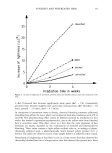
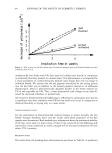
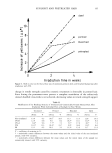
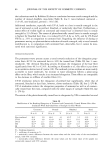
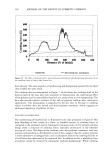
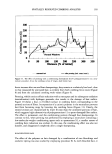
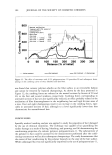
j. Soc. Cosmet. Chem., 48, 93-105 (March/April 1997) Spatially resolved cornbinD analysis j. JACHOWICZ and M. HELIOFF, International Specialty Products, Wayne, NJ 07470. Accepted for publication June 1, 1997, Synopsis A new technique, termed spatially resolved combing analysis, was employed to study the conditioning prop- erties of a cationic polymer on various types of hair. In this method, special frames are employed that allow the application of a treatment to selected areas of the fibers, while shielding the remaining portions as internal reference sections. The combing traces of hair treated in such a way, obtained by using a Diastron tensile tester, show positive or negative peaks depending on whether the treatment results in an increase or a decrease of friction against the hair surface. The method has higher sensitivity than previously employed procedures that involved the measurements of hair before and after conditioning of the whole tress. The conditioning of polyquaternium-11 was evaluated on untreated, Caucasian brown hair as well as on fibers damaged by oxidative dyeing, bleaching, bleaching/dyeing, and perming. It has been shown that the conditioning effect depends on the type of hair modification. The effect of the polymer on untreated hair is relatively small and becomes apparent only after multiple shampooing, which roughens the untreated sections of hair. For dyed hair, which exhibits three to four times higher combing forces than the reference virgin hair, the adsorbed polyquaternium-11 reduces the combing forces to the level of untreated hair. The conditioning layer of the polymer can be removed from dyed hair by one to two shampooings. The polymer showed higher substantivity for bleached and perreed hair, with the conditioning effect persisting after multiple shampooings. INTRODUCTION Quantitative combing measurements are widely employed in the evaluation of hair care products. The technique was first described by Newman eta/. (1), and further developed by Tolgyesi eta/. (2) and Garcia and Diaz (3). Detailed discussion of various factors affecting the quantitative combing analysis of hair, including the application of two combs, was reported by Kamath and Weigmann (4). In all these publications the procedure consisted of passing a comb through a hair assembly in the form of a tress and measuring the forces as a function of distance. To evaluate the conditioning effect, the measurements had to be performed first on untreated fibers, and then, after the treat- ment, on modified hair. The error of combing work data was +20% and +50% for wet and dry hair evaluations, respectively. This relatively high error, related to variability in relative placement or entanglement of the fibers in a tress, precludes the possibility of unequivocal detection of small changes in the frictional properties of hair. This report presents a new approach to combing measurements, termed spatia//y resolved combing analysis, which consists of applying the modifying treatments to only selected areas on 93

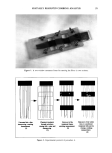
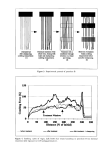
94 JOURNAL OF THE SOCIETY OF COSMETIC CHEMISTS a tress rather than to the whole fiber assembly. This was accomplished by the use of special treatment frames that allowed the application of polymer, surfactant, or formu- lation solutions to selected areas of the fibers, while shielding the remaining portions as internal reference sections. The combing traces of hair (usually presented as combing force as a function of distance or position of a comb in a hair tress) treated in such a way show positive or negative peaks depending on whether the treatment results in an increase or a decrease of the lubricating properties of the hair surface. Since treated and control areas are scanned in one combing measurement, the new technique has higher sensitivity than the previously employed procedures and also allows a more graphic representation of the data. The experimental data presented in this report refer to polyquaternium-11, which is a cationic copolymer frequently employed in fixative and conditioning hair care prod- ucts. Previously, the results of qualitative analysis of conditioning attributes of cationic copolymers of vinyl pyrrolidone were reported by Murphy (5). Recently, a reference to conditioning properties of polyquaternium-ll was made by Hossel and Pfrommer (6). EXPERIMENTAL INSTRUMENTATION Spatia//y resolved combing analysis. The formulations were applied to selected areas of hair tresses by the use of a two-window treatment setup (Figure 1). It consists of two plexiglas and two silicone rubber frames. A hair tress is compressed between the rub- ber and plexiglas frames with stainless steel screws and bolts. A typical procedure consists of (a) treating the exposed sections of the fibers with an appropriate formu- lation, (b) extensive rinsing with water to remove any residues of the treatment sol- ution, and (c) opening the frame to perform the wet combing analysis of the treated tress. The combing measurements were performed by employing a Diastron miniature tensile tester with the following instrument settings: range 500 G gauge 2 G sample size 50 mm phase 1 extension 350% phase 2, 0% phase 3, 0% and phase 4, 0%. The instrument was operated by Rheopac software (revision 3.0A). The data calculations and plotting were performed by using QuattroPro for Windows or Lotus 1-2-3 for Windows spreadsheets. The combing measurements were done on wet hair (3). In all experiments hair was combed several times to remove entanglements, and then mounted in the Diastron with hair evenly distributed across the 1.25-inch length of a comb (12 teeth/inch). The combing force was continuously recorded as the tress was combed at a crosshead speed of 12 cm/min. The data were analyzed either by comparing the features of the combing curves (combing force as a function of distance) or by calculating the total combing work as an integrated value of force over the length of the tress. MATERIALS Samples of hair. Experiments were performed on dark brown hair purchased from DeMeo Brothers, New York. Hair samples were precleaned with 3% ALS solution and thor-
Purchased for the exclusive use of nofirst nolast (unknown)
From: SCC Media Library & Resource Center (library.scconline.org)