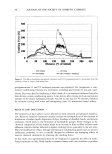
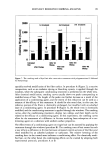
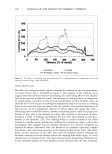
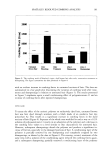
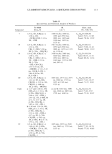
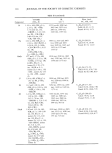
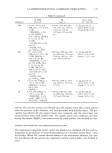
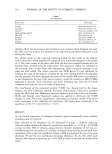
90 JOURNAL OF THE SOCIETY OF COSMETIC CHEMISTS 2. The photochemical reactions of cosmetically modified hairs are intensified by chemicMs remai,ing in the hair. In particular, H202 is taken into consideration, as (a) all examined cosmetically treated hairs had come in contact with H202 (c/f Table V), and (b) H202 can be transformed under irradiation into highly reactive hydroxy radicals (photochemi- cal melanin degradation correlates with duration and concentration of 8202 treatment). 3. Mela,i, is assigned a key role in the photochemical reactions. The extent of photo- chemical damage in many investigations deals with the cortex directly, dependent on pigmentation (1-4). In the present investigation, dependencies could, however, only be demonstrated between the duration of irradiation and degradation of melanin on the one hand and H202 treatment and pigment destruction on the other. Bleached hair is photochemically brightened the most, followed by dyed and permed samples. CONCLUSIONS On the basis of significant fading and yellowing of cosmetically treated hairs, protection against sunlight-induced (U¾-A and ¾IS) color changes is recommended for permed and dyed hair. Chemically bleached hair needs an additional protection against photochemi- cally caused protein and lipid modifications (U¾-B, U¾-A, and ¾IS), as these damage the structure of human hair. REFERENCES (1) E. Hoting, M. Zimmermann, and S. Hilterhaus-Bong, Photochemical alterations in human hair. Part I: Artificial irradiation and investigations of the hair proteins,J. Soc Cosmet. Chem., 46, 85-99 (1995). (2) E. Hoting, M. Zimmermann, and H. H6cker, Photochemical alterations in human hair. Part II: Analysis of melanin, J. Soc Cosmet. Chem., 46, 181-190 (1995). (3) E. Hoting and M. Zimmermann, Photochemical alterations in human hair. Part III: Investigations of the internal lipids, J. Soc Cosmet. Chem., 46, 85-99 (1995). (4) M. Tatsuda, M. Uemura, K. Torii, and M. Matsuoka, Studies on hair damage and demelanization by ultra violet light,J. Soc. Cosmet. Chem. Japan., 21, 43•49 (1987). (5) G. Reese and N. Maak, Die Bestiindigkeit yon Haarfarben unter dem EinfiuB yon Sonne, Wasser, Salz, •rztL KosmetoL, 12, 373-379 (1982). (6) G.J. Smith and W. H. Melhuish, Fluorescence and phosphorescence of wool keratin excited by UV-A radiation, Text. Res. J., 55,304-307 (1985). (7) K. R6per and E. Finnimore, Chemical structure of chromophores formed during photoyellowing of wool, Int. Wool Text. Res. Conf. Tokyo, IV, 21-31 (1985). (8) A. Elliott, The o•-[3 transformation in streched hair, Text. Res. J., 22, 783-786 (1952). (9) C. R. Robbins and C. Kelly, Amino acid composition of human hair, Text. Res. J., 40, 891-896 (1970). (10) P. Alexander, A. Fox, and R. F. Hudson, The reaction of oxidizing agents with wool, Biochem. J., 49, 129-138 (1951). (11) C. R. Robbins, Chemical and Physical Behaviour of Human Hair (New York, 1979), pp. 161-190. (12) U. Schumacher-Hamedar, J. F•Shles, and H. Zahn, Intermediate steps in the oxidation ofcystine in the bleaching process, Textilveredlung, 21, 121-125 (1986). (13) H. Zahn, Wool is not keratin only (Plenum Lect.), 6th Int. Wool Text. Res. Conf, Pretoria, I, (1980). (14) S. Hilterhaus-Bong and H. Zahn, Contribution to the chemistry of human hair: II. Lipid chemical aspects of permanently waved hair, Int. J. Cosmet. Sci., 11, 167-174 (1989). (15) M. Zimmermann and H. H&ker, Identification and quantification of simulated sunlight induced cholesterol oxides in wool by means of GC and GC-MS, Text. Res. J. (in press).

SUNLIGHT AND PRETREATED HAIR 91 (16) E. Finnimore, Wissenschaftliche Aspekte des Farbens, Text. Prax. Int., 43, 510-515 (1988). (17) M. Zimmermann, Interne Lipide der Wolle: Photooxidative Ver•'nderung und ihre Auswirkung auf die Wolla•kser, Thesis, RWTH, Aachen (1989). (18) K. Joko, J. Koga, and N. Kuroki, The interaction of dyes with wool keratin•The effect of solvent treatment on dyeing behavior, Proc. 7th Int. Wool Text. Res. Conf Tokyo, V, 23-32 (1995). (19) M. Wong and I.-J. Wolfram, The aging and weathering of human hair, Annual Scientific Seminar, Soc. Cosmet. Chem. (1987). (20) L.J. Wolfram, "Reactivity of Human Hair, a Review," in Hair Research: Status and Future Aspects, Orfanos, Montagna, and Stfittgen, Eds. (1981), pp. 479-500.
Purchased for the exclusive use of nofirst nolast (unknown)
From: SCC Media Library & Resource Center (library.scconline.org)