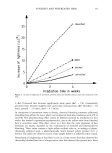
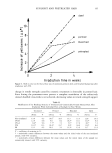
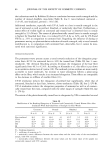
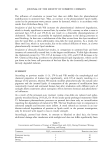
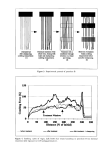
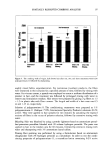
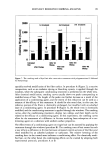
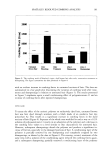
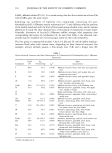
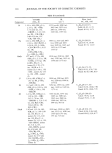
SPATIALLY RESOLVED COMBING ANALYSIS 97 500 300 200 100 1st treatment 2nd treatment ......... ii ..... _s• ............... _••_ .... 284 -I-7 ....... 306d=35 29o, 4-36 Untreated After 1st After 2nd After 3rd After 4th Hair Shamp. Shamp. Shamp. Shamp. Figure 5. Fhe combing work of virgin, dark brown hair after one, two, and three treatments with 0.2% polyquaternium-1 1 followed by shampooing. oughly rinsed before experimentation. For nonviscous treatment products, the fibers were immersed in their solution for a specified amount of time, followed by rinsing with water. For viscous creams, a spatula was employed to ensure a uniform distribution of a product in hair, and the treatment was followed by prolonged rinsing with water to remove any formulation residues. Hair tresses were prepared by gluing 2-g fibers to 1.5 x 1.5-in plastic tabs with Duco cement. The length and width of a hair tress was 6.5 in and 1.25 in, respectively. Solutions of polyquaternium-11. The conditioning treatments were prepared as 1% polyquaternium-11 (Gafquat 755N, International Specialty Products) solutions (0.2% active). They were applied to hair samples for two minutes by saturating the exposed sections of fibers in the excess of polymer solution, followed by extensive rinsing with water. Bleaching. Hair was bleached by using a powder lightener based on ammonium persul- fate/potassium persulfate blended with 20 volume hydrogen peroxide. The paste was applied to hair in the window area for 60 minutes, followed by extensive rinsing with water and shampooing with 3% ammonium lauryl sulfate. Perming. Hair perming was performed by using a formulation based on ammonium thioglycolate with 2% hydrogen peroxide as a neutralizer. In order to test the condi- tioning properties of polyquaternium-11, a neutralizer lotion containing 0.2% active

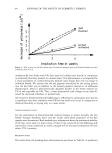
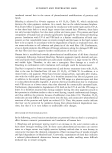
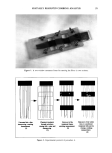
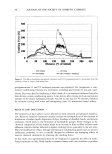
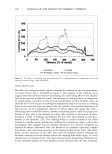
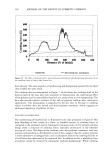
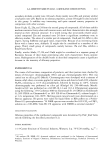
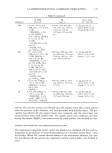
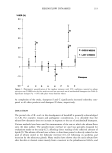
98 JOURNAL OF THE SOCIETY OF COSMETIC CHEMISTS 500 4OO 3OO 200 0 50 100 150 200 250 300 350 Distance [% of initial] .... before treatment -- after dycing aRer treatment -• aRcr 1st treatment + shampooing Figure 6. The effect of oxidative dyeing and treatment with 0.2% polyquaternium-11 (procedure A) on the combing curves of virgin, dark brown hair. polyquaternium-11 and 2% hydrogen peroxide was employed. For comparison, a com- mercial conditioning formula of a neutralizer including quaternium-52 was also used. Dyeing. Hair was dyed by employing a black shade of a conventional oxidative haircolor that did not contain conditioning agents. A dye lotion, after mixing with an equivolume amount of 20 volume hydrogen peroxide, was left on the hair for 30 minutes, followed by extensive rinsing with water and shampooing with 3% ammonium lauryl sulfate. RESULTS AND DISCUSSION The properties of hair surface can be affected by both chemical and physical modifica- tion. Reactive chemical treatments usually increase the hydrophilicity of hair because of dissolution of surface lipids, deposition of dyes, breakage of disulfide bonds, and keratin oxidation, which leads to the formation of hydrophilic groups. These changes in the chemical composition of hair surface result in an increase in fiber-to-fiber or fiber-comb adhesion, which is further reflected in higher combing forces, especially in the wet state. Physical modification of hair, through adsorption of conditioning agents such as cationic surfactants, polymers, or oils, is usually designed to alleviate the damaging effects of reactive chemical treatments by lowering the combing forces. In this work, two experimental protocols are employed to quantify the effect of modi- fying treatments on hair. Both employ treatment frames with two windows to produce
Purchased for the exclusive use of nofirst nolast (unknown)
From: SCC Media Library & Resource Center (library.scconline.org)