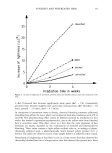
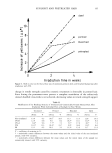
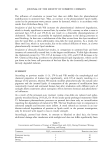
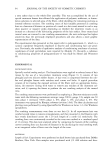
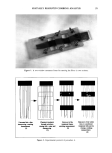
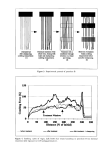
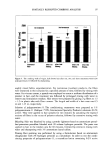
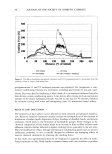
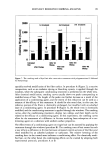
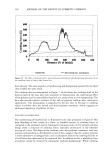
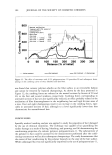
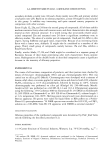
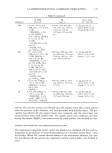
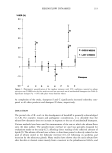
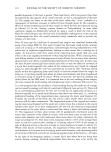
SPATIALLY RESOLVED COMBING ANALYSIS 99 2000 1500 lOOO 500 1st treatment 2nd treatment 3rd treatment 115o4-1•0 .......... 810-J-6• 10334-140 o Untreated After 1st After 3rd Hair Shnmp. Shnmp. After Dyeing After 2nd After 4th Shnmp. Shnmp. Figure 7. The combing work of dyed hair after consecutive treatments with polyquaternium- 11 followed by shampooings. spatially resolved modification of the fiber surface. In procedure A (Figure 2), a reactive composition, such as an oxidative dyeing or bleaching system, is applied through the windows, while the subsequent conditioning treatment is performed on the whole tress. After chemical modification, combing curves usually show two peaks corresponding to modified areas of hair. The height of the peaks can further decrease as a result of the application of a conditioning agent, and the extent of this reduction can be used as a measure of the efficacy of this treatment. It should be also noted that, in this case, the reference portion of the fibers is chemically unchanged, but modified with an adsorbed layer of a conditioning agent. In procedure B (Figure 3), the whole tress is chemically modified, and the conditioning treatment is applied through the windows. The combing curves, after the conditioning treatment, display two valleys, and their depth can be related to the efficacy of a conditioning agent. In this experiment, the combing curves allow for the assessment of a difference in friction resulting from adsorption of a con- ditioning agent on a substrate with uniform surface properties. The effectiveness of a conditioning agent on virgin hair can be assessed by applying the treatment through the windows (procedure B). The combing trace of hair treated in such a way reflects a difference in friction between untreated control sections of the fibers and those modified by an adsorbed polymer or surfactant. The relative lowering of the combing force in the treated areas indicates a conditioning effect. For chemically modi- fied hair, on the other hand, the conditioning effects can be studied by adopting both experimental protocols, procedures A or B.

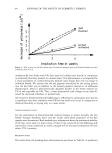
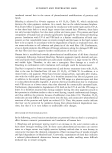
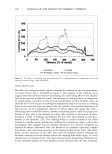
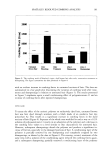
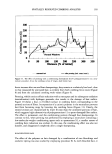
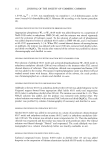
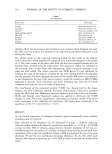
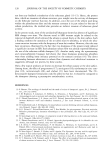
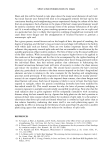
100 JOURNAL OF THE SOCIETY OF COSMETIC CHEMISTS 500 4OO 0 100 150 200 250 300 350 Distance [% of initial] .... befor• treatment -- after bleachlag • after bleaching + treanne•t • after treatment+4 ahamp. Figure 8. The effect of bleaching and treatment with 0.2% polyquaternium-ll (procedure A) on the combing curves of virgin, dark brown hair. VIRGIN, BROWN HAIR The effect of a cationic polymer, applied through the windows in the treatment frame, on virgin, brown hair is presented in Figure 4. The analysis of the combing traces suggests that after the first treatment and rinsing, the conditioning effect of the adsorbed layer of the polymer is relatively small. The lowering of combing forces, in comparison to untreated hair, is evident in tress sections corresponding to both windows, and is of the order of 10-20 G (Figure 4). Subsequent shampooing leads to an increase in combing forces in the areas that were not treated with the polymer. One possible explanation of this increase can be a progressive removal of sebum and/or hair lipids that form a lubricating layer on the fiber surface. Another contributing factor could be a progressive damage to hair, such as the abrasion of cuticle cells, incurred in the process of sham- pooing as a result of rubbing and handling the hair. This phenomenon is well docu- mented in the literature (7,8). The combing forces in treated sections of the fibers increase to a smaller extent, and the two combing force minima are clearly evident after shampooing. This suggests that the adsorbed polymer is not removed completely by exposure to anionic surfactants. Also, the formation of a polymer-surfactant complex may enhance the lubricating properties of the treated sections of the fibers. The subse- quent, second, treatment of the same tress with the polymer solution (through the windows combing traces not shown) reduces the combing force values again, to a level characteristic for untreated hair. The traces obtained after shampooings following the second treatment display the same pattern as those obtained after the first treatment,
Purchased for the exclusive use of nofirst nolast (unknown)
From: SCC Media Library & Resource Center (library.scconline.org)