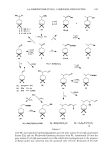
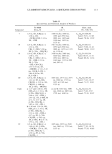
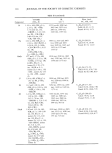
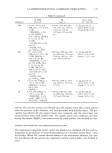
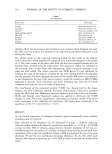
110 JOURNAL OF THE SOCIETY OF COSMETIC CHEMISTS LiAIH 4 afforded alcohol 25 (11). It is worth noting that the direct reduction of ester 23a with LiAIH4 gave the same result. Summing up, synthesis of eighteen new compounds containing the gem- dimethylbicyclo[3.1.0]hexane system substituted at C-3 and differing with the position of the double bond and with the kind of functional group (alcohol, ester, nitrile, ketone) allowed us to study the odor characteristics of this group of compounds in some detail. Generally, derivatives of bicyclo[3.1.0]hexane exhibit stronger odor properties than corresponding derivatives of cyclohexane (4). As seen from Table I, the obtained com- pounds may be classified into several groups, based on their odor properties. The first group is composed of alcohols 7, 8, 9, 14, 20, and 25, which exhibit medium- intensive floral odors with various notes, depending on their chemical structure. For example, tertiary alcohols possess a lilac-woody note (7,8) and a fungal note (9), Table I Physicochemical Constants and Odor Characteristics of 3-Substituted-6,6-Dimethylbicyclo[3.1.0]Hexane Derivatives Yield • b.p. Odor Compound (%) (øC/mm Hg) nD 2ø characteristics 7 80.0 67/3 1.4798 8 93.0 69/3 1.4828 9 78.0 86/1 1.4878 10 71.0 89/4 1.4577 11a,b 68.6 112-116/4 1.4763 12 63.4 90/2 1.4655 13 -- -- -- 14 17.0 105/1 1.4865 15a 18.1 131/4 1.4938 16a,b 50.5 99-101/4 1.5027 17 42.8 101-104/4 1.4935 18 46.5 94/4 1.4812 20 22.0 94/4 1.4867 21a,b 49.7 99-101/4 1.4878 22a 28.0 111/4 1.4958 23a 26.2 117/6 1.4779 24 24.6 89/2 1.4660 25 22.1 89/4 1.4745 Medium-intensive floral, with lilac and turpentine note Medium-intensive floral, with weaker lilac and turpentine note than 7 Medium-intensive floral, with agreeable fungal note Medium-intensive, agreeable, fresh, floral, with lilac, lavender, and woody note Medium-intensive fruity, with bildberry note Medium-intensive, agreeable, fruity, with apple note, similar to 1 la,b Sharp, penetrating, fruity-fiora, with citrus note Medium-intensive, agreeable, floral, with marked moldy note Medium-intensive, agreeable, fresh, fruity Intensive, penetrating, fresh, with lemon-cumin note Medium-intensive, penetrating, less fresh, with less lemon-cumin not than 16a,b Intensive, penetrating, fresh, with weaker lemon-cuminic note than 16a,b Medium-intensive, penetrating, floral, with fruity-moldy note Intensive, penetrating, cuminic, with aniseed note Medium-intensive, agreeable, fresh, floral, [3-ionone-like, with woody note Medium intensive, agreeable, fresh, fruity, with mango and wild-strawberry note Medium-intensive, agreeable, fresh, fruity with weaker wild-strawberry note than 12 Medium-intensive, agreeable, floral, with leaf-green note Yields calculated on 6.

6,6-DIMETHYLBICYCLO[3.1.0]HEXANE DERIVATIVES 111 secondary alcohols a moldy note (14) and a fruity-moldy note (20), and primary alcohol a leaf-green note (25). Based on its odorous properties, acetate 10 might be also included in this group. It exhibits very interesting and quite unusual sensory properties in comparison with other acetates. Esters 1 la,b, 12, 23a, and 24 form the second group of compounds. All of them exhibit medium-intensive fruity odors with various notes, and their characteristics also strongly depend on their chemical structure. It is worth noting that structurally related unsat- urated compound 23a and saturated ester 24 show a significant strawberry note in olfactory studies. The odors of a similar pair of compounds, 1 la,b and 12, differ in this respect, having bildberry and apple notes, respectively. Because of an interesting fruity flavor with a lemon note, aldehyde 13 might also be considered as a member of this group. Third, small group of compounds, namely ketones 15a and 22a, exhibits a floral-fruity flavor. Finally, nitriles 16a,b, 17, 18, and 21a,b might be considered as a separate group of flavorants because of their sharp penetrating odor with characteristic fruity-cuminic notes. Hydrogenation of the double bonds in described compounds causes a significant decrease in the intensity of olfactory properties. EXPERIMENTAL The course of all reactions, composition of products, and their purities were checked by means of thin-layer chromatography (TLC) and gas chromatography (GC). TLC was carried out on silica gel G (Merck). Chromatograms were developed with a mixture of hexane, ethyl ether, or acetone applied in various ratios and detected with 20% ethanolic H2SO 4 containing ca. 0.1% of p-anisaldehyde, followed by heating to 120øC. Column chromatography was performed on silica gel (Kiselgel 60, 230-400-mesh, Merck). Analytical GC was performed on a GCHF-18.3.4 and 18.3.6 (Chromatron) apparatus using the following: 15 % Carbowax 1000 on Chromosorb P 2% DEGS on Chromosorb G 20% PEGA on Chromosorb G or 10% XE-60 on Chromosorb G column length 1 or 3 m temperature 140-180øC. Melting points (uncorrected) were determinated on a Boetius apparatus. IR spectra were taken for liquid films or KBr pellets on a Perkin- Elmer 621 spectrophotometer. 1H NMR spectra were recorded for 10% CCI 4 or CDC13 solution on a 100-MHz Tesla BS 478 apparatus with HMDS as external standard. 2 OLFACTORY EVALUATION Odorous properties of the synthesized compounds were determined by Prof. J6zef G6ra strictly following the described procedure (12). INITIAL MATERIALS 20 (+)-3-Carene (Institute of Chemical Industry, Warsaw), b.p. 79øC/28 mmHg, n D 2 All analyses (IR, NMR, GC, elemental analyses) were performed in the Laboratory of Instrumental Analysis, Institute of Organic Chemistry, Biochemistry and Biotechnology, Technical University of Wrodaw.
Purchased for the exclusive use of nofirst nolast (unknown)
From: SCC Media Library & Resource Center (library.scconline.org)