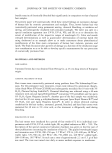
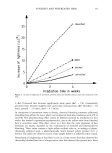
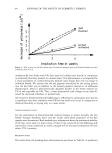
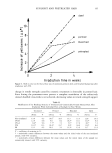
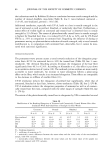
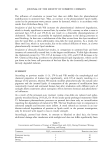
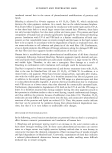
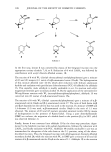
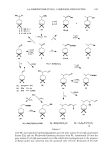
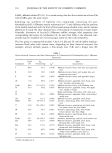
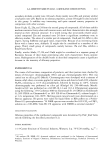
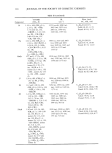
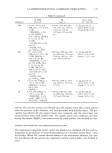
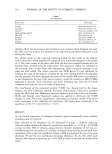
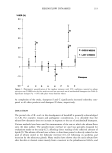
108 JOURNAL OF THE SOCIETY OF COSMETIC CHEMISTS OH ,OH Scheme 1 In the first step, ketone 6 was converted by means of the Grignard reaction into the appropriate tertiary alcohols 7, 8, or 9. Reduction of 6 with LiA1H 4 was followed by esterification with acetyl chloride afforded acetate, 10. The reaction of 6 with W• (diethyl ethoxycarbonyl methylphosphonate) gave a mixture of (E) and (Z) isomers (4:1 ratio) of o•,[3-unsaturated esters (11a,b). The hydrogenation of this mixture afforded ester 12 (8), which after reduction with lithium aluminium hydride and oxidation with pyridinium chlorochromate (PCC) (9) afforded the aidehyde 13. This unstable crude aldehyde is readily oxidizable in air. Its reaction with allyl- magnesium bromide gave secondary alcohol 14. By the application of the stereoselective Wittig-Horner reaction with W 3 (acetonylidenetriphenylphosphate), aldehyde 13 was converted into (E) isomer of o•,[3-unsaturated ketone 15a. The reaction of 6 with W 2 (diethyl cyanomethylphosphonate) gave a mixture of unsaturated nitrile 16a,b and lB,y-unsaturated nitrile 17. The ratio of both forms and lB,•/) depended on the solvent that was used in the reaction. If a mixture of DMF and 1,4-dioxane (2:1) was used, o•,•-unsaturated nitriles 16a,b in the ratio of 3:1 were obtained. The mixture of (E) and (Z) isomers provided saturated nitrile (18) by means of hydrogenation in the presence of Raney-nickel. Using a pure dimethylforamide (DMF) as a solvent, the migration of a double bond to the position [3,•/(in 90% yield) was observed (Scheme 2). Finally, ketone 6 was converted into aidehyde 19 by the three-step procedure: degra- dation by the haloform reaction with sodium hypobromite, followed by reduction with LiA1H4, and finally oxidation with PCC. Aldehyde 19 (readily oxidizable in air) was an intermediate for elongation of the side chain at the C-3 position, using all the above- described reactions. Thus the Grignard reaction with allylmagnesium bromide afforded secondary alcohol 20, while the reaction with W2 in DMF gave a mixture of (E) and (Z) isomers of o•,[3-unsaturated nitriles 2 la,b in the ratio of 1:1. Aldehyde 19 in the reaction

6,6-DIMETHYLBICYCLO[3.1.0]HEXANE DERIVATIVES 109 HO-..L/R _- 7 R =Me, X=I 8 R =Et, X=I 9 R =All, X= Br -.....•_ OAc _'•_'•CN b=Z •0 •6 a, b RMgX• 1. LiAIH412. AcCl -- - 1. NaOBr [• :2. LiAIH 4 3. PCC '•gBr •O w• 21a, b R=-CN W• 22 a R = -Pc W• 23a R =-COOEt PCC = [PyH]ClCrO 3 •COOE{ 11 a,b 20 13 1. LiAIH 4 2 PCC CN f7 •COOEt f2 W• = (EtO)•P(O)CH•COOEt W2 = (EtO)•P(O)CH2CN W3 = (CSH5)3 P=CH CCH3 II o Scheme 2 with W 3 (acetonylidenetriphenylphosphate) gave the pure isomer (E) of ot,•3-unsaturated ketone 22a, and the Wadsworth-Emmons procedure with W1 transformed 19 into the pure isomer (E) of ot,•3-unsaturated ester 23a, which after hydrogenation in the presence of Raney-nickel was converted into the saturated ester 24 (10). Reduction of 24 with
Purchased for the exclusive use of nofirst nolast (unknown)
From: SCC Media Library & Resource Center (library.scconline.org)