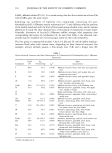
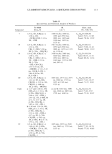
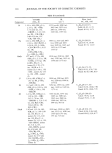
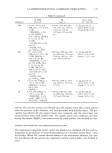
116 JOURNAL OF THE SOCIETY OF COSMETIC CHEMISTS Spectral data and elemental analysis of all compounds that possessed olfactory properties are presented in Table II. ACKNOWLEDGMENT This work was supported by the State Committee for Scientific Research (Komitet Badaft Naukowych), Poland. The author wishes to express his thanks to Prof. J6zef G6ra from the Technical University of L6d•, Poland, for performing the olfactory evaluation. REFERENCES (1) (2) (3) (4) (5) (6) (7) (8) (9) (lO) (11) (12) Preliminary communication presented at the 24th International Symposium on Essential Oils, Berlin, July 1993. Z. Kubica, Z. Burski, and K. Pi•ttkowski, Stereochemistry of the carane system. Part V. (-)-Cis-caran- 4-one in the Witfig-Horner reaction, Pol. J. Chem., 59, 827-836 (1985). A. Hendrich and K. Pi•ttkowski, Acetals and ketals of 3 [3,413-carandiol--New odoriferous compounds from (+)-3-carene, Perrum. Flavorist, 11, 85-88 (1986). S. Lochyfiski, C. Wawrzeficzyk, M. Walkowicz, and J. G6ra, Synthesis and odor characteristics of new gem-dimethylcyclohexane derivatives, Perfum. Flavorist, 10, 7-14 (1985). M. Walkowicz, S. Lochyfiski, and J. G6ra, Synthesis and odor characteristics of some 6,6- dimethylbicyclo[3.1.0]hexane derivatives, Perfum. Flavorist, 6, 21-24 (1981). S. Lochyfiski, B. Jarosz, M. Walkowicz, and K. Pi•tkowski, Modification of synthesis of dihydrochry- santhemolactone from (+)-3-carene, J. Prakt. Chem., 330, 284-288 (1988). W. S. Wadsworth and W. D. Emmons, The utility of phosphonate carbanions in olefin synthesis, J. Am. Chem. Soc, 83, 1733-1739 (1961). S. Lochyfiski, B. Jarosz, A. Siemieniuk, and K. Pi•ttkowski, Mode of preparation of new 3-(6,6- dimethylbicyclo[3.1.0]hex-trans-3-yl)propanoate, Polish Pat. P-168244 (1996). F.J. Corey and J.W. Suggs, Pyridinium chlorochromate: An efficient reagent for oxidation for primary and secondary alcohols to carbonyl compounds, Tetrahedron Lett., 2647-2650 (1975). S. Lochyfiski, M. Walkowicz, and J. G6ra, Mode of preparation of new ethyl 3-(6,6-dimethyl- bicyclo[3.1. O]hex-trans- 3-yl)propanoate, Polish Pat. P- 161426 (1994). S. Lochyfiski, M. Walkowicz, and J. G6ra, Mode of preparation of new 3-(6,6-dimethylbicyclo- [3.1. O]hex-trans-3-yl)propanol, Polish Pat. P- 161427 (1994). P.M. Mtiller and D. Lamparsky, Perfumes--Art, Science and Technology (Elsevier Applied Science, London, 1991), pp. 278-286.

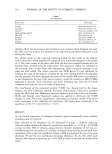
J. Soc. Cosmet. Chem., 48, 117-121 (March/April 1997) Sebum flow dynamics and antidandruff shampoos C. PI]•RARD-FRANCHIMONT, J. E. ARRESE, and G. E. PI]•RARD, Belgian SSTC Research Center 5596, Department of Dermatopathology, CHU Sart Tilman, B-4000 Liege, Belgium. Accepted for publication June 1, 1997. Synopsis The clinical efficacy of antidandruff shampoos is correlated with both their anti-Malassezia and their squamolytic activities. The sebum flow nourishing the lipophilic yeasts is another actor on the scene, fueling the skin disorder. This study was conducted in 120 men in order to quantify the effect of eight proprietary antidandruff shampoos on sebum flow dynamics. Evaluations were made using the Lipometer ©. Two shampoos exhibited a significant effect upon the sebum follicular reservoir, steadily increasing the sebum excretion rate in time. One other product induced a significant decrease in sebum output. Present data give insight into the distinct effects of shampoos on the follicular reservoir function in androgenic alopecia. The resulting sebum flow dynamics may be significantly increased or decreased by proprietary products. INTRODUCTION Dandruff and seborrheic dermatitis are the result of excessive growth of Malassezia ova/is releasing pro-inflammatory mediators and activating an immune response (1-3). The lipophilic character of M. ovalis makes sebum a likely actor on the scene, fueling the abnormal skin condition. It has been previously shown that excessive oiliness is a disturbing side effect following regular use of selenium sulfide shampoo to control dandruff (4,5). Little is known about the variations in sebum output during other antidandruff treatments. The aim of the study was to compare the effect of proprietary shampoos on sebum flow dynamics. MATERIALS AND METHODS Eight proprietary antidandruff shampoos were used (Table I). A total of 120 men, aged 21•44 years, who suffered from androgenic alopecia of the vertex with mild dandruff, were enrolled. The study was conducted during the winter season. A three-week period of wash-out was observed during which panelists shampooed their scalps thrice weekly with a nonmedicated shampoo (mild shampoo Galenco©). At completion of this run-in period they were randomly allocated to one of eight groups receiving a test antifungal 117
Purchased for the exclusive use of nofirst nolast (unknown)
From: SCC Media Library & Resource Center (library.scconline.org)