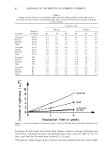
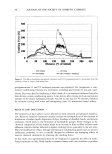
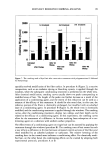
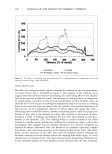
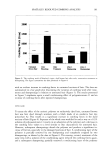
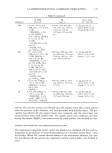
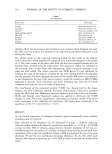
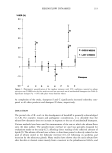
120 JOURNAL OF THE SOCIETY OF COSMETIC CHEMISTS not from any feedback stimulation of the sebaceous gland (13-15). Hence, the present data, which are measures of sebum excretion, give insight into the activity of shampoos on the follicular reservoir function. In addition, since the size of the sebum pool lying within the pilosebaceous duct and the stratum corneum is in part related to the rate of sebum production, the method also provides an indirect measure of sebaceous gland activity. In the present study, most of the antidandruff shampoos showed an absence of significant SER change over time. The discrete trend in SER increase might be related to the removal of dandruff, which allowed the sebum to spread freely at the skin surface. Such a finding confirms the unreality of the so-called reactive seborrhea, in which the seba- ceous excretion increases with the frequency of most hair washes. However, this rule may have exceptions, illustrated by the fact that two shampoos of the present study induced a significant increase in SER. Such abundant sebum flow was already reported following the use of the selenium sulfide shampoo (4,5). Another study using the squamometry and corneosurfametry bioassays had shown that those shampoos promoting seborrhea were those yielding some irritancy potential on the stratum corneum (16). The direct relationship between alterations in sebum flow dynamics and subclinical irritation is suggested, although not proven, by these studies. Only a few topical products are known to decrease the sebum output at the skin surface. Among them, the effect of progesterone (17), astringents (18), erythromycin-zinc com- plex (19), corticosteroids (20), and elubiol (21) have been documented. The 2%- ketoconazole shampoo formulation could be added to that list. It should be compared to the shampoos claiming a presumptive antiseborrheic activity. REFERENCES (1) S. Shuster, The aetiology of dandruff and the mode of action of therapeutic agents, Br. J. Dermatol., 111,235-242 (1984). (2) I.M. Bergbrant, S. Johansson, D. Robbins, A. Scheynius, J. Faergemann, and T. Soderstom, An immunological study in patients with seborrheic dermatitis, Clin. Exp. Dermatol., 16, 331-338 (1991). (3) C. Pidrard-Franchimont, J. E. Arrese, and G.E. Pidrard, Immunohistochemical aspects of the link between Malassezia ovalis and seborrheic dermatitis, J. Eur. Acad. Dermatol. Venereol., 4, 14-19 (1995). (4) H. Goldschmidt and A.M. Kligman, Increased sebum secretion following selenium sulfide shampoos, Acta Dermatol. Venereol., 48, 488-491 (1968). (5) G. E. Pi6rard, C. Pi6rard-Franchimont, and T. Ben Mosbah, Les pityrosporoses. Pityriasis versicolor, folliculite pityrosporique, dermatite s6borrh6ique et 6tat pelliculaire, Rev. Med. LiPge, 44, 267-271 (1989). (6) D. Saint-Ldger and J. L. L6v&que, A comparative study of refatting kinetics on the scalp and forehead, Br, J. Demzatol., 106, 669-675 (1982). (7) C. Pi6rard-Franchimont and G. E. Pi6rard, Approche physiopathologique de la s6borrh6e du cuir chevelu, Ann. Dermatol. Venereol., 115,451-453 (1988). (8) J. E. Arrese, C. Pi6rard-Franchimont, P. De Doncker, A. Heremarts, G. Cauwenbergh, and G. E. Pidrard, Effect of ketoconazole-medicated shampoos on squamometry and Malassezia ovalis load in pityriasis capiris, Cutis, 58, 235-237 (1996). (9) D. Saint L6ger, C. Berrebi, C. Duboz, and P. Agache, The Lipometre: An easy tool for rapid quan- titation of skin surface lipids (SSL) in man. Arch. Dermatol. Res., 265, 79-84 (1979). (10) W.J. Cunliffe and S. Shuster, The rate of sebum excretion in man, Br. J. Dermatol., 81,697 (1969). (11) D.T. Downing, A.M. Stranieri, and J. S. Strauss, The effect of accumulated lipids on measurements of sebum secretion in human skin, J. Invest. Dermatol., 79, 226-228 (1982).

SEBUM FLOW DYNAMICS 121 (12) J. L. Millns and H. I. Maibach, Mechanism of sebum production rates in young children, J. Invest. Dermatol., 84, 59-61 (1982). (13) A.M. Kligman and W. B. Shelley, An investigation into the biology of the sebaceous gland,.]. Invest. Dermatol., 30, 99-125 (1958). (14) J. S. Strauss, D. T. Downing, and M. E. Stewart, Sebum secretion rates in relation to age, J. AppL CosmetoL, 3, 257-266 (1985). (15) C. Pi•rard-Franchimont, G. E. Pi6rard, and A. Kligman, Seasonal modulation of the sebum excretion, Dermatologica, 181, 21-22 (1990). (16) V. Goffin, C. Pi•rard-Franchimont, and G.E. Pi6rard, Anti-dandruff shampoos and the stratum corneum, J. Dermatol. Treat., 7, 223-225 (1996). (17) N.B. Simpson, P.E. Bowden, R.A. Forster, and W.J. Cunliffe, The effect of topically applied progesterone on sebum excretion rate, Br. J, Dermatol., 100, 687 (1979). (18) G. E. Pi6rard, C. Pi6rard-Franchimont, and A. Kligman, Kinetics of sebum excretion evaluated by the Sebutape-Chromameter technique, Skin Pharmacol., 6, 38-44 (1993). (19) C. Pidrard-Franchimont, V. Goffin, J. N. Visser, H. Jacoby, and G. E. Pi•rard, A double-blind con- trolled evaluation of the sebosuppressive activity of topical erythromycin-zinc complex, Eur. J. C/in, PharmacoL, 49, 57-60 (1995). (20) J. L. LdvSque, C. Pidrard-Franchimont, J. de Rigal, D. Saint-Ldger, and G. E. Pi•rard, Effect of topical corticosteroids on the human seburn production assessed by two different methods, Arch. Dermatol. Res., 283, 372-376 (1991). (21) G. E. Pi6rard and G. Cauwenbergh, Modulation of sebum excretion from the follicular reservoir by a dichlorophenyl-imidazoldioxolan, Int. J. Cosmet. Sci., 18, 219-228 (1996).
Purchased for the exclusive use of nofirst nolast (unknown)
From: SCC Media Library & Resource Center (library.scconline.org)