142 JOURNAL OF COSMETIC SCIENCE destabilization of the keratin crystalline regions (9). The consequences of this type of process in hair cuticles after cyclical thermal stresses have not yet been analyzed. This paper represents part of a study whose aim is to reproduce patterns of cuticle damage found in a panel of 100 individuals (10). This article reports the production of small longitudinal cracks by cyclical thermal stresses. The cracks were mainly found in the hair cuticles of subjects who frequently blow-dry their hair. EXPERIMENTAL METHODOLOGY The panel of 100 individuals participating in this study was mainly composed of women with Caucasian brown hair never treated chemically. A total of ten fibers per each individual was analyzed. The different patterns of cuticle damage found in these indi- viduals such as cuticle decementation, abrasion, craters, and cracks were classified and quantified. Cycles of mechanical tension, torsion, bending, and thermal stresses were then applied to single hair fibers in order to reproduce such patterns (10). Only the cyclical thermal stresses were seen to reproduce the types of cracks mentioned above, and therefore, only the experimental conditions related to this type of stress will be described here. The other types of damage and experimental conditions are described elsewhere (10-12). Each thermal cycle consisted of immersing single hair fibers for a period of ten seconds into de-ionized water followed by ten seconds of blow-drying. The temperatures used during blow-drying and measured at the level of the wet hair surface varied between 30 ø and 120øC. The number of applied wetting/blow-drying cycles varied between five and 100 as required. A total of ten fibers per each set of thermal cycles was analyzed for short longitudinal cuticle cracks. The number of these cracks per millimeter of hair was then counted. From this data, means and standard deviations were calculated. Prior to the thermal cycles the fibers were thoroughly washed with SLS and rinsed with tap water. The hair used in the single-fiber experiments was from a subject whose hair was washed only with a 10% SLS aqueous solution for a period of one year. Sections of hair fibers three inches long and cut close to the root were used in the experiments. The hair fibers were subsequently cut into two snippets 1.5 inches long each one snippet was used as a control while the other one was subjected to thermal cycling. All selected hair fibers presented an average diameter of 82 + ll l•m. Caucasian virgin brown hair from International Hair Importers in the form of tresses was also used to study effects of combing abrasion on wet/blow-dry cycled hair. Aqueous solutions of glycerin, propylene glycol, polyquaternium ll, cetrimonium chloride, steralkonium chloride, and hydro- lyzed wheat protein polysiloxane copolymer (13) at a 2% w/w were also used as wetting solutions during thermal cycling. These solutions were prepared in order to test the effect of some cosmetic actives on cuticle cracking. After thermal cycling, the fibers were prepared for SEM analysis. RESULTS AND DISCUSSION SHORT LONGITUDINAL CUTICLE CRACKS FOUND IN A HAIR ANALYSIS FROM A PANEL OF 100 INDIVIDUALS SEM analysis of hair fibers pertaining to subjects in the panel showed that most of them presented different numbers of short longitudinal cracks in their cuticles. The popula-

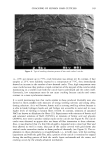
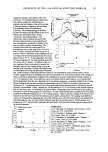
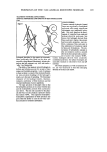
CRACKING OF HUMAN HAIR CUTICLES 143 tion of these individuals could, however, be divided into two main groups, namely one with a high number of cuticle cracks and the other with a very low number. The first group, representing about 40% of the panel, showed an average of 184 + 15.5 cracks per mm of hair (cpmh), while the other 60% showed an average of about 7 + 1.3 cpmh. Figures la and lb show typical images of these cracks as found in the panel analysis. Incidentally, the higher number of cuticle cracks corresponds to the hair of people who manifested to blow-dry their hair on a daily basis. It was precisely this observation that suggested the possibility of reproducing the cracks in the laboratory by cycles of wetting and blow-drying. In Figure l it can be seen that the particularity of these cracks is their position on the cuticles, i.e., they always appear aligned parallel to the longitudinal axis of the hair fiber, and their length is no longer than a single cuticle size. The cracks were found to occur more frequently at the discontinuities formed by the cuticle edges. They seemed to be initiated near the middle section of the cuticle at that end close to the cortex. Their direction of propagation also seemed to be towards the outer edges of the cuticles. Figure lb shows, for instance, a long crack whose width is larger at the cuticle end close to the cortex and very sharp at its tip towards the outer edge of the cuticle this crack has not yet been able to propagate all the way throughout the outer cuticle edge. CRACK REPRODUCTION IN THE LABORATORY After observing that the short longitudinal cracks were consistently found in a large portion of people from the panel, a way to reproduce them in the laboratory was researched. First, single hair fibers were subjected systematically to cyclical tension, torsion, and bending stresses, and it was found that none of these conditions could reproduce the cracks. The cuticle patterns of damage resulting from these stresses have been reported elsewhere (10-12). The next step was to take fibers three inches long and ' x2.4k x4.0k la ='" lb Figure 1. Typical cuticle cracks found in hair from individuals who blow-dry their hair. la, x2.4k lb, x4.0k.
Purchased for the exclusive use of nofirst nolast (unknown)
From: SCC Media Library & Resource Center (library.scconline.org)