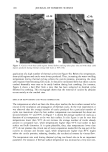
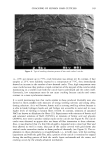
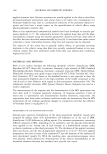
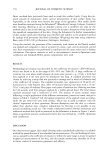
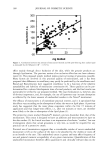
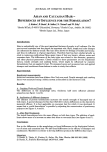
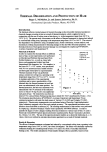
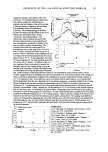
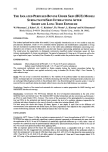
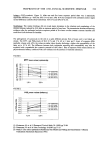
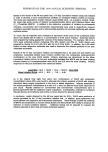
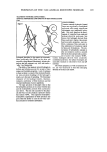
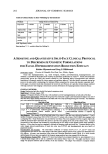
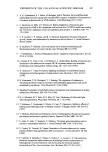
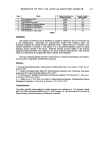
144 JOURNAL OF COSMETIC SCIENCE I . ! litk x 13k v 2?3 -- -- 7. I .3tlkx 8kv 3•'9 2b Figure 2. Cuticle cracks reproduced in the laboratory as follows: 2a and 2b after 20 thermal cycles 2c after 60 thermal cycles.

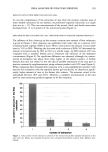
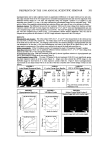
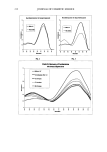
CRACKING OF HUMAN HAIR CUTICLES 145 2o Figure 2. Continued. cut them in half. One half was used as a control, and the other half was subjected to cycles of blow-drying and wetting at different temperatures and for different intervals of time. The number of cracks already present in the control were counted and compared with those appearing in the thermally cycled fibers. A total of ten fibers per each trial were analyzed. The average number of cracks per millimeter found in the control samples was 6 + 2.1. After several trials it was found that short thermal cycles of ten seconds of blow-drying at 75øC combined with ten seconds of wetting at 25øC were able to reproduce and increase dramatically the number of short longitudinal cuticle cracks. In Figures 2a, 2b, and 2c are shown typical images of hair fibers subjected to 20 and 60 of these cycles. A total of 21 cracks can be counted in the 76 x 52 micrometer section of hair represented in Figure 2b. In Figure 2c it can be seen that the total number of visible cracks reaches a value of 26 the surface hair dimensions captured by this micrograph are approximately 67 x 42 microns. The number of cracks shown in Figures 2b and 2c correspond to an average of 472 and 562 cracks per millimeter of hair, respectively. Such high concen- trations of cuticle cracks are rarely found in people's hair and can only be produced in the laboratory. Figures 3a, 3b, and 3c show higher magnifications of these cracks, while Figure 4 shows the average number of cuticle cracks found in hair samples as a function of thermal cycles in relation to the control. In this last figure it can be seen that the number of cracks per unit area on the hair surface increases up to a limit and then levels off with the number of thermal cycles. A close examination of Figures 1, 2, and 3 reveals that, in all cases, the applied thermal cycles resulted in the production of cracks similar to those already observed in the panel
Purchased for the exclusive use of nofirst nolast (unknown)
From: SCC Media Library & Resource Center (library.scconline.org)