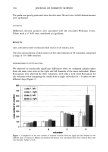
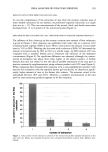
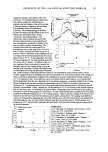
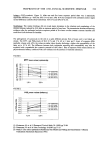
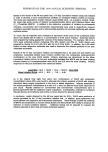
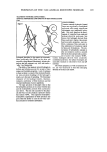
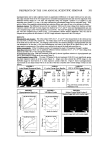
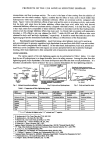
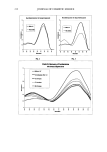
172 JOURNAL OF COSMETIC SCIENCE Enhancement factors obtained with the different vehicles under infinite- and finite-dose conditions, respectively, are shown in Figure 4. In the past, enhancement factors de- scribing only the specific effects of vehicles on the properties of the barrier stratum corneum were determined by several investigators (17-19). These factors correspond to the enhancement ratio introduced by Goodman and Barry (20) and to the so-called activity-standardized bioavailability factor f•, which can be determined from activity- response curves (14). The data presented in Figure 4 again show very pronounced MN depletion for MO and DIM, which is less obvious with the parameter 1/LT. In contrast to the pharmacody- namic response data, the results of the penetration rate data clearly show that IPM and MO act as penetration enhancers. Although MO is considered to be an inert vehicle, it has been shown to fluidize the lipid bilayers of the stratum corneum to some extent, possibly a result of its branched structure (21). Depletion factors calculated as the ratio of the enhancement factors obtained under infinite-dose conditions to those obtained under finite-dose conditions are shown in Figure 5. From the data it is obvious that with both response parameters a statistically significant MN depletion may be observed. From the fact that MN depletion is sig- nificant with the response parameter 1/LT, one may conclude that the determination of the relative bioavailability was not done in the high-response region of the concentra- tion-response curves. MN depletion seems to be more pronounced with MO than with DIM. This is due to the fact that MO causes penetration enhancement in addition to the high MN activity in this vehicle. It behaves like a vehicle with a thermodynamic activity of MN, even higher than that with the vehicle DIM, which does not cause penetration enhancement of the model compound. This indicates that, among others, a high ther- modynamic activity of the permeant and penetration-enhancing properties of the vehicle may lead to permeant depletion in the vehicle. 2.4 2.2' 2- 1.8- '" 1.6- 1.4- 1.2- 1- 0.8- 0.6- 0.4' 0 n=10 CCT IPM MO DIM CCT n=12 IPM MO DIM n=11 I i CCT IPM MO DIM ........... Latency time ........... Penetration measurement .............. Duration .......... Figure 4. Enhancement factors EF calculated from response measurements and flux data according to Eqs. 4a/e. Error bars are 95% confidence intervals.

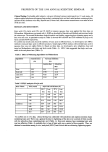
DEPLETION EFFECTS IN TOPICAL PREPARATIONS 173 0.9 0.5- , 0.4- . ß 0.2- Latency time Duration n=10 n=11 i i i i i i 0.1, 0 COT IPM MO DIM COT IPM MO DIM Figure 5. Depletion factors DF calculated for the response 1/LT and D according to Eq. 5. Error bars are 95% confidence intervals. From the presented results it may be concluded that any increase of the penetration rate constant may lead to permeant depletion. The mathematical elimination of parameters such as the thickness of the applied ointment formulation or the permeant solubility in the vehicle in order to differentiate between vehicle effects does not eliminate their influence on permeant depletion. Because of the insufficient parallelism of the dose- response curves, the duration of the erythema is an unsuitable parameter for the evalu- ation of thermodynamic or specific vehicle effects. In the case of the response parameter 1/latency time, correct estimations of the relative bioavailability can be expected only in the high-response region. Permeant depletion in the vehicle has to be considered par- ticularly if the permeant solubility in the vehicle is low and/or in the case of vehicles with penetration-enhancing properties. It can be avoided either by application of sus- pension-type preparations or by using vehicles with high dissolving capacities. REFERENCES (1) J. L. Zatz, "Percutaneous Absorption: Computer Simulation Using Multicompartmented Membrane Models," in Percgta,eogs Absorptio,, R. L. Bronaugh and H. I. Maibach, Eds. (Marcel Dekker, New York, 1985), pp. 165-181. (2) R. H. Guy and J. Hadgraft, A theoretical description relating skin penetration to the thickness of the applied medicament, I,t. J, Pharm., 6, 321-332 (1980). (3) E. R. Cooper and B. Berner, Finite dose pharmacokinetics of skin penetration, J. Pharm, ScL, 74, 1100-1102 (1985). (4) J. L. Zatz, Influence of depletion on percutaneous absorption characteristics,J. Soc. Cosmet. Chem., 36, 237-249 (1985). (5) W.J. Addicks, G, Flynn, N. Weiner, and R. Curl, A mathematical model to describe drug release from thin topical applications, Int. J. Pharm., 56, 243-248 (1989). (6) W. Addicks, N. Weiner, G. Flynn, R. Curl, and E. Topp, Topical drug delivery from thin applications: Theoretical predictions and experimental results, Pharm. Res., 7, 1048-1054 (1990).
Purchased for the exclusive use of nofirst nolast (unknown)
From: SCC Media Library & Resource Center (library.scconline.org)