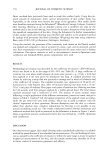
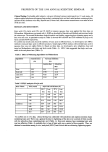
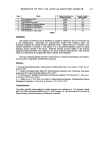
176 JOURNAL OF COSMETIC SCIENCE In addition, a quantification of the unabsorbed excess is necessary to identify the ab- sorbed or active proportion of the moisturizer, which is necessary in any future estimates of the relative efficacy of different moisturizers, i.e., effect per milligram of absorbed cream. MATERIALS AND METHODS All testing was conducted on healthy volunteers following informed consent. Prelimi- nary methodological studies were carried out using one type of moisturizer only (Loco- base ©, Yamanouchi Pharma, Leidendorp, Netherlands), while different commonly used moisturizers, a protective cream, and a simple gel were used in the final study (see Ta- ble I). The basic hypothesis of the study was that a standardized collection of excess or residue following a single application is a reliable method for the study of moisturizer greasiness in vivo. The basic design involved application of a known volume of moisturizer to a standardized area of volar forearm skin, allowing time for evaporation of the water phase of the moisturizer, and finally absorption of excess moisturizer into a standard laboratory filter paper. The increased weight of this filter paper then reflects the amount of excess moisturizer (=blotted weight) according to the following simple equation: Blotted mg = applied mg - (evaporated water mg + residue after blotting mg + absorbed by skin mg) The following preliminary studies were carried out in healthy volunteers to assess the variability of this simple method. Table I Moisturizers Used and Their Declared Contents Brand and producer Constituents Residue % (mean 95% confidence interval) Vaseline ©, Johnson & Johnson, New Jersey Locobase ©, Yamanouchi Europe B.V., Leiderdorp, Netherlands Decubal creme ©, Dumex A.S., Denmark Clinique Moisture-On-Call © , Clinique Laboratories, New York Nivea Visage ©, Beiersdorf OY, St. Karins, Finland Kerodex ©, ArSiMa, Copenhagen, Denmark Gel Petrolatum Cetearyl alcohol, ceteth-20, mineral oil, petrolatum, citric acid, sod. citr. anhydr., ethylparaben, purified water Isopropyl myristate in glycerin, purified lanolin, dimeticomin cetolatum, polysorbate 60, sorbic acid, purified water N/A Liposome complex 10% Paraffin products, sodium phosphate, emulgators, iron oxides, methylparaben Cellulose gum, glycerin, water, benzalconium chloride, disodium EDTA 48.2 (43.4-52.9) 37.9 (34.6-41.2) 19.6 (17.8-21.4) 14.7 (13.3-16.0) 14.5 (13.0-16.0) 9.8 (7.9-11.7) 1.5 (0.6-2.3) N/A = no data available. Unabsorbed % is the percentage of the applied cream that could be blotted from the surface of the skin after 20 minutes, and can be seen as an expression of the greasiness of the cream.

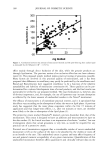
THE GREASINESS OF MOISTURIZERS 177 VOLUME APPLIED The applications studied were 25 121/25 cm 2, 50 121/25 cm 2, 100 121/25 cm 2, and 150 121/25 cm •. The volume was carefully spread with a rubber-gloved finger. The finger covers were weighed after application to ensure that a no major differences occurred due to the moisturizer adherent to the cover. Blotting was done after 20 minutes with the blotting paper (25 cm •) pressed against the skin with a rubber-gloved hand for two minutes (n = 15). TIME ALLOWED FOR ABSORPTION A previous study has suggested that the water phase evaporates within 15 minutes of a single application of a moisturizer (1). A standard amount of moisturizer (50 121/25 cm 2) was applied, and blotting was done after 20, 40, 60, 120, and 180 minutes. Blotting was done using standard-sized blotting paper (25 cm 2) and an even, firm pressure from a rubber gloved-hand for two minutes (n = 10). TIME ALLOWED FOR BLOTTING A standard amount of moisturizer (50 121/25 cm 2) was applied, and blotting was done after 20 minutes. Blotting was done using standard-sized blotting paper (25 cm 2) and a rubber-gloved hand for 30, 45, 60, 90, or 120 seconds (n = 15). AREA STUDIED The same density of moisturizer was applied in areas of different size (50 121/25 cm 2 and 200 121/100 cm2), and blotting was done after 20 minutes. Blotting was done using standard-sized blotting paper (25 cm 2) and a rubber-gloved hand for 120 seconds (n = 15). REGION STUDIED Dry skin (volar forearm) and sebaceous skin (upper back) were compared. Moisturizer was applied in different areas (50 121/25 cm2), and blotting was done after 20 minutes. Blotting was done using standard-sized blotting paper (25 cm 2) and a rubber-gloved hand for 120 seconds (n = 15). BLOTTING PRESSURE Moisturizer was applied (50 121/25 cm2), and blotting was done after 20 minutes. Blotting was done for 120 seconds either with a rubber-gloved hand or with a 1-kg weight (n = 15). TYPE OF BLOTTING PAPER The blotting capacity of filter paper with different mean pore sizes from 0.4 to 5.0 12m was compared (standard, small, medium, big filter type BB, OOH, OOK and OOR, Munktell, Sweden). Moisturizer was applied (50 121/25 cm2), and blotting was done after 20 minutes. Blotting was done for 120 seconds with a rubber-gloved hand (n = 15).
Purchased for the exclusive use of nofirst nolast (unknown)
From: SCC Media Library & Resource Center (library.scconline.org)