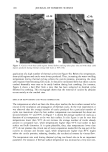
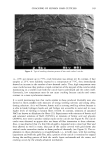
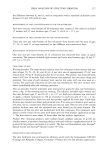
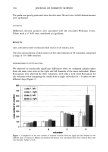
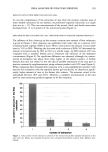
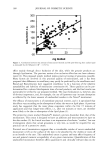
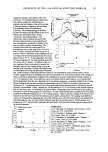
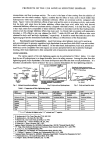
180 JOURNAL OF COSMETIC SCIENCE 300 250 200 150 100 50 -5O , I lO 20 rng blotted Figure 1. Correlation between the amount of moisturizer blotted and the post-blotting skin surface lipid as measured by the Sebumeter (R 2 = 0.5272). effect mainly through direct hydradon of the skin, while the greasier products act through lipidization. The previous notion of an occlusive effect has not been substan- tiated (2). The proposed simple method makes practical testing of greasiness possible. Many factors are involved in this practical quality of moisturizers, and it has been proposed that differences in emolliency may partly be predicted by the emollients used. Brand and Brand-Garnys have suggested emolliency to be a function of the inherent spreadability and lubricity of moisturizer constituents (4). These qualities can be pre- determined for a reduced development time of actual products, and the final results can potentially be verified by our proposed method. The exact formulation is, however, also of obvious importance, and, for example, the use of liposomes may increase absorption as reflected by the lower amount of unabsorbed residue in the Nivea © moisturizer. The efficacy of moisturizers is of immediate practical interest, and it is speculated that the effects vary according to the absorption of either the water or lipid phase. A previous study has suggested that the water phase evaporates within the first 15 minutes of application and that longer-term effects, i.e., after ten minutes or more, are therefore more likely to be due to absorption of the lipid phase (1). The protective cream studied (Kerodex ©) showed a picture dissimilar from that of the moisturizers. This cream is designed to leave an adherent and water-protective layer on the skin surface (2). In clinical use there is an impression of occlusive "residue," but our investigation shows that actual greasiness is very low, as would be required for any practical use of a protective cream. Practical use of moisturizers suggests that a considerable residue of excess unabsorbed moisturizer is left on the surface of the skin to be absorbed by the clothes or worn off at no benefit to the user. This unabsorbed excess is greasy and may affect frequency of use and general cosmetic acceptability of any given moisturizer. Quantification of this unabsorbed moisturizer therefore offers quantitative and clinically relevant data on the

THE GREASINESS OF MOISTURIZERS 181 cosmetic acceptability, as well as an impression of the absorbed amount, of a given moisturizer. The simple methodology studied in this paper reveals that it is possible to measure the non-absorbed moisturizer with an accuracy similar to that of other recog- nized biophysical methods. This approach therefore offers the possibility of studying actual absorption of moisturizers and other creams and subsequently better assessment of moisturizer efficacy per absorbed milligram. In addition, the quantification of non- absorbed residue on the skin surface has implications for the cosmetic acceptability of new preparations. ACKNOWLEDGMENTS The authors wish to thank Eva Hofmann, Ingelise Pealersen, Helle Thrane, and Bene- dicte Wulf for their excellent technical assistance. REFERENCES (1) C. Blichman, J. Serup, and A. Winther, Effects of a single application of a moisturiser: Evaporation of emulsion water, skin surface temperature, electrical conductance, electrical capacitance, and skin surface (emulsion) lipids, Acta Derva. Venerol. (Stockholm), 69, 327-330 (1989). (2) F. de Fine Olivarius, A. B. Hansen, T. Karlsmark, and H. C. Wulf. Water protective effect of barrier creams and moisturising creams: A new in vivo test method, Contact De•w•atitis, 35, 219-225 (1996). (3) R. Ghadially, L. Halki•er-S0rensen, and P.M. Elias, Effects of petrolatum on stratum corneum struc- ture and function,J. Am. Acad. Dermatol., 26, 387-396 (1992). (4) H. M. Brand and E. E. Brand-Garnys, Practical application of quantitative emolliency, Cosmet. Toiletr., 107, 93-99 (1992).
Purchased for the exclusive use of nofirst nolast (unknown)
From: SCC Media Library & Resource Center (library.scconline.org)