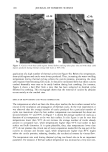
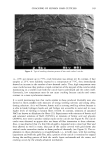
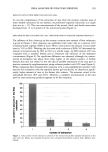
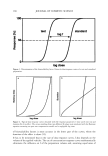
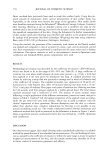
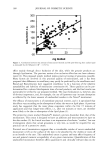
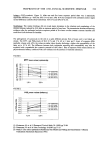
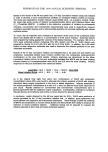
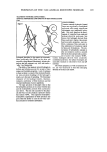
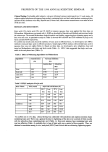
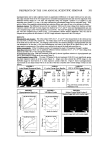
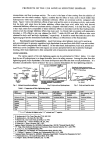
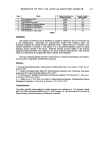
PREPRINTS OF THE 1998 ANNUAL SCIENTIFIC SEMINAR 209 intermediates, and thus tyrosinase activity. The x-axis is the lapse of time starting from the addition of tyrosinase into the culture medium. Figure 2 exhibits that the effect of kojic acid is much milder than hydroquinone while kojic acid has substantial inhibitory effects on tyrosinase activity compared with blank. Figure 3 shows the inhibitory effects of kojic acid and its esters on tyrosinase activity, and reveals that the kojic acid esters have far better inhibitory effects than kojic acid, while kojic acid showed substantial inhibitory effects on tyrosinase activity compared with blank (water). It is clear from Fig. 2 and 3 that kojic esters have comparable or better inhibitory effects on tyrosinase activity than hydroquinone, which in turn has stronger inhibitory effects than kojic acid. In clinical trials on patients with pigmentary disorders, a 55% effective rate was obtained for MAP, •2 while 60-95% and 80% effective rates were obtained for kojic acid ? and kojic dipalmitate, •3 respectively. It should be noted that both the active skin lightening agent and the formulation itself affect the efficacy or effectiveness of the final p•:oduct. D. Functionality and Compatibility: Apart from being a skin lightener, kojic acid is used as an anti-microbial agent to preserve vegetables, kojic dipalmitate is an emollient while MAP is an anti-oxidant. MAP also works synergistically with vitamin E. On the other hand, hydroquinone, kojic acid, arbutin and MAP may not be compatible with some organic sun screens and preservatives due to potential hydrogen bonding, while kojic dipalmitate is fully compatible with all sunscreens and preservatives. CONCLUSIONS: The various aspects of the skin lightening agents can be summarized in Table 1 below. It is clear that the use of hydroquinone is no longer desirable, due to its safety concerns. Among the other four skin lightening agents, kojic dipalmitate is the latest development and offers the best overall performance. It is therefore considered the "active of choice" for use in cosmetic formulations for skin lightening purposes. ./ ',...:-= 1,4ueM)O fAd•.eee DHI• Dor• M q..b....• K•41dmdm MmlO iF_ 4 ß O I 4 O I le 111 11 I•11 II as Fig. 1. Mclanin biosynthcsis pathways. Fig.2. Kojic acid and hydroquinone Fig. 3. Kojic acid and its csters Table 1. Comparison of Skin Lightening Agerib Agent Hydmquinone Arbutin Kojic Acid Kojic Dipalmitate MAP Functionality Skin Lightening Skin Lightening Skin Lightening, Skin Lighten/rig, Skin Lightening, Anti- Antimicrobial Emollient Oxidant Mechanism of Acdo• Tymsinase inhibitor Tyrosinase inhibitor Tyrosinase inhibitor Tyrosinase inhibitor Tymsinase inhibitor ELle of Formulig•on + -I-I-t- • .:',::: : | ', ', ',q Stability 4-• • • ::::: ::::: !mtmon • 4+ + -/+ E•cl• ::::: :::', :::: :',::: Safety + :::: :::: ::::: ::::: Cost + ::::: 4-i- .I-l-i- ::::: indicates the highest value "4+"minimal and "-"negative, ' G. imokawa ct al, JSoc Costa Chetn Jpn 17 0), 149 1993. 2 G. imokawa ct al., Jlnv Derm 91, 106, 1988. • Y Ohmoff ½t al, JSoc Costa Chem Jpn 18 (4), 215, 1994. 4 C.R. Denton ½t al., J- Invest. Dermatoi., 18, 119, 1952. s S. lijima ½t al., J. Invest. Dermatoi., 28, 1,1957. 6 Japanese Patent, Publication No. 60016906, Publication Date: 850128, "External Drug for S, kin" ? Y.F. Yang, China Surfactant Detergent and Cosmetics (DaO• Chemical Industry), No. 1, p28, 1995 ß C.F. Liu, X. L. Yc, Unpublished Data, 1995. 9 H.F. Jordaan, D.G. Van Nickcrk, ,4m JDermatopathoi 13(4), 418-424, 1991. lO j. 1. Phillips, C. issacson, H. Cannan,,4mJDermatopathol, 8(1), 14-21, 1986. n Japanese Patent, Publication No. 60056912, Publication Date 850402, "External Use Preparation for Skin". • 2 K. Kamcyamn ctal., J ,4m ,4cad Dermatoi 34(1 ): 29-33, 1996. n S. Nagai T. lzumi, US Patent 4•78,656, July. 14, 1981.

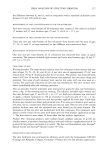
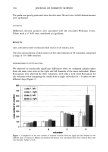
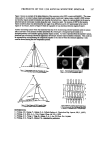
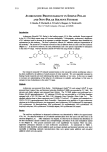
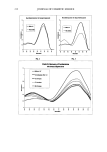
210 JOURNAL OF COSMETIC SCIENCE AVOBENZONE PHOTOSTABILITY IN SIMPLE POLAR AND NON-POLAR SOLVENT SYSTEMS C. Bonda, P. MarineIll, J. Trivedi, S. Hopper, G. Wentworth The C.P. Hall Company, Chicago, IL 60606 Introduction Avobenzone (Parsol© 1789, Roche) is the leading organic UV-A filter worldwide. Recent approval by the U.S. FDA likely means usage will increase substantially) Unfortunately, avobenzone's absorbance of UV radiation tends to decrease as its exposure to sunlight increases. 2 Researchers have identified two explanations for this tendency. The first is photolysis wherein UV radiation catalyzes fragmentation of the molecule? The second is UV-induced conversion of this [•-diketone from the enol to the keto tautomer (Figure 1). 4 In all known solutions, the enol predominates and is the sp•. ies responsible for absorption in the solar UV range. The keto tautomer absorbs UV below the range found in sunlight. 0 '•H 0 0 0 Enol Keto kmax = 350-355nm C20H2203 kmax = 260-265nm mw= 310.39 Fig. 1 Our research measured UV-induced tautomerization in the non-polar solvent cyclohexane when it has been modified by the addition of small amounts of other materials. We were especially interested in finding ff polar materials are more stabilizing than protic materials, or vice versa. In this way we sought to increase our understanding of the behavior of avobenzone in sunlight, and perhaps to find ways to mitigate its loss of absorbance in the solar UV range. Methods Avobenzone was procured from Roche. Octyldodecanol (Isofol © 20) and octanol (Alfol © 8) were procured from Condea-Vista, and butyloctyl salicylate (HallBrite TM BHB) was provided by C.P. Hall. The solvents and diethyl adipate were procured from Aldrich. The •H NMR studies were performed on a Bruker AM-400 spectrophotometer. UV radiation (290-400 nm) was provided by a 16S Solar Simulator equipped with a WG 320 filter and PMA 2100 Automatic Dose Controller (Solar Light Co.). The standard radiation dose in these experiments was 35 MED (735 mJ/cm2). UV spectra were measured on a CECIL CE 3021 spectrophotometer (Buck Scientific). Experiments were applied to 10 ppm avobenzone solutions in the following diluents: neat isopropanol neat cyclohexane 99% cyclohexanedl% isopropanol 99% cyclohexaned 1% tetrahydrofuran 99% cyclohexaned 1% octyldodecanol 99% cyclohexaned 1% butyloctyl salicylate 99% cyclohexaned 1% diethyl adipate 99% cyclohexanedl% octan& Remits The enol-keto equilibrium in deuterated cyclohexane was determined by NMR to be approximately 97%- 3%. We observed evidence of UV-induced tautomerization from the enol to the keto form in all solutions (Figures 2, 3). After irradiation was stopped, we observed in all solutions that absorbance of the keto immediately started to decline and, correspondingly, absorbance of the enol immediately started to rise (Figure 4). This process continued until a new equilibrium was reached. There was some, apparently permanent reduction in total avobenzone concentration. As $nmmarized in Table 1, hydroxylic (and, therefore, protic) additives such as primary alcohols and butyloctyl salicylate were more succes,nful at inhibiting enol-keto tautomerization than were aprotic polar additives and non-polar additives which were also aprotic.
Purchased for the exclusive use of nofirst nolast (unknown)
From: SCC Media Library & Resource Center (library.scconline.org)