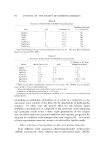
164 JOURNAL OF THE SOCIETY OF COSMETIC CHEMISTS EXPERIMENTAL The nacreous pigment is dispersed in nitrocellulose drawdown lac- quer which has the following composition: Nitrocellulose, RS type, 15-20 sec 2.9% Nitrocellulose, RS type, 30-40 sec 6.6 Isopropanol 5.1 Amyl acetate 44.8 n-Butyl acetate 37.6 Monobutoxydiethylene glycol 3.0 00.0% In this particular formulation, which has a viscosity of approximately 2000 cP at 25øC, the two grades of nitrocellulose* are used in order to ob- tain the desired combination of solids content and viscosity. The mono- butoxydiethylene glycol is used to prevent "blushing" or clouding of the lacquer film by condensation of water vapor from the atmosphere. Other vehicles can be devised for nacreous pigment preparations in- compatible with nitrocellulose. Drawdowns of the nacreous pigment dispersion are made on a card which has both a black and a white area. A pool of the drawdown sus- pension is poured on the card held firm against a Bird vacuum plate, and is drawn into a fihn by means of a Bird film applicator producing a wet fihn of approximately 0.003 inch thickness.* The sample for the Trilac spectrophotometer is a 7.5 X 7.5 cm square cut from the black portion of the card. For special purposes, a sample may be taken from the white portion of the card, as will be men- tioned below. This square is placed in the sample holder of the Trilac with a specific orientation, i.e., with the drawdown direction perpen- dicular to the plane of the light beam. The use of a constant orientation is an important factor with pigments which have platelets longer than they are vide. The Trilac instrument may be used to measure either reflected or transmitted light, although the present work is confined to reflectance measurements. (Transmission characteristics are inferred from certain * Hercules, Inc., Wilmington, Del. 19899. * The card used in these experiments is Opacity Chart Form 5C of the Leneta Company, Ho-Ho-Kus, N.J. 07423. The Bird items are available from Gardner Laboratory, Inc., Bethesda, Md. 20014. The vacuum plate is Catalog No. AG-3876 and the film applicator is Catalog No. AG-3800-L.

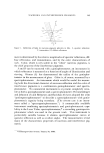
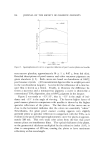
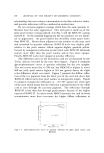
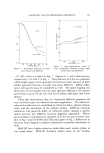
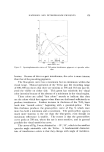
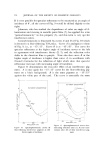
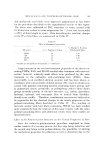
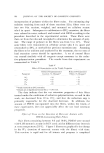
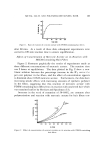
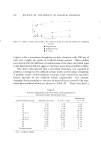
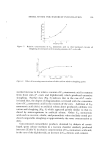
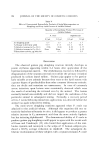
NACREOUS AND INTERFERENCE PIGMENTS 165 reflectance curves.) The light from a tungsten source first passes through the monochromator before it is allowed to fall alternately on the sample and a reference standard which are located adjacent to one another and in the same plane (5, 6). Two adjustments are made to set the angle of incidence and the angle of viewing. Restrictions on the settings are that the total angle between the incident beam and the viewed beam cannot be less than 30 ø nor more than 90 ø . Thus, the values of the angles i/v, i.e., angles of incidence and viewing, respectively, must be between --15ø/15 ø and --45o/45 ø for specular reflectance. Diffuse reflectance, however, can be measured over a greater range of angles, e.g., up to --15ø/75 ø. In either case, the reflectance is recorded as a function of wavelength from 400 to 700 nm. The reference standard for these experiments was a barium sulfate pressed cake which was chosen as a white diffuse reflector. Because the reflectance at specular angles from nacreous surfaces would be con- siderably greater than specular reflectance from the BaSO4 standard, a neutral density filter transmitting 10% of the light was placed between the nacreous sample and the light detector for angles close to specular. This filter reduced the intensity of the reflected light sufficiently to ob- tain a balance against the BaSO4 cake without distorting the color char- acteristics of the reflected light. For readings far from specular, e.g., m15ø/45 ø to --15ø/75 ø, where diffuse reflectance by nacreous samples is much less than by BaSO4, the filter was either removed or placed in front of the BaSO4. Reflectance readings made with the filter were mul- tiplied or divided by 10 to make all readings comparable. The reflec- tance readings are relative to the reflectance of the BaSO4 standard under the same angular conditions, and do not indicate the absolute reflectance of the nacreous pigment sample. Some of the nacreous pigments on which data are reported are not at present commercially available. RESULTS AND DISCUSSION Nacreous Luster The essentially specular nature of nacreous luster has been men- tioned. A first impression of the reflectance of nacreous pigments can be obtained by examining specular reflectance with the trilac gonio- spectrophotometer. Figure 2 demonstrates the reflectance of natural pearl essence plates (crystals approximately 30 X 6 X 0.07 3t from fish scales) and natural pearl essence "needles" (a mixture of plates and the
Purchased for the exclusive use of nofirst nolast (unknown)
From: SCC Media Library & Resource Center (library.scconline.org)