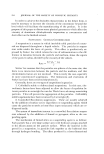
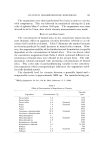
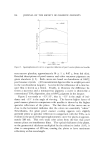
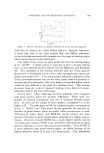
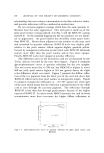
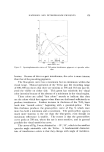
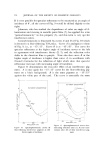
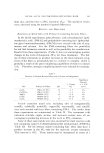
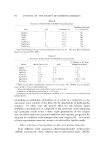
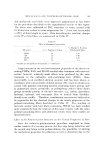
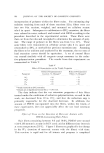
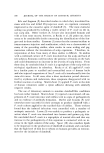
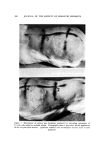
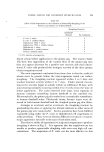
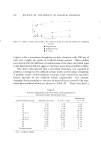
166 JOURNAL OF THE SOCIETY OF COSMETIC CHEMISTS I/v : -15ø/15 * o 88 • Pearl Es5ence Plates o 88 • Pe3rl Essence Needles Clear Lacquer 0 88 • EOe 550 ' 65o - WAVELENGTH (rim) Figure 2. Spectrophotometric curves at specular reflection of pearl essence plates and needles very narrow platelets, approximately 30 X 1 X 0.07 /•, from fish skin). Detailed descriptions of pearl essence and other nacreous pigments are given elsewhere (1, 3). Both curves are based on drawdowns of 0.88% pearl essence crystals. (All concentration figures refer to weight per cent in the wet drawdown lacquer.) A curve for the reflectance of a clear lac- quer fihn is shown as a blank. Finally, to illustrate the difference be- tween a nacreous and a nonnacreous pigment, a curve is shown for a conventional TiO=dispersion, also at 0.88% pigment in the lacquer. Figure 2 was made at --15ø/15ø, that is, --15 ø is the angle of inci- dence and +15 ø is the angle of viewing. The known higher luster of pearl essence plates in comparison with needles is shown by the higher specular reflectance of the plates. The fact that all the curves are so close to the horizontal indicates that the colors are essentially "white." Nevertheless, the plate pearl essence coating appears very slightly greenish yellow at specular reflection in comparison with the TiO,,, as is evident in the peak of the spectrophotometric curve for plates at approxi- mately 520 ran. This very weak color arises from the fact that pearl essence plates are interference films. The optical thickness of the plates, or the geometrical thickness multiplied by the refractive index (1.85), is close to one-quarter of 520 rim, causing the plates to have maximum reflectivity at this wavelength.

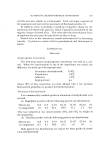
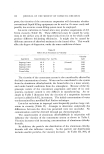
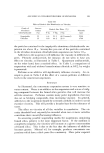
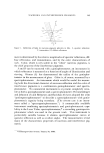
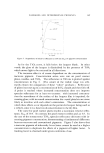
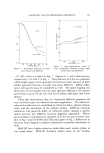
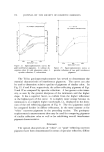
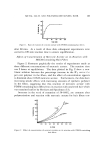
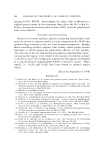
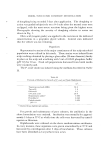
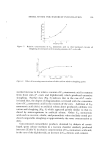
NACREOUS AND INTERFERENCE PIGMENTS 167 As for the TiO= curve, it falls below the lacquer blank. In other words, the gloss of the lacquer is diminished by the presence of TiO2 which causes light to be scattered in all directions. The nacreous effect is of course dependent on the concentration of nacreous pigment. Concentration series were run on pearl essence plates, needles, and TiO=. The reflectance at 550 nm is plotted against concentration in Fig. 3. (The center of the visible range was arbi- trarily chosen for comparison of these "white" products.) Reflectance of plates increases up to a concentration of 2.670 crystals and then falls off. A point is reached where increased concentration does not improve specular reflectance for at least two reasons: with increased concentra- tion the smoothness of the surface of the lacquer film is impaired, de- creasing gloss with increased concentration the crystal platelets are more likely to interfere with each other's orientation. The concentration at which these effects occur depends on the particular lacquer being used as a vehicle, since it is a function of concentration in the dry film. The curve for pearl essence plates reaches a maximum relative reflec- tance, Ra.50, of 10.4. In contrast, the pearl essence needles peak at 4.8. In the case of the nonnacreous TiO2, specular reflectance decreases with in- creasing pigment concentration, demonstrating a fundamental difference between nacreous and conventional pigments. Figure 3 also shows that a nacreous pigment of inherently lower luster cannot be used at a higher concentration to duplicate the effects of a pigment o• higher luster. A limiting luster is obtained under given conditions of use.
Purchased for the exclusive use of nofirst nolast (unknown)
From: SCC Media Library & Resource Center (library.scconline.org)