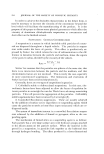
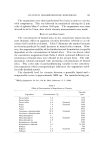
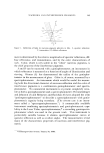
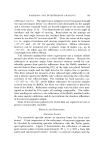
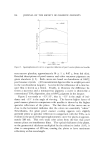
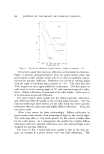
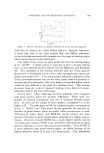
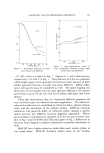
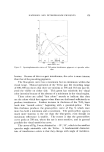
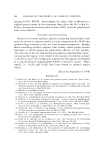
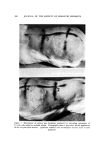
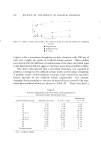
168 JOURNAL OF THE SOCIETY OF COSMETIC CHEMISTS O.I OOI -15ø/v '•"• 76•o PE Needles '•. '•. lear Lacquer 3•) 40 50 60 70 80 VIEWING ANGLE (v ø) Figure 4. Directional reflectance of pearl essence. Angle of incidence, --15 ø It has been stated that nacreous reflection is directional in character. Figure 4 presents goniophotometric plots for pearl essence plate and pearl essence needle samples which were at or close to optimum concen- trations for specular reflection. Reflection was viewed at varying angles with the angle of incidence kept constant at --15 ø. The clear film and TiO2 samples are once again added for comparison. The first point on each curve is at the viewing angle of 15 ø and represents specular reflec- tance. Diffuse reflectance is measured at all other angles. Each curve is at its maximum at specular reflection. The pearl essence plate sample has the highest specular reflectance, and reflectance falls off rapidly as the viewing angle increases. The less lustrous needle-type pearl essence, on the other hand, has lower specular reflectance than the plate-type and higher diffuse reflectance. Thus, the two curves cross. What is the reason for these relationships? Diffuse reflectance in pearl essence arises mainly from scattering of light by the crystal edges. The total edge effect is very much greater for the narrow needles than for the wider plates. As a consequence, the needles have higher diffuse reflectance and lower specular reflectance, since the scattered light is not available for specular reflection. The curve in Fig. 4 which falls most rapidly is that of the clear lac- quer, an example of a glossy surface with very little diffuseness. The

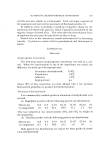
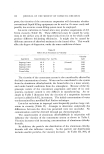
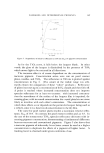
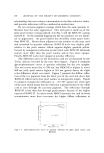
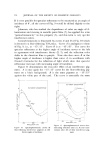
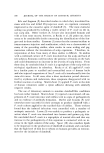
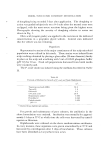
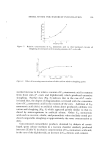
NACREOUS AND INTERFERENCE PIGMENTS 169 I2 •6 oe o 2 4 6 8 10 I2 % P•gment Figure 5. Relative reflectance at specular reflection of several nacreous pigments TiO,• film, in contrast, is a rather diffuse reflector. Specular reflectance is lower than that of the clear lacquer film, and diffuse reflectance is relatively high and essentially constant over the range of viewing angles which can be covered by the instrument. The slopes of the curves are quite gentle between the viewing angles of 15 ø and 20 ø. A glossy surface is expected to give a sharply spiking curve, as was demonstrated by Hunter (4) and Billmeyer and Davidson (6). The broadness of the maxima obtained with the Trilac spectro- photometer is attributable to the rather wide viewing beam, which sub- tends a total angle of 19 ø. This characteristic limits the resolution of the Trilac spectrophotometer but, on the other hand, makes it possible to measure specular reflectance with a fair degree of reproducibility, which would be very difficult at the peak of a spiking curve. The average deviation from the mean of repeated readings is less than 0.1 relative reflectance unit in the 5.0 to 10.0 range. Several other "white"-refiecting nacreous pigments were compared with pearl essence plates for specular reflectance. These were two samples of bismuth oxychloride and two of titanium dioxide-coated mica. In each case the sample of lower quality is designated as I, the higher as II. The reflectance at 550 nm is plotted against concentration in Fig. 5. BiOCI-I and TiO2-mica-I do not approach the specular re- flectance of pearl essence plates no matter what concentration is used. TiO2-mica-II comes closer, and giOCl-II reaches almost the same specular reflectance as pearl essence plates, although at a higher concen- tration. However, because BiOC1 has a much higher specific gravity (7.7) than pearl essence crystals (1.6), its volume concentration at equal specular reflectance is lower than that of pearl essence. Thus, giOCl-II is more reflective than pearl essence plates, no doubt because of its higher refractive index (2.15 and 1.85, respectively). The interesting
Purchased for the exclusive use of nofirst nolast (unknown)
From: SCC Media Library & Resource Center (library.scconline.org)