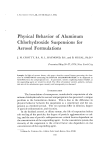
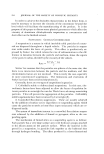
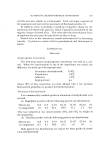
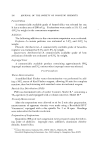
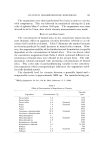
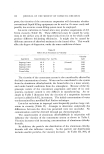
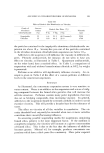
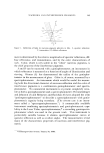
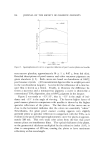
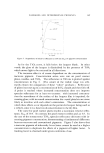
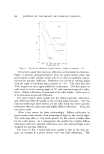
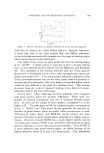
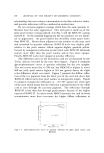
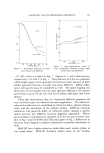
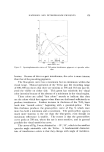
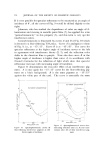
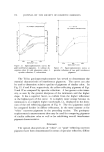
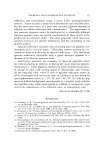
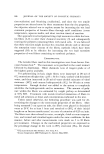
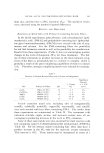
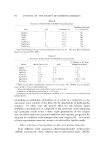
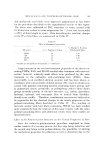
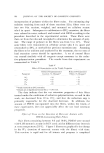
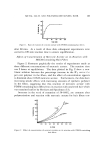
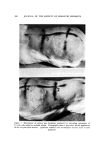
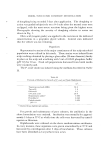
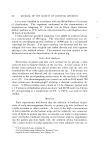
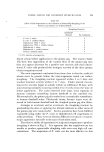
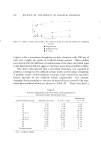
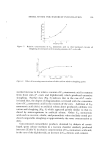
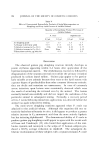
170 .JOURNAL OF THE SOCIETY OF COSMETIC CHEMISTS relationships between volume concentration in the film, refractive index, and specular reflectance will be considered at another time. Do two nacreous pigment coatings which have the same specular re- flectance have the same appearance? One such pair is made up of the plate pearl essence coating marked d in Fig. 5 and the BiOCI-II coating marked B. In the standard dipping test the two products are not identi- cal in appearance: the pearl essence has decidedly better pearl luster than BiOCI-II. Drawn down adjacent to one another on the same card and examined by specular reflection, BiOCI-II looks very slightly pink relative to the pearl essence, which appears slightly greenish yellow. Viewed by nonspecular reflection on the black card, BiOCI-II definitely scatters more light than the pearl essence and is thus more opaque. Finally, BiOCI-II is also more opaque at specular reflection. The differences seen on the drawdown card are all discerned by the Trilac, and are revealed by the next three figures. Figure 6 compares spectrophotometric curves at specular reflection for the two samples. The two curves meet close to 550 nm, but BiOCI-II is highest at about 660 nm (red), pearl essence highest at 515 nm (green)--hence the slight color difference which was noted. Figure 7 presents the diffuse reflec- tion of the two pigments from the black part of the card and shows that BiOCI-II reflects more than pearl essence at nonspecular angles. Figure 8 compares nonspecular reflectance at --15ø/60 ø against the white part of the card, which means that the reflection is primarily that of the white card as seen through the nacreous pigment. The reflectance through BiOCI-II is less than that through pearl essence because of the higher opacity ot• BiOCI-II. In other words, BLOC1 transmits less, and its lower transmittance more than overcomes the higher diffuse reflectance at • IO •8 oe, 0 •/v = -15•/15 ø 450 550 650 WAVELENGTH (rim) Figure 6. Spectrophotometric curves at specular reflection for plate pearl essence anti BiOCI-II

NACREOUS AND INTERFERENCE PIGMENTS 171 0.1 o ol - 15'/v VIEWING ANGLE (v*) Figure 7. Directional reflectance of plate pearl essence and BiOCI-II 0.8 • o.6 0.2 -15'/60' g g% p[ plO• 450 550 WAVELENGTH (rim) 6•o Spectrophotometric curves of Figure 8. white background reflected through plate pearl essence and BiOCI-II --15ø/60 ø which is evident in Fig. 7. Figures 6, 7, and 8 demonstrate, respectively, S, D, and T of Fig. 1. They indicate why the two pigments which might appear to be equivalent in nacreous luster because of their similar specular reflectance actually look quite different: diffuse reflec- tance and opacity must be considered as well. The pearl dipping test shows that, of two samples with the same specular reflectance, the greater pearl luster is given by the one with lower diffuse reflectance and lower opacity. These data demonstrate that two chemically different pigments are very unlikely to give the identical nacreous appearance. The character- istics of the reflection are established by refractive index, platelet dimen- sions, and the smoothness of the platelet surface. Different chemical substances will generally differ in refractive index, making a perfect match between two different nacreous pigments impossible. Where given chemical components are involved, as in the two pearl essence sam- ples of Fig. 3 and the BiOC1 and TiO2-mica pairs of Fig. 5, differences in nacreous luster depend on platelet dimensions or platelet smoothness or both. BiOCl-II has a higher refractive index than pearl essence plates, as was noted above. BiOCl-II therefore reflects more of the incident
Purchased for the exclusive use of nofirst nolast (unknown)
From: SCC Media Library & Resource Center (library.scconline.org)