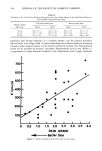
380 JOURNAL OF THE SOCIETY OF COSMETIC CHEMISTS imal swelling occured between C 12 and C 14 carbon atoms. Surfactant interactions to reduce swelling were found e.g., addition of ethoxylated alcohol sulfates and amphoterics to anionics produced less swelling than the anionics alone. The results sug- gest mechanisms of action of surfactants and a basis for in vivo irritation. The use of magnitude estimation with para- metric statistical methods in the subjective measurement of axillary odor Mark J. Levine and Penelope Giles, American Cy- anamid Company, Consumer Products Research Di- vision, 697 Route 46, Clifton, NJ 07015 A conventional axillary deodorant clinical study in- volves 3-6 trained odor judges providing numerical ratings of human axillary malodor intensities. A 0- 5 or 0-10 rating scale is typically used. This paper discusses the use of the magnitude estimation rating scale method in these studies. In addition, clinical evaluation studies are presented. Advantages of the magnitude estimation method include scientific va- lidity grounded in psychological literature, ratio scale properties supporting deodorant efficacy mea- surement in terms of "percent odor reduction," and statistical validity, flexibility, power, and conve- nience. A data analysis involving a total of 562 subject evaluations provides empirical justification for applying parametric statistical methods (t-tests, analysis of variance, regression, etc.) to the loga- rithm of the judge ratings. A simple method for analyzing data containing some zero ratings (whose logarithm is undefined) is presented. Subjects with higher initial odor levels are shown to yield greater percent odor reductions than those with lower ini- tial odor levels. Study designs which control for this factor are recommended. The power to detect small product efficacy differences is shown to be dimin- ished in studies which include other deodorants with large efficacy differences. Some considerations in the selection and training of judges are presented. Stabilization of oil-in-water emulsions by gums Joel L. Zatz, Ph.D., and Bernard Ip, Rutgers Uni- versity College of Pharmacy, P.O. Box 789, Pis- cataway, NJ 08854 Model emulsions containing 10% mineral oil, oleth 3, oleth 10, methylparaben, propylparaben, water, and several concentrations of selected gums were prepared. A two-step procedure, designed to pre- vent variations in initial particle size in emulsions containing the same emulsifier concentration, was employed. Median particle size, measured by an electronic sizing technique, was inversely related to emulsifier concentration. There was no change in particle size distribution of the emulsions after storage for 7 months. Viscosity values for emulsions containing xanthan gum did not change signifi- cantly during the storage period. In emulsions con- taining 0.25 to 1.0% emulsifier, addition of xan- than gum decreased the creaming rate to about the same extent. The logarithm of creaming rate was a linear function of gum concentration, making it possible to compare different gums quantitatively. The order of effectiveness in retarding creaming was xanthan gum carbosymethylcellulose, high viscosity methylcellulose, 4000 cp. Thiol reduction of hair fibers in the presence of exogenous disulfides J. Cincotta, E.J. Klemm, L. Salce, S. Barrow., Zotos International, Inc., 100 Tokeneke Road, Darien, CT 06820 Reduction of keratin hair fibers with excess thiol proceeds in a two-step equilibrium reaction. Factors affecting this equilibrium were examined using amino acid analyses and fiber bundle tensile tech- niques. When hair fibers were treated with either ammonium thioglycolate or glycerly monothiogly- colate, at a fixed pH and concentration, the rate and extent of reduction of these fibers were curtailed when exogenous disulfides were added to the re- acting medium. Observations were made under var- ious experimental conditions. Attempts were made to correlate loss of tensile properties of hair fiber bundles with percent keratin reduction in the pres- ence of thioIs containing exogenous disulfides. Loss of fiber bundle tensile properties were found to be related to the concentration of disulfide added to the thiol solution. Results of the experimental data obtained in these studies will be discussed. Applications of matrix engineering in skin care E. A. Balazs, M.D., P. A. Band, Ph.D., A. K. Leshchiner, Ph.D., and E. A. Leschiner, Ph.D., Biomatrix, Inc., P.O. Box 536, Ridgefield, NJ 07657 Matrix engineering is a technology based on the naturally occurring polymers found in the inter- cellur matrix of all animal tissues. Based on the in vivo functions of connective tissue biopolymers, spe- cialized properties of human tissues can be mim- icked or enhanced. Derivatives and modifications of hyaluronic acid (HA) molecular networks have skin care applications arising from both their intrinsic properties and their ability to act as a cosmetic de- livery system. Using such HA-based materials, ef- ficacious cosmetic ingredients such as petrolatum can be delivered in formulations which mask their undesirable properties. Matrix engineering-based methods which bridge the gap between aesthetics and efficacy will be presented, and their impact on the classical differentiation of formulations into oils, lotions, and creams will be discussed.
Purchased for the exclusive use of nofirst nolast (unknown)
From: SCC Media Library & Resource Center (library.scconline.org)