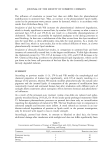
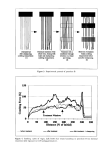
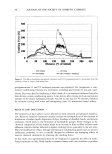
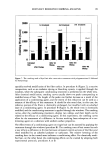
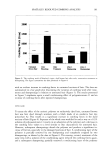
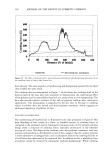
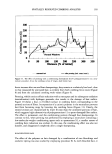
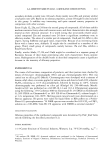
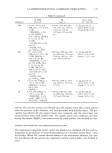
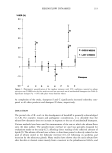
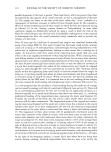
SPATIALLY RESOLVED COMBING ANALYSIS 103 300 • 150 ]- .......................... --3/:,/•74--\•.:/'¾•,• .... o 0 50 100 150 200 250 300 350 Distance [% of initial] after perming (incl. neutr./cond.) Figure 11. The effect of perming with a conditioning formulation (0.2% polyquaternium-11 in a neu- tralizer procedure A) on the combing curves of virgin, dark brown hair. forces increase after one and four shampooings, they remain at a relatively low level, close to that measured for untreated hair, as evident from both combing force traces (Figure 8) and from the calculated combing work values (Figure 9). Perming, which consists of hair reduction with a mercaptan and its subsequent oxidation (neutralization) with hydrogen peroxide, also results in the damage of hair surface. Figure 10 shows a four- to fivefold increase in combing forces corresponding to the permed sections of fibers. Incorporation of a cationic polymer in the neutralizer prevents hair from becoming raspy by lowering the combing forces (Figure 11). Clearly, the treated sections are characterized by lower friction than the untreated portions of hair, which suggests high substantivity of polyquaternium-11 to perm-damaged fiber surface. The effect is permanent, and the conditioning persists through four shampooings. In contrast to this, when perming was performed by employing a neutralizer containing a low-molecular-weight conditioning agent such as quaternium-52, a smaller extent of combing force reduction was evident. In this case, the conditioning effect was also not durable, and disappeared completely after a single shampooing. BLEACHED/DYED HAIR The effect of the polymer on hair damaged by a combination of two bleachings and oxidative dyeing was also studied by employing procedure B. As with bleached hair, it

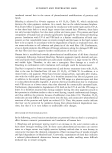
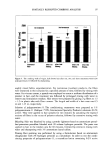
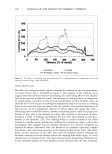
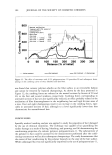
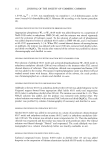
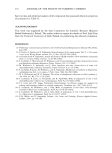
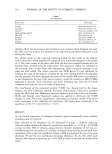
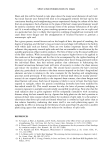
104 JOURNAL OF THE SOCIETY OF COSMETIC CHEMISTS 8OO 600 u. 400 :200 0 Bleached and Dyed Hair Treatment with 0.2% solution of polyquaternium-11 Combing Work [Gcm] Before treat. - 5233 .............. 7 - '•f[ 7. ....... ,- .................. After treat. - 679 / After treat. + I shamp. - 1194 After treat. + 4 shamp. - 2319 0 50 100 150 200 250 300 350 Distance [% of initial] -- before treatment after treatment after treatment + 4 shampooings Figure 12. The effect of treatment with 0.2% polyquaternium-ll (procedure B) and subsequent sham- pooings on the combing curves of twice bleached and dyed hair. was found that cationic polymer adsorbs on the fiber surface in an irreversible fashion and cannot be removed by repeated shampooings. As shown by the data presented in Figure 12, the combing forces are reduced in the treated sections by factors of 20 and 40, in the first and second windows, respectively. Combing forces corresponding to untreated sections of hair are also significantly reduced, an effect probably related to the mechanism of fiber disentanglement in the neighboring low and high friction areas of a tress. Four and eight shampooings result in an increase in the combing forces, espe- cially in untreated sections of hair, although to a level significantly lower than that characteristic for unconditioned hair. CONCLUSIONS Spatially resolved combing analysis was applied to study the properties of hair damaged by the use of chemical treatments. The technique was capable of (a) quantifying the surface damage as a result of dyeing, bleaching, and perming, and (b) demonstrating the conditioning properties of a cationic polymer, polyquaternium-11. The substantivity of the polymer to hair could be assessed by the measurements performed after the condi- tioning treatment as well as after subsequent shampooings. The study demonstrates that the extent of hair conditioning by the polymer depends on the state of the hair surface. While undamaged hair was not significantly improved by the use of polyquaternium-11,
Purchased for the exclusive use of nofirst nolast (unknown)
From: SCC Media Library & Resource Center (library.scconline.org)