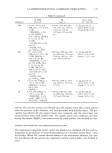
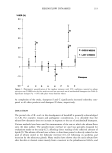
SPATIALLY RESOLVED COMBING ANALYSIS 105 its effect on chemically modified and raspy hair was very pronounced. In addition to this, the conditioning effect was found to be durable since an adsorbed layer of a cationic polymer could not be removed, from either virgin or damaged hair, by shampooing. ACKNOWLEDGEMENTS The authors acknowledge useful discussions with J. Kosiek and K. Krummel. REFERENCES (1) W. Newman, G. L. Cohen, and C. Hayes, A quantitative characterization of combing force, J. Soc. Cosmet. Chem., 24, 773 (1973). (2) W. S. Tolgyesi, E. Cottington, and A. Fookson, Mechanics of hair combing. Presented at the Sym- posium on Mechanics of Fibrous Structures, Fiber Society, Inc., Atlanta, May 14, 1975. (3) M.L. Garcia and J. Diaz, Combability measurements on human hair, J. Sot'. Cosmet. Chem., 27, 379 (1976). (4) Y. K. Kamath and Hans-Dietrich Weigmann, Measurement of combing forces,J. Soc. Cosmet. Chem., 37, 11 (1986). (5) E.J. Murphy, Cationic polymer conditioner evaluation, Soaps, Cosmetics, Chemical Specialties, Feb- ruary 1980. (6) P. Hossel and E. Pfrommer, Test methods for hair conditioning polymers, Conj•rence Proceedings, In-Cosmetics, Barcelona, March 1994, p. 133. (7) J. A. Swift and A. C. Brown, The critical determination of fine changes in the surface architecture of human hair due to cosmetic treatment,J. Soc. Cosmet. Chem., 23, 695 (1972). (8) M. L. Garcia, J. A. Epps, and R. S. Yare, Normal cuticle-wear patterns in human hair, J. Soc. Cosmet. Chem., 29, 155 (1976).

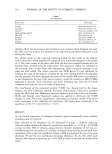
j. Soc. Cosmet. Chem., 48, 107-116 (March/April 1997) (,)-a-Carene as a key compound in syntheses of 6,6-dimethylbicyclo[a.l.O]hexane derivatives with olfactory properties STANISLAW LOCHYi•ISKI, Institute of Organic Chemistry, Biochemistry and Biotechnology, Technical University of Wroctaw, Wyb. Wyspiadskiego 27, 50-370 Wroctaw, Poland. Accepted j•r publication April 30, 1997. Synopsis The synthesis of new 6,6-dimethylbicyclo[3.1.0]hexane derivatives with various substituents at the C-3 position are described. Alcohols, esters, ketones, and nitriles possess interesting olfactory properties. Odor characteristics and the odor-structure relationship are presented. INTRODUCTION (+)-3-Carene (1), a major constituent of Polish turpentine, is a natural, inexpensive, easily available raw material. During several years of study of the stereochemistry and chemical transformations of the carane system, some simple preparative methods for the syntheses of various compounds with olfactory properties were elaborated. Previous- ly (2-5), we described syntheses of compounds 2 and 3 (Scheme 1), in which the carane system was preserved and futher compounds formed from the intermolecular rearrangement of the gem-dimethylbicyclo[4.1.O]heptane system into the gem-di- methylcyclohexadienone (4) and derivatives. Other functionalization of carane gave the gem-dimethylbicyclo[3.1.O]hexane system, substituted at C-2 and C-3 positions, namely derivatives of ketones 5 and 6. In this paper, I present a series of new compounds containing the 6,6-dimethylbicyclo[3.1.0]hexane system, with various substituents at the C-3 position obtained using compound 6 as a key substance. RESULTS AND DISCUSSION The starting material, trans-3-acetyl-6,6-dimethylbicyclo[3.1.O]hexane (6), was ob- tained from (+)-3-carene via (-)-3,4-dibromocarane as described earlier (6). The struc- ture of ketone 6 allowed us to carry out various synthetic operations the aim of which was to modify the side chain substituted at C-3. Two reactions are most useful: (a) the Grignard and Witrig reactions with the furher one carried out in a classical manner or (b) a Wadsworth-Emmons modification (7). The full synthetic scheme is outlined below. This paper was presented as a preliminary communication in 1993. See ref. (1). 107
Purchased for the exclusive use of nofirst nolast (unknown)
From: SCC Media Library & Resource Center (library.scconline.org)