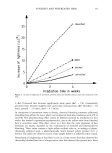
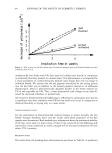
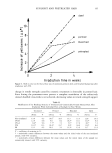
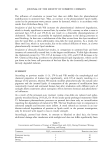
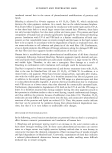
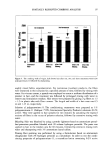
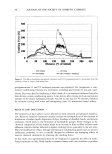
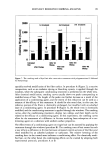
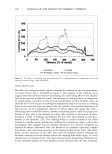
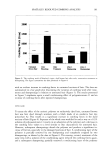
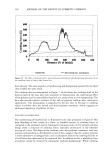
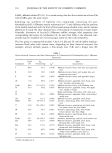
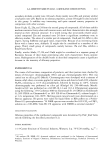
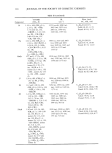
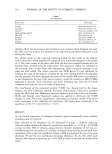
84 JOURNAL OF THE SOCIETY OF COSMETIC CHEMISTS 5 3 2 1 •111 dyed ß bLec[ched ..•"' ........... .••o perreed unfreafed I' o 2 Irradiafion lime in weeks Figure 3. Shift in color on the blue yellow axis of untreated, permed, dyed, and bleached human hair after irradiation with UV-A. irradiation for four weeks with VIS, hair dyed red is faded most heavily in comparison to chemically bleached, permed, or untreated hair. This phenomenon is accompanied by a visual assessment of a photochemically induced color change from red via orange to yellowish blonde. We assume that the red pigment introduced by the dyeing process into the hair fiber acts in addition to the natural pigment melanin as an additional photoreceptor, which is photochemically degraded parallel to the brown melanin by UV-A and especially by VIS. Thus, a more pronounced color change occurs than ob- served for untreated, bleached, or permed hairs. An increase in the photochemical brightening or yellowing by a permanent-wave process is significant only after irradiation with VIS for four weeks and occurs in comparison to chemical bleaching or dyeing only to a lesser extent. TENSILE STRENGTH TESTS For the examination of photochemically induced changes in tensile strength, the hair bundle strength (breaking force) and the tensile stress-strain properties of the hair samples were determined. Both methods give information about the mechanical stability of the hair cortex and, to a lesser extent, of that of the cuticle (8). In the following only statistically certain reductions in tensile strength will be discussed (comparison of mean values, 95% certainty). BR•^•:INO FORC• The results from the breaking force determinations are shown in Table II. A significant

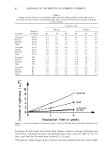
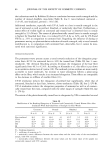
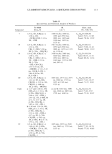
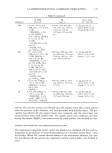
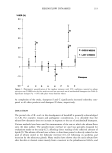
SUNLIGHT AND PRETREATED HAIR 85 10 4 8 6 ! /. /. / / /m dyed ß ß .$ permed , ß ß ß bleached unfreofed Irrodiofion lime in weeks Figure 4. Shift in color on the blue yellow axis of untreated, permed, dyed, and bleached human hair after irradiation with VIS. change in tensile strength caused by cosmetic treatments is detectable in permed hair. Since during the permanent-wave process a complete reoxidation of the reductively cleaved disulfide cross-links is not achieved, decreasing values in tensile strength support Table II Modification of the Breaking Tenacity of Untreated and Cosmetically Treated Human Hair After Irradiation With Individual Parts of Sunlight for Four Weeks Untreated Permed Bleached Dyed cN/tex V cN/tex V cN/tex V cN/tex V Non-irradiated 13.0 9.3 10.6' 10.5 13.3 13.5 12.8 10.1 UV-B 12.9 6.8 9.6 8.2 10.2' 10.1 11.2' 8.4 UV-A 8.6* 9.6 7.7* 7.1 5.1' 17.0 8.1' 7.2 VIS 10.1' 11.3 10.4' 13.7 9.9* 18.0 11.2' 8.6 IR 12.1 6.5 10.2 5.1 11.3' 13.9 11.7 11.9 V = coefficient of variation in %. * = statistically certain differences between the mean values and the initial value of the non-irradiated sample, with 95% certainty. * = statistically certain differences between the mean values and the initial value of the sample not cosmetically treated, with 95% certainty.
Purchased for the exclusive use of nofirst nolast (unknown)
From: SCC Media Library & Resource Center (library.scconline.org)