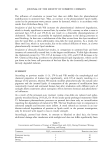
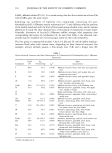
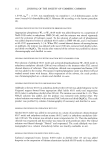
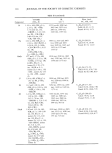
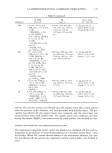
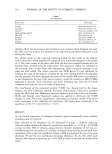
86 JOURNAL OF THE SOCIETY OF COSMETIC CHEMISTS the indications made by Robbins (9) about a correlation between tensile strength and the number of cleaved disulfide cross-links (Table II, line 1: non-irradiated, untreated -- 13.0 cN, non-irradiated, permed = 10.6 cN). Additional irradiation, especially with UV-A, leads to a loss in tensile strength in the case of untreated as well as perreed, bleached, or oxidatively dyed hair. Furthermore, a minor effect of visible light on untreated and treated hair is observed (loss in tensile strength by 2.9 cN/tex). The extent of photochemically caused losses in tensile strength is highest for bleached hair thus, it is reduced by UV-A by ca. 62%, and by UV-B and VIS by ca. 25% in comparison to untreated hair. Regarding the influence of dyeing or permanent waving on photooxidative reduction of tensile strength, only a trend towards modification is, in comparison with untreated hair, detectable, but it cannot be mea- sured with statistical significance. TENSILE ELONGATION The permanent-wave process causes a trend towards reduction of the elongation prop- erties from 46.5% for untreated hair to 44% for treated hair (Table III, line 1: non- irradiated). The chemical bleaching process decreases the elongation of the hair fiber significantly from 46.5 to 42.4%. According to Alexander et aL, this effect is put down to an oxidative destruction of cystine (10). The oxidized cystine residues are more readily accessible to water molecules. An increase in water absorption follows a plasticizing effect on the fiber, which results in an increased elongation. These effects are comparable to the decrease in stiffness of swollen fibers (11). UV-B irradiation reduces the elongation of permed hair significantly, while that of untreated, bleached or dyed hair, however, shows tendencies (Table III, line 2: UV-B). UV-A irradiation reduces the elongation properties of untreated as well as of cosmeti- cally treated hair the most, compared with the other ranges of sunlight (Table III, line 3: UV-A). The extent of the photochemically caused loss in elongation by VIS is somewhat less and Table III Modification of the Breaking Elongation of Untreated and Cosmetically Treated Human Hair After Irradiation With Individual Parts of Sunlight for Four Weeks Untreated Perreed Bleached Dyed Din % V Din % V D in % V Din% V Non-irradiated 46.5 5.0 44.0 4.3 42.4* 3.2 43.9 6.3 UV-B 42.8 4.8 41.0' 10.1 41.4 10.1 40.8 10.1 UV-A 38.5* 11.7 39.0* 9.1 36.0* 7.6 38.5* 7.7 VIS 38.7* 24.8 43.6 13.6 36.6* 10.7 39.4* 9.3 IR 45.9 6.0 45.4 4.4 44.1 5.6 40.8 7.4 D = breaking elongation. V = coefficient of variation in %. * = statistically certain differences between the mean values and the initial value of the non-irradiated sample, with 95% certainty. * = statistically certain differences between the mean values and the initial value of the sample not cosmetically treated, with 95% certainty.

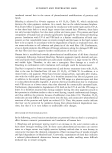
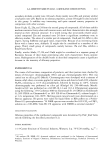
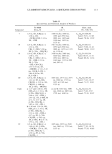
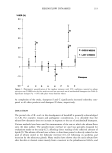
SUNLIGHT AND PRETREATED HAIR 87 only significant for untreated, bleached, or dyed hair. A photochemical influence of IR irradiation on the elongation properties of untreated or cosmetically treated hair is not detectable. The major part of mechanical and consequently protein chemical damage of human hair is caused by irradiation with UV-A, followed by VIS (elongation). Both irradiation ranges cleave the S-S cross-links photooxidatively (12), which results in an additional loss in tensile strength. Under the tested conditions, an additional effect on the irradiation-induced reduction of elongation brought about by cosmetic treatment could not be improved. LIPID DETERMINATION The internal lipids of hair are derived from the cell membranes of the living tissue and form ca. 50% of the cell membrane complex (CMC) between the keratinized cells of the cortex and the cuticle. Since this CMC plays a role in the diffusion properties of solubilized substances and is, furthermore, responsible for the cohesion of hair cells (13), the quantitative modifications of the CMC lipids were determined as a function of cosmetic treatment, and the type of irradiation was determined by quantitative deter- mination of the cholesterol fraction. The results are shown in Table IV. Non-irradiated, untreated hair contains ca. 1 mg cholesterol per gram of hair. This corresponds to 20-25% of the total lipid fraction (14). In contrast to permanent-wave treatment or dyeing, the chemical bleaching process reduces the cholesterol content of the untreated hair by 12% (Table IV, line 1: non/irradiated). UV-B irradiation reduces the cholesterol content of perreed or bleached hair only in- significantly (Table IV, line 2: UVB). The influence of UV-A (Table IV, line 3) is detectable from the reduction of the cholesterol content by ca. 25% in the case of untreated, permed, or bleached hair as compared to the initial concentrations. Visible light (Table IV, line 4: VIS) results in the largest photochemical degradation of cho- lesterol. Still, in untreated, perreed, or dyed hair, 42%, 60%, and 66%, respectively, of the original cholesterol content could be detected in chemically bleached and addition- ally VIS-irradiated hair, 26% of the initial cholesterol content is still detectable. This confirms the results from the most recent publications, which emphasized for the first time the photooxidative destruction of cholesterol from internal lipids in medium blonde hair by UV-A light (15) and in particular by visible light (3). Table IV Modification of the Cholesterol Content of Untreated and Cosmetically Treated Human Hair After Irradiation With Individual Parts of Sunlight for Four Weeks Amount of cholesterol in pg/g hair Untreated Permed Bleached Dyed Non-irradiated 970 908 856 948 UV-B 986 836 788 916 UV-A 748 734 548 948 VIS 416 482 208 604 IR 840 884 768 780
Purchased for the exclusive use of nofirst nolast (unknown)
From: SCC Media Library & Resource Center (library.scconline.org)