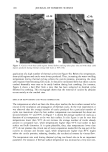
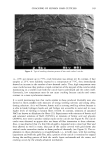
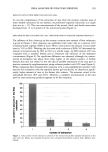
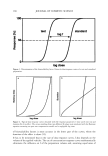
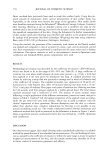
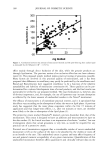
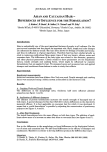
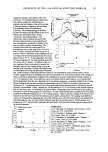
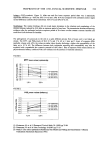
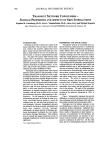
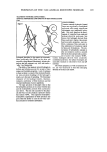
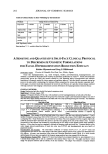
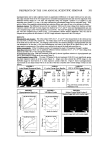
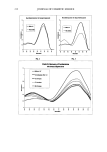
150 JOURNAL OF COSMETIC SCIENCE Average number of short longitudinal cuticle cracks per mm of hair 600 5OO 4OO 300 2OO lOO 20 30 40 50 60 70 80 90 lOO 11o 12o Air temperature (C) Figure 7. Plot of average number of cuticle cracks reproduced in the laboratory vs blow-drying tempera- ture. The number of applied thermal cycles was kept constant at 20 cycles, and the air temperature was measured at the level of the hair surface. Error bars represent one standard deviation about the mean. Figure 8. Cuticle cracks produced after immersing a hair fiber in a 50/50% solution of saturated NaCI and formic acid for ten hours.

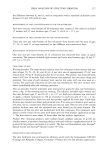
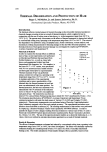
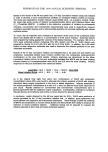
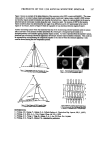
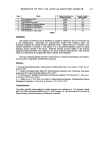
CRACKING OF HUMAN HAIR CUTICLES ! 5 ! 9b • x2.4k Figure 9. Fiber with a thin gold film deposited on its surface before water immersion (9a) and after water immersion (9b). EFFECT OF SOME COSMETIC ACTIVES When 2% w/w aqueous solutions of glycerin and propylene glycol were used during thermal cycling instead of water, the hair cuticles did not show any increase in the average number of cracks characteristic of virgin hair fibers. This observation suggests that during thermal cycling these actives retard water evaporation and also are able to plasticize the cuticles, thereby preventing crack formation. Glycerin and propylene glycol could, however, be easily removed from the hair fiber by simple water rinsing, and under these conditions the cuticles cracked again. The use of 2% aqueous solutions of various quarternaries instead of water during thermal cycling did not indicate any cuticle crack prevention at all. The quaternaries analyzed were as follows: polyquaternium 11, cetrimonium chloride, and steralkonium chloride. The deposition of four alternating layers of a positive polymer (polyethylenimine) and a negative polymer (polyacrylate) on the hair surface was not capable of preventing crack formation. For instance, in Figure 10 it can be seen that cracks still formed, both on the hair cuticles and also on the deposited polymer layers. Other substances that did not prevent crack formation when deposited onto the hair surface were oils such as triglyc- erides, silicon oils, mineral oil, and petrolatum. In contrast, an aqueous solution of hydrolyzed wheat protein polysiloxane copolymer at 2%, used instead of water during thermal cycling, prevented cuticle cracking. The crack prevention effect was seen to take place even after the hair was water rinsed. This protein copolymer, which crosslinks upon heat application, is believed to retard water evaporation and also to give a strong cohesiveness to the cuticles, thereby preventing thermal crack formation. CONCLUSIONS Hair blow-drying produces cuticle cracks that can be reproduced in the laboratory by the application of alternating cycles of hair wetting and blow-drying. The cracks were seen to result as a consequence of circumferential tension stresses imposed on the dried portion of the cuticles at the top by the swollen cortex. The temperature range at which
Purchased for the exclusive use of nofirst nolast (unknown)
From: SCC Media Library & Resource Center (library.scconline.org)