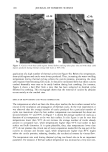
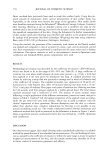
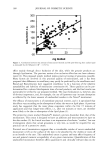
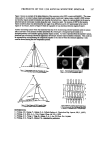
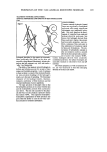
152 JOURNAL OF COSMETIC SCIENCE I . ::-:kx kv Figure 10. Cracks formed on cuticles of hair treated with four alternating layers of polyethylenimine and polyacrylate. these cracks seem to take place is between 75 ø and 95øC. It was also shown that the combing of hair with cracked cuticles results in the removal of big portions of cuticle. The prevention of crack formation by the use of some cosmetic actives was shown to be possible. ACKNOWLEDGMENTS The author wishes to thank Ann Harder for her valuable technical assistance and Herb Eldestein for his helpful discussions. REFERENCES (1) R. Robbins, Chemical and Physical Behavior of Human Hair, 3rd ed. (Springer-Verlag, New York, 1994), pp. 211-226. (2) V. N. E. Robinson, A study of damaged hair, J. Soc., Cosmet. Chem., 27, 155-161 (1976). (3) M. L. Garcia, J. A. Epps, R. S. Yane, and L. D. Hunter, Normal cuticle wear patterns in human hair, J. Soc. Cosmet. Chem., 29, 155-178 (1978). (4) E. Hoting, M. Simmermann, and S. Hiltherhaus-Bong, Photochemical alterations in human hair. I. Artificial irradiation and investigations of hair proteins, J. Soc. Cosmet. Chem., 46, 85-99 (1995). (5) J. A. Swift, The critical determination of fine changes in the surface architecture of human hair due to cosmetic treatment, J. Soc. Cosmet. Chem., 23, 695-702 (1972). (6) J. A. Swift, Fine details on the surface of human hair, Int. J. Cosmet. Sci., 13, 143-159 (1991). (7) P. Milczarek, M. Zielinski, and M. Garcia, The mechanism of stability of thermal transitions in hair keratin, Colloid Polym. Sci., 270, 1106-1115 (1992).

CRACKING OF HUMAN HAIR CUTICLES 153 (8) H. Ito, T. Miyamoto, and H. Inagaki, States of water sorbed on wool as studied by differential scanning calorimetry, Text. Res. J., 57, 66-72 (1987). (9) A.R. Haly and J. W. Snaith, Specific heat studies of various wool-water systems, Biopolymers, 6, 1355-1377 (1968). (10) M. Gamez-Garcia, Morphological Changes in Human Hair Cuticles upon the Simultaneous Action of Cyclical Mechanical and Thermal Stresses: Their Relevance to Grooming Practices, presented at the Annual Conference of the Society of Cosmetic Chemists, New York, December 1997. (11) M. Gamez-Garcia, Cuticle de-cementation and cuticle buckling produced by circumferential com- pression stresses on the cuticular envelope of human hair (in preparation). (12) M. Gamez-Garcia, Plastic yielding and fracture of human hair cuticles by cyclical torsion stresses (in preparation). (13) Hydrolyzed wheat polysiloxane copolymer, a Croda product with the name of Crodasone W. (14) E. I. Valko and G. Barnett, A study of the swelling of hair in mixed aqueous solvents,J. Soc. Cosmet. Chem., 3, 108-117 (1952). (15) L. A. Holt, Wool treatments from non-swelling solvents, Proc. 7th Int. Wool Text. Res. Conf Tokyo, Vol. IV, 1985. (16) J. H. Bradbury and J. D. Leeder, Sorption of liquids by wool. Part I. Determination of the sorbate content by a new technique, J. Appl. Polym. Sci., 7, 533 (1963). (17) W. A. Nash, Strength of Materials, Schaum's Outline Series (McGraw-Hill, New York, Chap. 3), pp. 40-53 also see F. Ziegler, Mechanics of Solids and Fluids (Springer-Verlag, New York, 1981), pp. 88-91. (18) C. B. Bucknail, "Deformation Mechanics in Glassy Polymers," in Toughened Polymers, C. B. Bucknail, Ed. (Applied Science Publishers Ltd, London, 1977), p. 136. (19) N.J. Abbott, S.C. Temin, and Chungi Park, The stress-strain behavior of wool in various swelling media, Text. Res. J., 38(10), 1026-1039 (1968). (20) J. D. Leeder, The cell membrane complex and its influence on the properties of the wool fibre, Wool Science Review 63 (Pub. Int. Wool Secretariat Dev. Center, October 1986). (21) P. Alexander and R. F. Hudson, in Wool, Its Chemistry and Physics, P. Alexander and R. F. Hudson, Eds. (Reinhold New York, 1954), pp. 218-219.
Purchased for the exclusive use of nofirst nolast (unknown)
From: SCC Media Library & Resource Center (library.scconline.org)