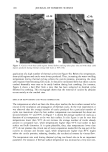
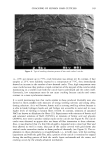
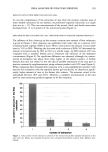
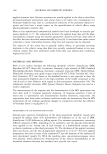
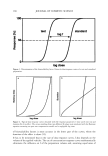
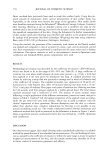
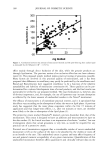
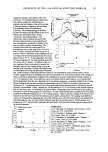
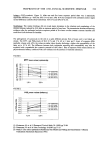
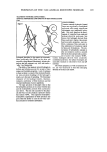
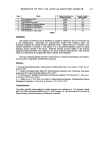
148 JOURNAL OF COSMETIC SCIENCE .... x2.4k x2.4k 5a 5b Figure 5. Cuticles with shear yield regions formed before cracking takes place (5a) and with shear yield regions produced during thermal cycling with water at 50øC (5b). application of a high number of thermal cycles (see Figure 5b). Below this temperature, shear yield regions and cracks were always produced. Thus, increasing the water-swelling temperature during thermal cycling softens the cuticle proteins, preventing the shear yield regions from becoming full cracks. It should be mentioned here that those cuticles cracked thermally were seen to be easily broken during hair combing. For instance, Figure 6 shows a hair fiber from a tress that has been subjected to thermal cycles followed by combing. This micrograph shows that the removal of cuticles by abrasion occurs mainly at the cracked sites. EFFECTS OF BLOW-DRYING AND WATER TEMPERATURE The temperature at which air from the blow-dryer reaches the hair surface seemed to be crucial in the incubation and propagation of thermal cracks. In the trial experiments it was observed that the average number of cracks produced for a particular number of cycles was maximum when the hair surface temperature was maintained for about ten seconds between 75 ø and 95øC. In Figure 7 is shown the average number of cracks as a function of air temperature at the wet hair surface. In this figure it can be seen that temperatures lower than 50øC do not increase the average number of cracks already present in unexposed hair, while temperatures higher than 95øC lead rather to hair surface and bulk distortion. It is quite plausible, thus, that temperatures lower than 65øC do not produce the critical rate of water evaporation needed for the top part of the cuticles to contract and become rigid, while temperatures higher than 85øC might soften the cuticle proteins, releasing, thereby, the mechanical stresses by viscous flow. The temperature rate used during thermal cycling was found also to be an important parameter. For instance, if the hair surface temperature was increased at a very slow rate,

CRACKING OF HUMAN HAIR CUTICLES 149 2.kx {}81 Figure 6. Typical combing abrasion pattern of hair with cracked cuticles. i.e., 10øC per minute up to 75øC, crack formation was almost nil. In contrast, if hair samples at 25øC were suddenly exposed to a temperature of 75øC, they immediately showed an increase in the number of new thermal cracks. Thus, high temperature rates cause cracks because they produce a rapid contraction of the top part of the cuticles while maintaining in a swollen state both the cuticle layers underneath and the cortex itself. Conversely, low temperature rates do not cause cracking because cuticles and cortex contract in a more synchronous manner. It is worth mentioning here that cracks similar to those produced thermally were also formed in fibers swollen with mixtures of strong swelling solvents and strong dehy- drating solutions. As is well known, formic acid is a strong swelling solvent because it is able to break hydrogen bonds and salt bridges not accessible to water and to cause higher levels of swelling in keratin fibers (19,20). In contrast, solutions of saturated NaCI are known to dehydrate the fibers (21). Experiments with mixtures of formic acid and saturated solutions of NaCI (50/50%), or mixtures of formic acid and glycerin (20/80%), were seen to produce similar cracks on the cuticles (see Figure 8). The cuticle cracks were observed to appear after ten hours of fiber immersion in these solutions. Also, it was observed that if a thin film of gold is deposited onto a clean hair fiber and then allowed to swell in water, that part of the cuticle covered with gold shows also vertical cracks somewhat similar to those produced thermally (see Figure 9). The ex- planation to these phenomena is straightforward, i.e., in both cases, with the swelling experiment and with the gold film, only a portion of the cuticle is restrained to expand during the swelling process of both the cuticle layers underneath and the cortex, and cracking occurs by the already advanced mechanism.
Purchased for the exclusive use of nofirst nolast (unknown)
From: SCC Media Library & Resource Center (library.scconline.org)