166 JOURNAL OF COSMETIC SCIENCE applied ointment layer. Because ointments are usually applied to the skin as thin films, decreased permeant penetration rates always have to be taken into consideration (1). Permeant depletion may lead to a pronounced reduction of the permeant-induced re- sponse and thus have a major impact on the quantification of vehicle effects using pharmacodynamic response data. More or less sophisticated mathematical models have been developed to describe per- meant depletion (1-7). The relationship between the applied drug dose and the phar- macodynamic response using the response parameters' duration and time until onset of the effect has been described mathematically by Levy (8). It was found that under certain conditions a linear relationship between drug dose and response may be obtained. The objective of this study was to quantify vehicle effects, in particular permeant depletion in the vehicle, using data from two recently conducted human i, v/vo pen- etration studies that were performed under finite-dose and infinite-dose conditions, respectively (9,10). MATERIALS AND METHODS Both in vivo studies included the following lipophilic vehicles: dimethicone (DIM Baysilone M 100 ©, Bayer AG, Leverkusen, Germany), light mineral oil (MO Parafiuid Minerali31gesellschaft, Hamburg, Germany), isopropyl myristate (IPM: Henkel KGaA, Dtisseldorf, Germany), and caprylic/capric triglyceride (CCT Hills Troisdorf AG, Trois- doff, Germany). CCT was chosen as the standard because it was expected to show the least pronounced depletion due to the high solubility of the model compound in this vehicle and its inert behavior with regard to skin penetration enhancement (10). The rubefacient methyl nicotinate (MN Janssen Chimica, Beerse, Belgium) was used as a model compound. The measurements of the response and the determination of the MN penetration rate were done with 11 (response parameter duration), 10 (response parameter 1/time of onset) and 12 (penetration rate measurements) healthy volunteers, respectively. All experiments were done under occlusion conditions under the assumptions that the MN preparations do not undergo significant changes in composition and that the influence of boundary layers is negligible (11). MEASUREMENT OF THE RESPONSE (FINITE DOSE) Solution-type ointment formulations of the above-mentioned lipophilic liquids were prepared by adding either 10% polyethylene (10 kdaltons) or, in the case of DIM, dimethicone (1,000 kdaltons) as gelling agents. Five ointment preparations, containing different amounts of MN, depending on its solubility, and two placebo formulations were applied to the ventral side of each forearm in a double-blind manner under occlusion conditions as described previously (9). The thickness of the applied ointment films was 50 12m, and the area of application amounted to 3.14 cm 2. For every applied preparation, the time of onset of the erythema LT and the duration of the erythema D were determined visually (9). With the resulting data, concentration-response curves were plotted, which allowed the determination of the relative bioavailability as the horizontal distances between the standard curve and the test curves.

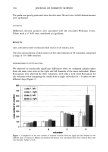
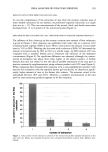
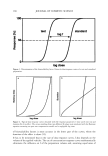
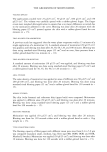
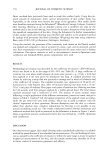
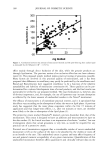
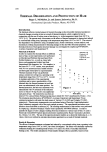
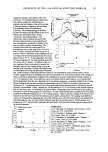
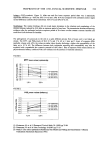
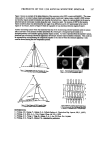
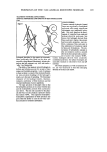
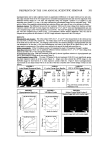
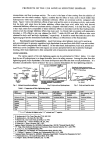
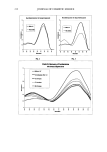
DEPLETION EFFECTS IN TOPICAL PREPARATIONS 167 MEASUREMENT OF MN PENETRATION (INFINITE DOSE) For the penetration study a recently developed glass chamber system was used (11). Briefly, two glass cells were fastened to both upper arms of each subject, allowing the examination of four MN preparations at the same time under occlusion conditions. The glass cells were filled with MN solutions of equal permeant activity, emptied after one-hour time periods, and refilled with the initial MN solutions. The MN concentra- tion of the donor phase samples was measured spectrophotometrically. Because the concentration decrease in each one-hour time interval was •10%, zero-order kinetics were assumed. MN disappearance rates were calculated from the concentration differ- ences between the initial solution and the samples obtained after every hour. CALCULATIONS AND DATA TREATMENT Bioavailability factors fandf3. Using Fick's first law of diffusion, bioavailability factors f may be obtained by calculating the ratios of the first order penetration rate constants of the test vehicles R T and the standard vehicle RST: f RT/RsT (Eq. la) where the penetration rate constant R is defined as follows: R D B ø A' PCB/v/(dB ß V) (Eq. lb) where D B is the diffusion coefficient of the permeant in the barrier stratum corneum, A is the application area, PCB/v is the stratum corneum/vehicle partition coefficient of the permeant, d B is the thickness of the stratum corneum, and V is the volume of the applied preparation. The ratio V/A is an expression of the thickness h of the ointment layer. In the case of penetration rate data, bioavailability factors may be determined as the ratio of the penetration rate constants R obtained with the test vehicles and with the standard vehicle. Penetration rate constants are calculated as the quotient of the steady-state penetration rate and the permeant amount in the vehicle. From the horizontal distance between the parallel portions of the dose-response curves of a standard preparation (ST) and a test preparation (T) at a certain response level Resp%, the bioavailability factor f is determined as follows (Figure 1): log f = log doSeResp%S T - log doSeResp%T (Eq. 2a) f dOSeResp%ST/dOSeResp%T (Eq. 2b) In practice, the shape of the dose-response curves is sigmoidal for the response parameter 1/LT. A plateau is reached as soon as the permeant solubility limit in the vehicle is exceeded (Figure 2a). This plateau may be elevated under the influence of penetration enhancers. With the response parameter D, a sigmoidal shape of the curves cannot be expected because the pharmacodynamic effect will last as long as the amount of dissolved permeant in the vehicle, and thus the penetration rate is high enough, no matter if permeant solutions or suspensions are applied. In addition, the more R decreases, the more pronounced the reservoir function of the applied preparation will become and the higher the gradient of the curve will be, which at a certain dose level even leads to an intersection of the test and the standard curve (Figure 2b). Therefore, the determination
Purchased for the exclusive use of nofirst nolast (unknown)
From: SCC Media Library & Resource Center (library.scconline.org)