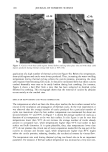
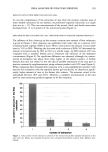
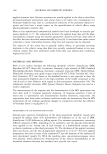
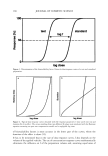
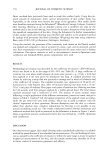
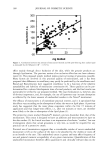
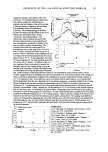
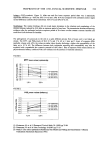
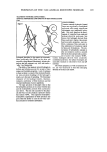
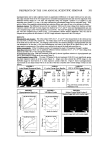
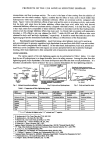
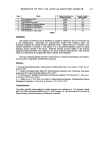
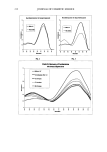
168 JOURNAL OF COSMETIC SCIENCE 100,,, so- tes log f 0 log dose standard Figure 1. Determination of the bioavailability factor f from the dose/response curves of a test and a standard preparation. log dose log dose Figure 2. Typical dose-response curves obtained with the response parameters 1/time until onset (a) and duration (b) of an effect. The curves resulting from. two different R values were simulated with the Bateman equation assuming an open one-compartment model and a negligible lag time. of bioavailability factors is more accurate in the lower part of the curves, where the duration of the effect is short (12). It has to be mentioned that in the case of dose-response curves, f also depends on the volume of the applied vehicles. The use of concentration-response curves mathematically eliminates the influence on f of the preparation volume and, assuming equal areas of

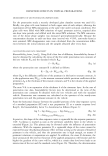
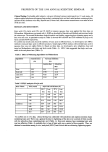
DEPLETION EFFECTS IN TOPICAL PREPARATIONS 169 application for test and standard preparations, also the thickness of the preparation. After elimination of the ointment film thickness, the resulting bioavailability factors are called fh: log fh = log CResp%S T - log CResp%T (Eq. 3a) fh = CResp%ST/CResp%T (Eq. 3b) fh = RT ' hT/(RsT hST) = PBT/PBsT (Eq. 3c) From measurements of the permeant, penetration rate bioavailability factors may there- fore be determined as the ratio of the permeant permeabilities PB = Dn' PCn/v/d n obtained with the test vehicles and the standard vehicle. The permeant permeability PB is calculated as the steady-state permeant penetration rate multiplied by the preparation thickness (=V/A) and divided by the permeant amount in the vehicle. Enhancement factor EF. Enhancement factors may be calculated by dividing the bioavail- ability factors fh by the relative effective activity coefficient •/T/ST (Eq. 4a), which is defined as the ratio of the permeant partition coefficients ST/reference phase and T/ref- erence phase (13). Procedures to determine these partition coefficients have been de- scribed (10,13). EF --- fh/YT/ST = fa (Eq. 4a) In absence of penetration enhancement and permeant depletion, fh equals •T/ST' En- hancement factors EF, which sometimes are called activity-standardized bioavailability factors fa (14), may be calculated from the horizontal distance between activity-response curves, where the relative permeant activity a is the product of the permeant concen- tration in the vehicle and •/T/ST' log EF = log aResp%S T - log aResp%T (Eq. 4b) EF = aResp%ST/aResp%T (Eq. 4c) With activity-response curves, not only the influence of the preparation thickness h but also the influence of the permeant solubility in the vehicle CsB on the bioavailability factor f is mathematically eliminated. Provided that the thickness of the stratum cor- neum is not affected by the ointment bases, enhancement factors are only dependent on the permeant diffusion coefficient DB and the permeant solubility in the barrier CsB and may therefore be written as EF = DB T ß CSBT/(DBsT ' CSBsT ) (Eq. 4d) In the case of the penetration rate data, EF values may also be calculated as the ratio of the steady-state permeant penetration rates from a test vehicle (ssPRaT) and the standard vehicle (ssPRasT) , provided that the permeant activity a is the same in all vehicles and again assuming equal application areas for test and standard preparations. EF = ssPRaT/ssPRasT (Eq. 4e) Equal permeant activities in the vehicles may be obtained if the initial permeant con- centration in the standard vehicle is divided by the 3'T/ST value of the test vehicles. The direct influence of the factors A, V, and csv on the bioavailability factor f may be eliminated by the above-mentioned mathematical procedures. However, it has to be taken into consideration that the contribution of all of these factors to permeant deple- tion cannot be eliminated by these calculations, a fact which may lead to a false
Purchased for the exclusive use of nofirst nolast (unknown)
From: SCC Media Library & Resource Center (library.scconline.org)