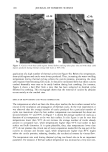
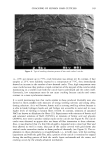
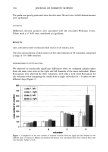
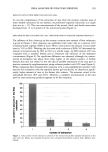
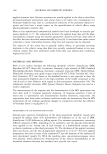
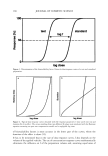
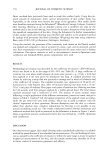
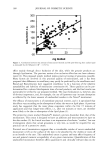
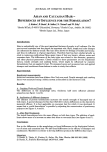
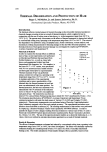
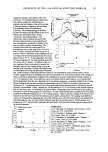
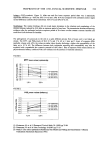
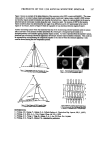
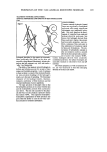
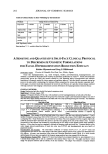
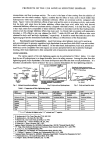
146 JOURNAL OF COSMETIC SCIENCE x2 4k " 3a 3b 3c. x2.4k Figure 3. Magnified views of cracks shown in Figure 2 as follows: 3a after 20 thermal cycles 3b and 3c after 60 thermal cycles. Each cycle consisted of ten seconds of blow-drying at 75øC followed by ten seconds of wetting at 25øC. Number of short longitudinal cuticle cracks per mm of hair 700 (a) Average number of • . -- , 600 - cracksinha, I I L ' 500 - 4OO 3O0 200 - / ' (b) Average number . /•' ofcra•s in controls • '100 - f (SD=2.1) '• 0 5 10 15 20 25 30 35 40 45 50 55 60 Number of applied thermal cycles Figure 4. Variations in the average number of cuticle cracks found in the laboratory as follows: (a) in thermally cycled fibers as the number of thermal cycles increases, and (b) in their corresponding half snippet used as a control (non-exposed to thermal cycles). Each point represents average of cracks found in ten hair samples. Each cycle consisted of ten seconds of blow-drying at 75øC followed by ten seconds of water immersion at 25øC. Error bars represent one standard deviation about the mean. analysis. This observation clearly shows that the cuticle cracks found in hair subjects from the panel arise mainly as a consequence of subjecting hair to thermal stresses during blow-drying. An analysis of the cracks shown in Figures 1, 2, and 3 indicates that their

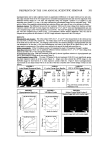
CRACKING OF HUMAN HAIR CUTICLES 147 formation is mainly limited to the outer part of the cuticles. This observation suggests that the stresses involved in crack formation are more intense at those cuticle portions near the outer hair surface. Since blow-drying and wetting involves swelling and deswelling of the hair fiber, the following experiment was carried out in order to test whether the phenomenon of swelling per se plays a role in crack formation. Several solvents with limited swelling capacity were used in the thermal cycling experiments instead of water. The solvents were ethanol, iso-propanol, and methanol these solvents have already been reported in the literature as poor keratin swelling solvents (14-16). The results showed that thermal cycling experiments with these solvents do not lead to crack production at all, indicating that cuticle swelling is a necessary phenomenon for cracks to occur. Increasing both the water-swelling and blow-drying times to periods longer than ten seconds did not have any effect on the number of produced cracks. Also, it was observed that non-swollen hair fibers, which were thermally cycled with water immersion time periods as short as five seconds, underwent cuticle cracking. In such short time periods of water immersion, only the cuticular system and a small portion of the cortex can be expected to swell. These observations indicate that cuticle cracking is not due to a thermal shock arising from rapid changes in cuticle temperature. It seems rather that cuticle cracking occurs because those outer cuticles sections lack elasticity to comply with the dimensional changes either of the swelling cuticle layers underneath or of the swelling cortex. In the case of blow-drying, the lack of elasticity in the outer cuticle sections will originate from rapid cuticle dehydration at high temperatures. Thus, it would appear that when hair is wet or dried at room temperature, all cuticle portions and the cortex contract in a synchronous manner. However, if during a water evaporation process only the outer cuticle sections contract more rapidly than those cuticle layers underneath or than the cortex itself, cracking will occur. Cracking during blow-drying takes place, thus, as a consequence of circumferential extension stresses set up on dry portions of cuticle by the swollen pressure of both the cuticle layers underneath and the cortex itself. It should be mentioned here that circumferential or "hoop" stresses are known to occur in cyclindrical pipes subjected to internal positive high pressures (17). Cracks at lower hair-swelling pressures may also occur if the cuticles lose their natural elasticity due to weathering. This might explain why cuticle vertical cracks are found at lower hair- surface concentrations in people who do not blow-dry their hair. The repetitive action of cuticle "rigidization" and water swelling set up on the outer cuticle sections by the absorption and desorption of water during thermal cycling did not lead immediately to crack formation. For instance, it was found that before the cracks became fully developed, they appeared first as sharp white lines on the cuticle surfaces (see Figure 5a) then, upon further thermal cycling, the white lines turned into full cracks. The appearance of these white lines indicates that before the cuticles crack, the mechanical energy accumulated by the circumferential tension stresses or "hoop stresses," is first dissipated by the formation of localized shear yield regions. This form of mechanical energy dissipation is a very common phenomenon that takes place in polymeric materials before they fracture (18). Increasing the water temperature during thermal cycling to about 50øC resulted in more diffuse and wider shear yield regions that did not turn into cracks even after the
Purchased for the exclusive use of nofirst nolast (unknown)
From: SCC Media Library & Resource Center (library.scconline.org)