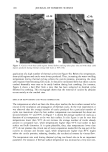
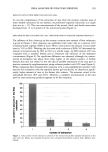
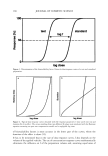
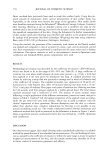
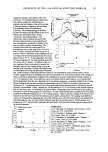
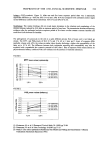
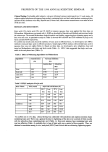
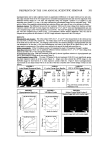
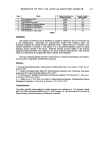
PREPRINTS OF THE 1998 ANNUAL SCIENTIFIC SEMINAR 197 Figure 3 shows an example of the phase behavior of the sunscreen active ODP in water and laureth 4. The evapo- ration paths of an initial 2-phase (water and lameliar liquid crystal) and 3-phase (water, laureth 4-ODP solution and lameliar liquid crystal) formulation are traced by the dashed lines. Again, the various phases can be seen by polarized optical microscopy at paints along the water evaporation path. The location of ODP in the lameIlar liquid crystalline phase was determined by low angle X-ray diffraction and by UV spectroscopy to be in the B region of the bilayer, shown in Figure 4 while the vegetable oil was distributed between regions B and C. Another interesting system which was examined was that of the moisturizing polymer hyaluronic acid (in sodium salt) a and water in the presence of either polysorbate 80, (which gave a hexagonal liquid oTstal) or a phospholipidffatty acid emulsifier (giving lamellar liquid crystals). As water evaporated from the laureth 4 system, polarized light microscopy showed the appearance of lyotropic nematic liquid crystalline structures. This could not be reproduced by mixing/heating the components together in the ratio at which the structure appeared, it only could be formed during the slow evaporation process. o Figure •wp• a•rm orso• o• Po• •0 w• • a•rt=vap•alJmPaihsfcrW/OnndO/W -Enn• ' Figure 3. Ptmse Diagram of ODP, Lmm• 4, Water REFERENCES: Figure 2. Polarized •t Micro•eope • of Points i, 2, 3, 4 of W/O Formulation. Figure ! z 2'//././/. ' 1.) Friberg, S.E., Huan& T., Aikens, P. A., Colloids SurfacesA: Phys•ochem Eng. Aspects, 121, 1, (1977) 2.) Friberg, S. E., Brin, A-J., J. Soc.-Cosmet. Chem., 46, 255, (1995) 3.) Friberg S. E., Yang• J., Yang, I•, Aikens, P. •,J. Ar• Oil Chem. Soc., in press 4.) Friberg, S. E., Yang, tL, Aikens, P.A., submitted for publication

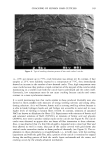
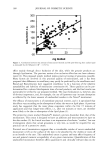
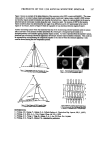
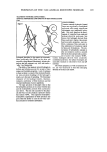
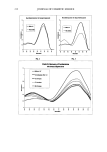
198 JOURNAL OF COSMETIC SCIENCE TRANSIENT NETWORK COPOLYMERS - SURFACE PROPERTIES AND ASPECTS OF SKIN INTERACTIONS Stephen M. Greenberg, Ph.D., Alex L. Vainshelboim, Ph.D., A!ena Lovy and Michael Esposito Lipo Chemicals, Inc., Paterson, NJ and HYMEDIX International, Dayton, NJ INTROIYUCTION Hydrogels are found in almost every aspect of the human experience. They are used in various indus- trial, medical and scientific applications (latex paints, wound care and cultivation media are exam- ples), in foods (think of the Jello you recently ate), and of course, in cosmetics and personal care prod- ucts. This paper will concern itseft with this latter industry that is, the chemistry, characterization and application of a unique and unusual polymeric materials (produced through the controlled base- catalyzed hydrolysis of polyacrylonitrile) 1, in cos- metic and personal care products, particularly as related to the surface modification of skin. Hydrogels can be prepared from either natural polymers such as gelatin or polysaccarides, or from synthetic polymers such as polyacrylic acid or poly- acrylonitrile derivatives. In either group is possible to modify the polymer to literally design the proper- ties of the final hydrogel. This capability has creat- ed a broad variety of polymers (and resultant hydro- gels) that vary just as broadly in their properties. Polymers that can form hydrogels will have the ability to hold water (from low swelling to super- absorbents), to degrade biologically (from none to complete), and may exist as either of the two basic physiochemical categories (thermosetting or ther- moplastic.) For the purposes of this discussion, thermosetting polymers are defined as being cova- lently crosslinked during synthesis, cannot be reshaped once set, and may form permanent net- work hydrogels. Likewise, thermoplastic polymers are defined as not being covalently crosslinked, and form may transient network hydrogel. Additionally, the subject polymer of this paper pro- duces thermoplastic hydrogels that also display non-Newton rheology (thixotropy.) This combina- tion of unusual and unique properties results in hydrogels beneficial for cosmetic and personal care application. I-U.S. Patent Number 4,943,618 PROPERTIES AND APPLICATIONS Through the process of controlled base-cat- alyzed hydrolysis, polyacrylonitrile is transformed into polymers capable of producing hydrogels dis- tinctly different from other natural and synthetic polymers intended for skin care applications. Original technology allows the creation of medium molecular weight polymeric structures that contain about 20% hydrophilic groups segmented within the primarily hydrophobic character of the chain. It is this arrangement of hydrophilic and hydrophobic segments that gives the hydrogels their unique and desirable qualities that is, this arrangement, in the aqueous environment, allows the independent poly- mer molecules to electrostatically interact and form non-covalent, transient bonds. This unique interac- tion allows the creation of matrices that can deform and reform during energy input without destroying the polymer. The result is hydrogels having thixotropic rheology that form thin, uniform and non-tacky films. In addition, the polymer will orient on the skin due to interactions between the hydrophilic skin surface and the hydrophilic moi- eries in the polymer. The result of this orientation is to present to the environment the hydrophobic portions of the molecule, interpreted as 'silky' to the touch. Figure I schematically represents the essential differences in structure between polymers that pro- duce permanent network hydrogels (left) and those that produce transient network hydrogels (right). Hydrogels serve the primary purposes in skin care formulations to improve viscosity and to aid in the delivery of active ingredients. Traditional (ther- toosetting/permanent network) hydrogels suffer from a number of drawbacks in these respects i.e., tackiness, non-uniformity of film thickness, are irreversibly shear-thinned, are sensitive to elec- trolytes and pH extremes, and make little, if any, positive contribution to after-feel. On the other hand, the novel (thermoplastic/transient network)
Purchased for the exclusive use of nofirst nolast (unknown)
From: SCC Media Library & Resource Center (library.scconline.org)