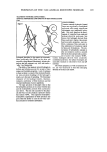
PREPRINTS OF THE 1998 ANNUAL SCIENTIFIC SEMINAR 205 or 5,6 dihydroxyindole-2-carboxylic acid (DIllCA). 5,6 dihydroxyindole and 5,6 dihydroxyindole-2--carboxylic acid are oxidized to indole-5,6-quinones, which is in turn further polymerized to form the less well defined melanochrome and finally eumelanin. Unfortunately for those Who are studying the process ofmelanogenesis, the actual synthesis of melanin is only part of the process. Melanogenesis also involves the development of the melanosomes, the organelle of the melanocyte in which melanin is synthesized, and the subsequent transfer of the melanosomes to keratinocytes. Melanosome development is generally divided into four phases. In phase I melanosomes contain tyrosinase but are clear. In the second phase the melanosome assumes an oblong shape as microtubules and microfilaments begin to expand. In phase II melanin is being formed. Phase III melanosomes are darker with a higher density and begin to migrate toward the dendrites of the melanocytes. In the final phase the melanosomes are opaque and are ready for transfer from the dendrites to keratinocytes. Once melanosomes have been transferred to keratinocytes their fate depends extensively on the race of the subject. In Caucasian subjects melanosomes begin to be hydrolyzed almost immediately upon uptake. The degradation continues until no melanosomes are detected by the time that the keratinocytes have migrated into the stratum corneum. In Black skin melanosomes remain intact in the stratum corneum, indicating that there is little or no enzymatic degradation. Melanosomes in Asian skin do degrade but not at the rate seen in Caucasian skin. To make the subject more interesting all of the aforementioned steps are influenced by environment, genetics, and hormone flux. Haven taken a basic look at the process of melanogenesis, we can now begin to look at ways to prevent or reverse adaptive pigmentation. There are several routes by which we can slow down melanogenesis. Perhaps the best way to slow down melanogenesis is to reduce the amount of UV light that reaches the skin. If people cannot stay out of the sun, they should attempt to regularly use sunscreens. UV radiation not only directly stimulates the generation oftyrosinase mRNA, but it also provokes the synthesis of Vitamin Ds, which activates tyrosinase, and o•-MSH (melanocyte stimulating hormone). As a result of the UV radiation, oxidative stress is generated which in turn generates inflammation. Inflammation, perhaps mediated by cytokines, increases pigmentation. Perhaps the most talked about means of minimizing adaptive pigmentation is reducing tyrosinase activity. This can be accomplished by blocking the production of tyrosinase, inhibiting the enzymatic activity of tyrosinase, or preventing the uptake of tyrosinase by the melanosomes. Lactic acid and placental extracts suppress tyrosinase production at a genetic level. Matehals such as licorice extract, or kojic acid inhibit the enzymatic activity oftyrosinase. Amino sugars such as glucosamine or galactosamine are capable of inhibiting the glycosylation oftyrosinase required for its uptake into melanosomes and subsequent activation. Another approach to reducing the development of pigmentation is to reduce the activity of melanocytes. Melanocyte activity can be reduced through the use of selectively cytotoxic materials such as hydroquinone. Alternatively materials which are o•-MSH antagonists, such as melatonin can be used to prevent the activation of the melanocytes.

206 JOURNAL OF COSMETIC SCIENCE The last common approach is to take advantage of the fact that melanogenesis is an oxidative process. Highly reactive antioxidants such as ascorbic acid can be used to compete with melanin precursors for the oxidative stress available to the system. This approach not only inhibits the production of melanin, but can reduce the amount of melanin already present in the skin. Most commonly used skin-lightening ingredients share a common problem. Most skin- lightening ingredients tend to be unstable in typical cosmetic formulations. Some lighteners such as hydroquinone also demonstrate significant toxicity. In order to maximize the whitening effects while minimizing possible toxicity or formulation incompatibilities it is important to use a multifaceted approach. The first step in optimizing a skin-lightening formulation is to select actives that will cover several routes ofmela-nogenesis. Initially a broad spectrum sunscreen must be selected. While it may take months to alleviate pigmentation, it may only take one day in the sun to regenerate it. UV filters will also help to improve the stability of any photo-labile actives present. Having selected a sunscreen it is now important to apply a combination of tyrosine inhibitors and antioxidants. The question remains. How do you take a cocktail of commonly used skin lightening agents and significantly increase the activity? The answer lies in the field of potentiation. By stimulating cell activity it is clearly possible to influence the pigmentation process. Just as cyclic AMP agonists can accelerate tannihg, materials that increase cell respiration can reduce melanogenesis. Many ingredients such as Sacchromyces ferment extract or Clintonia boreallis extract increase cell respiration. These potentiators do not increase the amount of oxygen available to the cell, but increase the efficiency with which the cell utilizes the oxygen. Increase efficiency in oxygen utilization translates to increased efficiency in other process. Activation of fibroblasts reduces the rate of melanogenesis. Activation of keratinocytes increases the speed at which melanin is eliminated from the skin. Potentiators in conjunction with more traditional approaches to skin lightening offer a revolutionary approach to skin lightening. The future of research for skin lightening should not focus on looking for new specific lightening agents, but at potentiating the natural processes which can inhibit melanogenesis. References 1. G. Prota, Melanins and melanogenesis, Academic Press, London 1992. P. Aroca, K. Urabe,T. Kobayashi, K Tsukamoro, and V. J. Hearing, Melanin biosynthesis patterns following hormonal stimulation, J. Biol Chem 268 (34) 25650 (1993) J. R. Jara, F. Solano, J. C. Garcia-Borron, P. Aroca, J. A. Lozano, Regulation of mammalian melanogenesis. II the role of metal cations. Biochim Biophys Acta 1035: 276-85 (1990) 4. M.T. McEwan, P. G. Parsons, Regulation oftyrosinase expression and activity in human melanoma cells via histamine receptors. J Invest Dermato197:868-73 (1991)
Purchased for the exclusive use of nofirst nolast (unknown)
From: SCC Media Library & Resource Center (library.scconline.org)