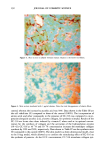
294 JOURNAL OF COSMETIC SCIENCE statistical evaluation. Both in the cheek region and the eye region, there was no sig- nificant difference between the control (base cream) and treated cream (base cream + 3% CC-516) on all the measuring points. From the results, which are represented in Table V as means of five test persons, it can be concluded that after six weeks of treatment with a test sample, a smaller depth of penetration of the skin into the tube, and thus elasticity, increased by 35%. In the case of the control, no modification was observed. Table V shows the anti-wrinkle effect by three-dimensional image analyzing. The average values were used for statistical evalu- ation. We applied 2 mg/cm 2 of a control cream or a cream containing 3% of CC-516 twice a day for six weeks to twenty volunteers. The results obtained from the treated side show significant reductions of roughness (-16.7%) and of the average depth of the cutaneous relief (23%), but the untreated skin (control) shows no significant difference. The study of wrinkle depth using SEM reveals apparent reduction in depth of the wrinkles against untreated skin (Figures 6,7), but the control cream showed no signifi- cant difference between before and after treatments (not shown). CONCLUSIONS The enzyme elastase has received significant attention, primarily because of its reactivity and unspecificity. It is able to attack all major connective tissue matrix proteins, e.g., elastin, collagen, and keratin (43). In contrast to elastase, collagenase is a specific proteinase with a limited number of substrates (44). One major target of cosmetologic research is to find effective elastase inhibitors. Such inhibitors could find their applica- tion in anti-wrinkle, anti-aging creams and more generally in numerous compositions intended for skin care. The object of this natural extract is not only to provide an active ingredient that inhibits elastase enzymatic activities (protective role) but also provides the necessary supplies for cells to maintain an appropriate energetic level and to produce their constituents (repairing role). The cells synthesize, secrete, and deposit the proteins of the extracellular matrix made up by collagens, elastin, fibronectin, etc. These proteins ensure the cell inking at the basal plate in the dermal structure. Protecting the skin, its elasticity is the major theme of cosmetic research. The action of a product can be Table V Anti-Wrinkle Effect on Roughness and on Mean Depth of Wrinkles and Skin Elasticity of Cream Treated With CC-516 Anti-wrinkle effect Elasticity Roughness Mean depth (arbitrary units) (peak depth, pm) ds (mm) Before 32.7 40.5 0.0475 Untreated cream After 28.3 40.0 0.0480 Before 33.4 52.0 0.0575 Treated cream After 28.0 40.0 0.0375 The control is untreated cream before and after six weeks of treatment. Data for skin to which the cream treated with CC-516 has been applied is shown before and after six weeks of treatment. The results obtained on the treated side show significant reduction (-16.7% of roughness and 23% of average depth of wrinkles) compared to before treatment. Skin elasticity increased about 35% compared to before treatment.

ARECA CATECHU L. EXTRACT 295 Accell Vol. ' 12KV ! Magnification ' X 30 Figure 6. The wrinkles of the skin surface before treatment ]mill •" Accell Vol. ' 12KV Magnification ß X 30 . .. Figure 7. The wrinkles of the skin surface after treatment The wrinkles decrease in depth after application of the treated cream (3% CC-516).
Purchased for the exclusive use of nofirst nolast (unknown)
From: SCC Media Library & Resource Center (library.scconline.org)