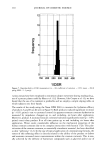
3,3,7-TRIMETHYL-4-OCTEN-1-OLS 301 ether 7 leads to (Z) alcohol 8. The yield of isomerization based on alcohol 3 was 37%. The (Z) configuration of the double bond was confirmed by •H NMR (Jn-4,H-5 = 12.2 Hz) and IR (712 cm-•). 3-Sila analogues of alcohol 3 as well as alcohol 8 were obtained from 4-methyl-1- pentyne. Ethyl silaester 10 was synthesized in a two-step procedure: hydrosilylation of alkyne with dimethylchlorosilane in the presence of hexachloroplatinic acid as a catalyst (12) followed by the Reformatsky reaction of alkenechlorosilane intermediate with ethyl bromopropionate (Scheme 2). Unfortunately, the product mixture isolated from this synthesis (yield 75%) contained, according to GC, 90% of ester 10, 8% of regioisomer 11, and a small amount of the Z isomer of 10. Separation of this mixture by column chromotography on silica gel impregnated with AgNO 3 (4%) afforded pure (above 97%) ester 10. In the last step of synthesis, ester 10 was reduced with lithium aluminum hydride to alcohol 12 in 84% yield. The 3-sila analogue of alcohol 8 was also obtained from 4-methyl-l-pentyne (Scheme 3). Lithium alkyne was silylated at -78øC with vinyl dimethylchlorosilane, and the result- ing vinylsilane 14 (yield 84%) was oxidized with m-chloroperbenzoic acid to epoxide 15 in 81% yield. Then epoxide was reduced with diisobuthylaluminum hydride (DIBAL) to alkynesilanol 16. The application of lithium aluminum hydride for this reduction gave the mixture of products in which the content of alcohol 16 was 30% only. The secondary ot-silenol was obtained as the second main (20%) component in this mixture. Further reduction of alcohol 16 with DIBAL gave the final (Z)-silenol, 17. More effective + • '/ • /C1 H/Sk'c1 Si •. • Si•'"'CO2C2H• 11 •SiOCO2C2H 5 lO • .j d S••O -• 13 a) H 2 PtCI 6 ß b) BrCH 2 CO 2 C 2 I-Is, Zn, THF c) LiA1H 4 ß d) AcC1, Py Scheme 2

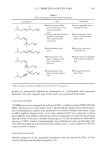
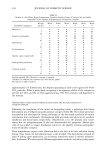
302 JOURNAL OF COSMETIC SCIENCE 18, R = Ac c /Si•oR dE17 ,R=H 19, R Ac a) 1. nBu-Li, Et.20 , _ 78 o C, 2. CISi(CH3)2CH=CH 2 , Et.20 b) MCPBA c) DIBAL d) AcCI, Py Scheme 3 (yield 79%) was the one-step reduction of epoxide 15 with two equivalents of diisobu- tyloaluminum hydride, which led directly to 17. Acetates 4, 9, 13, 18, and 19 were obtained in good yield (60-90%) by esterification of corresponding alcohols 3, 8, 12, 16, and 17 with acetyl chloride in the presence of anhydrous pyridine. The odor characteristics of the compounds obtained are given in Table I. Comparison of the odors of carbon compounds and their silicon analogues indicates that the odors of carbon compounds are more intensive and more fresh than silicon ones. The odors of carbon alcohols can be generally described as fresh-green, whereas sila alcohols are described as floral-fruity or fruity. Acetates, with the exception of 19, are characterized by a fruity or a fruity-floral odor. The comparative olfactory analysis of compounds with different geometry of the double bond shows differences in notes of odors. The most distinctive difference was observed for E and Z isomers of sila acetates (13 and 19). Alcohol with a triple C-C bond is characterized by the most floral odor among the compounds evaluated. EXPERIMENTAL STARTING MATERIALS AND REAGENTS 4-Methyl-l-pentyne (b.p. 61-62øC lit. (13) 61øC) was synthesized from 4-methyl-i-
Purchased for the exclusive use of nofirst nolast (unknown)
From: SCC Media Library & Resource Center (library.scconline.org)