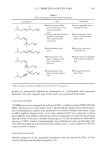
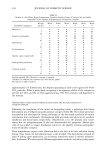
3,3,7-TRIMETHYL-4-OCTEN-1-OLS 303 Table I Odor Descriptions of Compounds Synthesized* Compound - OH - OC(O)CH 3 Medium-intensive, fresh- green, fioral-fruity, with rose and grapefruit notes Intensive, more than E isomer, agreeable, fresh-green, with tomato leaf and citrus notes Weak, agreeable, floral- fruity Medium-intensive, less than C analogue, fresh, fruity, with melon fruit note Weak, agreeable, floral- fruity, with lime flower note Intensive, agreeable, fruity, with apricot note Medium-intensive, fresh, fruity, with desiccated- apricot note Weak, fruity, with wild strawberry note Medium-intensive, agreeable, fresh, balsamic-vegetable note Weak, agreeable, fresh, fruity-fioral * The odor was evaluated for samples that were above 97% (gc) purity. pentene by bromination followed by elimination of 1,2-dibromide with potassium hydroxide. All other reagents used in this work were purchased from Fluka. ANALYTICAL METHODS 1H NMR spectra were measured for solutions (CDC13) on Bruker Avance DRX 300 (300 MHz). IR spectra were determined with a Specord M-80 infrared spectrophotometer. Gas chromatographic analyses were performed on a Hewlett-Packard instrument, using an HP-5 capillary column (30 m x 0.31 mm). Analytical TLC was carried out on silica gel G (Merck) with different developing systems. Compounds were detected by spraying the plates with 7 % H2SO 4 in ethanol containing ca 0.1% of p-anisaldehyde, followed by heating to 120øC. Column chromatography was performed on silica gel (Kieselgel 60, 230-400 mesh, Merck) with petroleum ether-ethyl acetate 7:1 (for alcohols) or 50:1 (for esters) systems as eluents. OLFACTORY EVALUATION Odorous properties of the compounds synthesized were determined by Prof. J. G6ra strictly following the described procedure (14).

304 JOURNAL OF COSMETIC SCIENCE 2, 6-Dimethyl-2-he#te,-4-o/(1). The Grignard reaction of 3-methyl-2-buten- 1 -al (16.8 g, 0.2 mole) with isobutyl magnesium bromide formed from isobutyl bromide (34.2 g, 0.25 mole) and magnesium (6.0 g, 0.25 mole) was carried out in ethyl ether by a method described earlier (2). The crude alcohol 1 was distilled i, vac•o (b.p. 50-51 øC/5 mm Hg) to afford (21.0 g, 75% yield) pure alcohol 3: nD 2ø = 1.4455 (lit. (15) b.p. 74-76øC/12 mm Hg, nD 20 = 1.4410). •H NMR (8): 0.83 (d, J = 6.5 Hz, 6H, -CH(CH3)2) , 1.05-1.42 (m, 3H, -cn2cn(cn3)2), 1.62, (s, 6H, =C(CH3)2), 4.30 (dr, j = 8.3 and 7.3 Hz, 1H, -CH (OH)-). __ Ethyl (E)-3,3,7-trimethyl-4-octe,oate (2). A mixture of alcohol 1 (20.0 g, 0.14 mole), triethyl orthoacetate (180 ml, 1 mole), and 0.3 ml of propionic acid was heated (138- 139øC) with a simultaneous removal of ethanol. Then unreacted orthoacetate was dis- tilled off and the residue was distilled i, vac•o (b.p. 74-76øC/5 mm Hg). In this way 23.2 g (yield 78%) of pure ester 2 was obtained, nD 2ø = 1.4475 •H NMR (8): 0.83 (d, J = 6.6 Hz, 6H, -CH(CH3)2), 1.09 (s, 6H, -C(CH3)2-) 1.21 (t, J = 7.2 Hz, 3H, -OCH2CH3), 1.54 (m 1H, -CH(CH3)2) , 1.81 (t, J = 6.7 Hz, 2H, -CH2CH=CH), 2.23, (s, 2H, -CH2CO2-), 4.07 (q, J = 7.2 Hz, 2H, -OCH2CH3), 5.32 (dr, J = 15.6 and 6.7 Hz, 1H, -CH2CH=CH-) , 5.43 (d, J = 15.6 Hz, -CH2CH=CH-) IR (cm-•): 1736 (s), 1384 (m), 1368 (m), 1136 (s), 976 (s). Anal. Calcd. for C•3H2402: C, 73.53, H, 11.39. Found C, 73.25 H, 11.45. (E)-3,3, 7-Trimethyl-4-octe,-l-ol (3). Reduction of ester 3 (2.2 g, 0.01 mole) with lithium aluminium hydride (0.2 g, 0.006 mole) afforded alcohol 3 in high yield (1.5 g, 89%): b.p. 89-91øC/6 mm Hg nD 2ø = 1.4450 •H NMR (8): 0.84 (d, J = 6.3 Hz, 6H, (CH3)2CH-), 1.01 (s, 6H, -C(CH3)2-), 1.86 (t, J = 6.6 Hz, 2H, -CH2-CH=CH-), 3.64 (t,J = 7 Hz, 2H, -CH2OH) , 5.31 (dt, J = 15.6 and 6.6 Hz, 1H, -CH2CH=CH-), 5.39 (d, J = 15.6 Hz, 1H, -CH2CH=CH-) IR (cm-•): 3320 (s,b), 1364 (m), 1384 (m), 1024 (s), 876 (s). Anal Calcd. for C•H220: C, 77.58 H, 13.12. Found: C, 77.40 H, 13.41. Tetrahy#ro#yra,yl ether of alcohol 3 (5). A mixture of alcohol 3 (11.1 g, 0.065 mole), 3,4-dihydro-2H-pyran (5.7 g, 0.07 mole), and pyridinium p-toluenosulfonate (0.15 g) was stirred for 46 h at room temperature. Then the reaction mixture was diluted with ethyl ether (200 cm3). The ethereal solution was washed with saturated NaHCO3 and water, and dried (MgSO4). The crude product was purified by column chromatography (silica gel, petroleum ether-ethyl acetate, 40:1). Thus 15.3 g (yield 92%) of 5 was obtained: nD 2ø = 1.4530 •H NMR (8): 0.86 (d, J = 6.7 Hz, 6H, -CH(CH3)2) , 1.00 (s, 6H, -C(CH3)2-) , 3.32-3.57 and 3.70-3.86 (m, 4H, -O-CH2-), 4.55 (m, 1H, -O-CH-O), 5.29 (dt, J = 15.6 and 6.5 Hz, 1H, CH2-CH=CH-) 5.36 (d, J = 15.6 Hz, 1H, -CH2-CH=CH-) IR (cm-•): 1384 (s), 1376 (s), 1136 (s), 1080 (s), 1032 (s), 976 (s). Anal. Calcd. for C•6H3oO2: C, 75.52 H, 11.88. Found C, 75.41 H, 11.94. Tetrahydro#yra,yl ether of 3,3, 7-trimethyl-4, 5-e#oxyocta,- 1 -ol (6). m-Chloroperbenzoic acid (4.0 g, 0.023 mole) CH2C12 (25 cm 3) was added dropwise at 0øC to a solution of ether 5 (5.1 g, 0.02 mole) in 30 cm 3 ofCH2C12, and the reaction mixture was warmed to room temperature and stirred for 48 h. Then it was diluted with ethyl ether (200 cm3), washed alternately with saturated solutions of Na2SO 3 and Na2CO3, and dried (MgSO4). A preparative column chromatography of the crude product accorded 4.5 g (84% yield) of pure epox ether 6: no 2ø -- 1.4570 •H NMR (8) 0.89, 0.90, 0.92 and 0.93 (four s 6H, -C(CH3)2-), 0.96 and 0.98 (two d, J = 6.6 Hz, 6H, -CH(CH3)2) , 2.51 (d, J = 2.4 Hz,
Purchased for the exclusive use of nofirst nolast (unknown)
From: SCC Media Library & Resource Center (library.scconline.org)