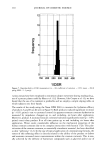
PHOTODEGRADATION OF HUMAN HAIR 311 x 30 .-- 20 --,e,--XENOTEST (88%) • SUNTEST (5%) ...e ß ß ß ß E 10 ''''' '• ,•' ' ½ 0 0 50000 100000 150000 Doses (J/cm 2) Fiõur½ 2. Ch•es i• [•-st•etchJ• j•dex o[ pigmented h•J• exposed •t two EH levels (8). parallel to one another on plastic frames using double-sided tape. The mounted speci- mens were exposed to simulated solar radiation in the Atlas weatherometer at RH levels of 10, 20, 30, 50, and 70% for 100, 200, and 300 hours at 50øC. The Atlas weatherometer uses a Xenon arc lamp to simulate the solar spectrum. Boro- silicate filters were used to provide an "average" 45 ø Miami sunlight. The energy density at 340 nm was maintained at 0.3 W/m 2, resulting in a total energy density of 41.27 mW/cm 2. It should be noted that only about 10% of this energy was in the UV region and that the remaining energy was in the visible region of the solar spectrum. Automatic controllers maintained set temperature and humidity levels in the chamber (11). TESTING Three tests were employed to assess photodamage: 1. The difference in tensile properties between untreated and weathered hair was mea- sured with the fibers totally immersed in deionized water. 2. Swelling tests were conducted on hair weathered for 300 hours, with an eye towards assessing changes in crosslink density as a function of RH during weathering. 3. The Fourier transform infrared/attenuated total reflection (FTIR/ATR) technique was used to assess surface damage of hair weathered for 300 hours at various RH levels. TENSILE TESTS A laser-scan micrometer supplied by Diastron Ltd., UK (Mitutoyo, model LS 3100) was used to measure the fiber cross-sectional area. The instrument employs a 1.0 mW 670- nm wavelength laser. The sample is placed in air, obstructing the laser beam, and rotated slowly by a motor. The resultant shadow falls on a sensor. The micrometer assimilates the data from the sensor and continuously measures the fiber diameter. The instrument has a precision of about 5 pm. The included LSMVB software analyzes the data from the micrometer, and identifies the minor and major axes of the fiber. From this data, the

312 JOURNAL OF COSMETIC SCIENCE cross-sectional area is calculated assuming an elliptical cross section. The micrometer was calibrated using standard calibration wires of known cross-sectional area (12). Test specimens for the laser-scan micrometer were prepared using a metal-tube sample- mounting system. This system uses a pair of hollow brass tubes with plastic sheaths on the inside and a stamping press (stock no. RS622-032) to crimp the fiber ends in the holders. The tubes are 1.4-cm long with an inner diameter of 0.1 cm and an outer diameter of 0.2 cm. The base of the press is a stainless steel template with a gauge length of 3.0 cm. The hair was threaded through two tubes, and the assembly was placed on the template. When crimped by mechanical pressure, a hair fiber is held securely by the crimped tubes. After measuring the cross-sectional area, the samples were directly transferred to the tensile tester. Tensile tests were conducted in deionized water using a Diastron © miniature tensile tester. The miniature tensile tester autosampler, MTT 600 series, from Diastron Ltd., UK, has a sample holder with a capacity of one hundred (100) specimens. Each specimen can be wetted i, sit•. The degree of deformation and the rate of extension were preset. Data from each specimen were collected and transferred automatically to a personal computer using the MTTWIN software included with the instrument. The software was also used to calculate the tensile properties of the fibers (13). Forty fibers per sample were tested, a number that earlier work has shown to be statistically acceptable (7). The sample length was 30 mm. The strain rate was 40%/min, that is, a crosshead speed of 12 mm/min was used. Samples were soaked for at least ten minutes to ensure complete wetting and saturation prior to tensile testing. SWELLING TEST Swelling was measured by determining the change in hair diameter in a 0.1 N solution of sodium hydroxide at room temperature (9). The "diameter" both dry and after swelling was measured using a Bausch & Lomb microscope fitted with a Digital Filar © eyepiece connected to a Microcode © meter from Boeckler Instruments. Hair fibers weathered for 300 hours at different humidity levels were tested. FTIR/ATR ANALYSIS The IR spectra of hair fibers exposed for 300 hours at different humidity levels were compared. IR spectra were obtained using a UMA 500 FTIR microscope from Bio-Rad. Samples were pressed between two optically matched diamond surfaces. The ATR (attenuated total reflectance) technique, with a depth of penetration of about 5 pm in hair, was employed. The ATR technique involves bringing the fiber in contact with a germanium crystal designed for total internal reflection of the incident radiation. The reflected beam is altered by absorption by the sample surface in contact with the reflecting medium, and this alteration or attenuation is analyzed. Transmission spectroscopy was not used be- cause the variation in hair sample diameter resulted in spectra unsuitable for comparison (•4).
Purchased for the exclusive use of nofirst nolast (unknown)
From: SCC Media Library & Resource Center (library.scconline.org)