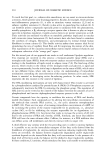
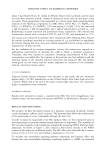
DSC ANALYSIS OF HAIR IN WATER 227 Plotting all individual values of AH D vs T o for the perm-waved samples, as realized in Figure 6, shows a heuristic, exponential relationship. The decrease in enthalpy occurs much faster than that of the peak temperature. In view of the morphological interpretation of the parameters, it can be concluded that perm-waving damage is much more pronounced in the helical segments of the inter- mediate filaments than in the surrounding, highly sulfur cross-linked matrix. Perm- waving greatly reduces the amount of native, u-helical material in hair. Leroy et al. (13) in their DSC studies on dry hair also found the progressive decrease of the peak area through perming. This is in agreement with 13C CP/MAS NMR studies by Nishikawa et al. (17), showing a decrease in the amount of u-helical material in Asian hair through perm-waving. Similar effects have been observed by Ogawa et al. (18), upon submitting hair to strong heat/reduction conditions. In contrast to our results, however, Leroy et al. (13), when testing dry hair, found no change in the peak temperature. This shows the overriding importance of hydrogen bonds in the dry state. Once these are broken through the presence of water, the effects of perming on the disulfide bonds can be detected by thermal analysis. Calculating HXre I on the basis of AH o = 14.9 J/g for the bleached material (bleach) and plotting the results as ln(HXre l) vs time as well as against the number of treatments, yields in the 3D-plot of Figure 7 a well-defined plane (r -- 0.89), which supports the assumption of additive first-order kinetics in both parameters. 1,0 0,fi 0,0 .0,fi .1,0 .1 ,fi .2, 0 .2, fi .3, 0 z = 0,37 -0.408x-0.01 ly r= 0.89 Figure 7. Plot ofln(HXre ) vs time (y) and number (x) ofperm-waving treatments. Based on the assumption of first-order kinetics for both parameters, a plane, for which the equation is given, is fitted through the data.

228 JOURNAL OF COSMETIC SCIENCE From the slopes of the plane in both directions, the related rate constants for the reactions (95% confidence limits) were determined: k t = 0.011 + 0.0164 min -• (1.83 + 2.73 * 10 -4 S -1) and k, = 0.408 + 0.0896 CONCLUSIONS DSC analysis of human hair in water yields results for the denaturation temperature T o and the related enthalpy AH o. The enthalpy depends on the structural integrity of the or-helical material in the intermediate filaments (IF), while T o is kinetically controlled by the cross-link density of the matrix (IFAPs) in which the IFs are embedded. Against the background of this view, a detailed description and interpretation of the changes, or rather the structural damage bleaching and permanent waving impart to human hair, can be given, including kinetic considerations. REFERENCES (2) (3) (4) (5) (6) (7) (8) (9) (10) (11) (12) (13) (1.4) (15) (16) (17) (18) R. D. B. Fraser, Keratins: Their Composition, Structure, and Biosynthesis, (C. C. Thomas, Springfield, IL, 1982). M. Feughelman, Mechanical Properties and Structure of Alpha-Keratin Fibres (UNSW Press, Sydney, 1997), pp. 28-59. M. Feughelman, A two-phase structure for keratin fibers, Text. Res. J., 29, 223-228 (1959). H. Zahn, F.-J. Wortmann, G. Wortmann, and R. Hoffman, "Wool," in Ullmann's Encyclopedia of Industrial Chemistry (VCH Verlagsges, Weinheim, 1996), Vol. A28, pp. 395-421. F.-J. Wortmann and I. Souren, Extensional properties of human hair and permanent waving, J. Soc. Cosmet. Chem., 38, 125-140 (1987). G. Ebert, Anwendungsm/Sglichkeiten der Differentialkalorimetrie zur Untersuchung von Keratin- fasern, Melliand Textilber., 48, 87-90 (1967). A. R. Haly and J. W. Snaith, Differential thermal analysis of wool--The phase transition endotherm under various conditions, Text. Res. J., 37, 898-907 (1967). J. S. Crighton and E. S. Hole, A study of wool in aqueous media by high pressure differential thermal analysis, Proc. 7th Int. Wool Text. Res. Conf, Tokyo, I, 283-292 (1985). F.-J. Wortmann and H. Deutz, Characterizing keratins using high-pressure differential scanning calorimetry (HPDSC),J. AppL Polym. Sci, 48, 137-150 (1993). F.-J. Wortmann and H. Deutz, Thermal analysis of ortho- and para-cortical ceils isolated from wool fibers,J. Appl. Polym. Sci., 68, 1991-1995 (1998). H. Schmidt and F.-J. Wortmann, High pressure differential scanning calorimetry and wet bundle tensile strength of weathered wool, Text. Res. J., 64, 690-695 (1994). M. Spei and R. Holzem, Thermoanalytical investigations of extended and annealed keratins, Colloid Polym. Sci., 265, 965-970 (1987). F. Leroy, A. Franbourg, and J. L. L6v&que, Thermoanalytical investigations of reduced hair, 8th lnt. Hair-Science Symp. German Wool Res. Inst., Kiel (1992). J. F/Shles, K. J/Srissen, and M. Spei, Aminos•iureanalysen von thermisch behandelten Faserkeratinen im Zusammenhang mir R/Sntgenstrukturuntersuchungen, Proc. 6th Int. Wool Text. Res. Conf, Pretoria, II, 159-172 (1980). J. Cao, Origin of the bimodal "melting" endotherm of alpha-form crystallites in wool keratin,J. Appl. Polym. Sci., 63, 411-415 (1997). A. Franbourg, F. Leroy, J. L. L•v•que, and J. Doucet, Synchroton light: A powerful tool for the analysis of human hair damage, iOth Int. Hair-Science Symp. German Wool Res. Inst., Rostock (1996). N. Nishikawa, Y. Tanizawa, S. Tanaka, Y. Horiguchi, and T. Sakura, Structural change of keratin protein in human hair by permanent waving treatment, Polymer, 39, 3835-3840 (1998). S. Ogawa, K. Fujii, K. Kaneyama, K. Arai, and K. Joko, A curing method for permanent hair straightening using thioglycolic and dithioglycolic acids, J. Cosmet. Sci., 51,379-399 (2000).
Purchased for the exclusive use of nofirst nolast (unknown)
From: SCC Media Library & Resource Center (library.scconline.org)