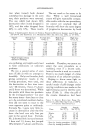
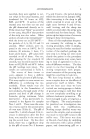
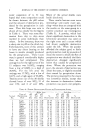
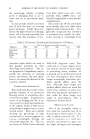
ANTIPERSPIRANTS 5 recorded, they were applied to cot- ton strips in the usual manner, and incubated for 24 hours at 85% R.H. and 80øF. A section of the treated area was then cut out and the pH determined directly on it. If the cream had "bled," as occurred in two cases, the pH of that portion of the strip was also taken. Other sections of each strip were pressed-- with the ironer set at 275-295øF. -- for periods of 5, 8, 10, 12 and 15 seconds. Other sections were ex- posed in the oven at 100øC. for 15 minutes, 30 minutes, 1 hour, '11/2 hours and 2 hours. pH values were recorded on all of them. One set, after pressing for the standard 10 seconds, was reconditioned for three hours at 85% R.H. and 80øF. before the pH readings were taken. The results are summarized in Table 3. The source of heat--ironer or oven--appears to have a definite bearing on the picture of pH change. This may explain to some extent our difficulties in correlating the two methods. These results may also be helpful, in the formulation of new products, through study of the pattern and level of pH change in formulas giving minimum fabric destruction. I was particularly in- terested in the figures for samples Nos. 1 and 2. These were the same two creams used in the second series of oven tests (Table 2). The pH of cream No. 1, which showed little in- crease in destruction after the first hour, rose steadily in the oven dur- ing the second hour. On the other hand, there was a significant drop in the pH of cream No. 2 between 11/2 and 2 hours--the period during which the destruction jumped 10%. Also interesting is the drop in pH which occurred in seven out of the eight cases between 8 and 10 sec- onds' ironing, and the sharp rise which occurred when the strips were reconditioned for three hours. This points up the importance of accurate timing in these investigations. Since all this emphasizes the pres- ent necessity for sticking to the ironing procedure, while .re-empha- sizing the need for further standard- ization of the method, perhaps the next step is to bring out even more clearly the points in the procedure where inaccuracies may occur, lead- ing to lack of agreement in the re- suits of different workers. The idea occurs to me that lowering of the ironing temperature with propor- tional extension of the pressing time might be something to look into. We have long wanted to collect more complete data on the effects of perspiration itself on fabric. This has not been easy since we have trained our testing groups to habits of good grooming so well that they are now completely unwilling to go without deodorant protection. We have managed to get, at long last, a set of figures. The usual procedure for practical use investigation was used, with two modifications. Nothing except distilled water was used on the armpits, and an attempt was made to record pH values in the axillar area. This latter was done at the end of each day, by swabbing the underarms with a piece of filter paper, and determining pH on a

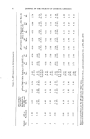
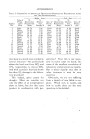
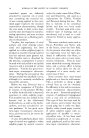
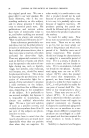
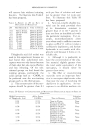
6 JOURNAL OF THE SOCIETY OF COSMETIC CHEMISTS water suspension of it. It was hoped that some comparison could be drawn between the pH values and the amount of destruction pro- duced by the perspiration in each case. That this hope was vain is shown all too clearly by the figures in Table 4. There was some fluc- tuation from day to day--mor. e marked in some individuals than others. In five instances, there was a sharp rise in pH on the third day. Unfortunately , none of this seemed to have any direct bearing on the losses in tensile strength produced by the perspiration. These losses were in general considerably higher than We had anticipated. Th• average loss for the right arms of the 15 subjects was 16.52%, ranging from a low of 0.66% to a high of 26.80%. F6r the left arms the average was 17.79%, with a low of 9.37% and a high again of 28.60%. Twenty-seven out of the 30 shields showed losses of over 10%, 21 of over 15% and 8 of over 20%. Many of the actual shields were badly discolored. These results become even more interesting--and vastly more puz- zling-when they are compared with the results on the same group in a routine practical use investigation (Table 5). A powder, which had shown significant destruction in the laboratory procedure was used on the right arms and a cream which had shown negligible destruction under the left. When the powder afforded the subject good to fairly good protection (and by protection I mean the extent to which the flow of perspiration was checked) the fabric destruction dropped significantly below that caused by perspiration alone. Where the protection was poor, the amount of destruction was about the same, or slightly exceeded that caused by perspiration alone. The picture presented by the cream was somewhat similar, except that the increase in destruction (where protection was poor) over perspira- TABLE 4--FABRIC DESTRUCTION CAUSED BY PERSPIRATION ALONE Type of Su: ject Perspiration No. Flow ..... Right Arm • Left Arm-- pH pH pH pH pH pH 1 st 2nd 3rd % I st 2nd 3rd D•y Day Day Destruction Day Day Day Destruction 1 Light 5.21 5.98 2 Heavy 5.14 5.88 3 Normal 4.95 6.12 4 Slight 5.72 5.67 5 Normal 5.31 5.61 6 Slight 5.28 6.28 7 Heavy 5.36 5.71 8 Slight 6.45 5.46 9 Normal 5.52 5.61 10 Normal 6,98 5.95 11 Normal 5.98 5.72 12 Heavy 6.04 6.02 13 Normal 5.91 5.56 14 Normal 6.11 6.61 15 Normal 5.78 5.46 5 5 5 5 5 5 5 52 5 69 5 38 7 76 7 41 8 11 7 88 5 82 7 90 28 32 81 81 42 62 20.74 25.06 14.60 13.73 24.19 21,57 7.63 19 38 16.34 11.12 0.66 19.38 16.34 26.80 10.25 6.11 5.82 5.62 5 30 6.29 5.51 5,02 5.48 5 41 5.28 5.31 5 88 5.89 5,60 6 62 5.21 6.18 5 41 5.42 5.41 5 31 5 91 5.52 5 66 5 02 5.58 5 51 6 52 5.52 7.22 5 71' 5.41 7.58 5 98 5.46 7.42 5 72 5.36 6.95 5 62 5.72 5.52 5 48 5.52 8.31 18.96 18'. 96 16.34 19.38 18.96 17.21 18.08 11.12 26.80 14.60 9.37 24.18 19.38 17.21 16.34
Purchased for the exclusive use of nofirst nolast (unknown)
From: SCC Media Library & Resource Center (library.scconline.org)