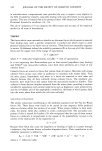
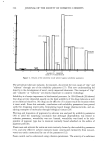
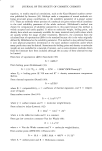
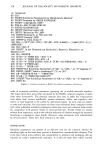
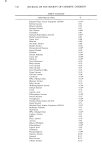
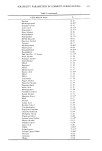
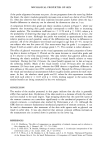
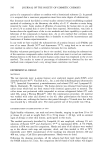
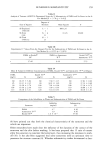
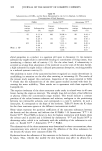
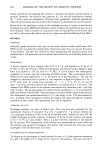
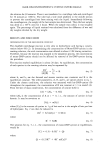
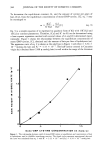
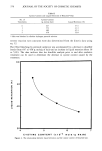
328 JOURNAL OF THE SOCIETY OF COSMETIC CHEMISTS 10 'Solparam 20 CLS 30 PRIET"Solubility Parameters by Hildebrand's Method" 40 PRINT"Program by CHRIS VAUGHAN" 50 PRINT" copyrighted 1985" 60 FOR X= 220 TO 880 STEP 20 70 SOLTND X,2:NEXT:CLS 80 INPUT"chemical name" C$ 90 INPUT "Molecular Wt." MW 100 INPUT"Boiling Pt. at 760 mm" BP 110 INPUT"Density" DEN 120 INPUT"at what temp" T 130 S0L = ((23.7'(BP + 273) +.02*(BP + 273)^2-2950)-(1.986'(273+ T)))/ (MW/DEN) 140 SOL= SOL^.5 150 PRINT" Is the Chemical an Alcohol(a), Ester(e), Ketone(k), or Neither(n)?" 160 IS= INKEY$ 170 180 190 200 210 220 230 240 250 260 270 IF IS = "a" TI-IEN SOL = SOL + 1.4 IF IS = "e" TI-IEN SOL = SOL + .6 IF IS ="k" TI-IEN SOLTND 1000,4: IF BPm100 TI-IEN SOL=SOL+.5 IF IS = "n"TI-IEN 220 IF IS ="" TI-IEN 160 PRINT"The Solubility Parameter of:" C$ "is " SOL "at " T "Degrees C." PRINT: PRIET,"want a hardcopy?? (Y) or (N)" AS = INKEY$:IF AS ="" TI-IEN 240 IF AS = "y" TI-IEN 260 ELSE 270 LPRINT "The Solubility Parameter of:" C$ " is " SOL " at " T "Degrees C." GOT0 80 Figure 4. Computer program in BASIC for solubility parameter calculations. order of increasing solubility parameter, grouping the co-soluble materials together. The values listed here were either calculated by the BASIC computer program or taken from other literature(*). The physical constant data used to make the computations were taken from various handbooks, journal references, tables, and supplier's data sheets, or were supplied to the author by individual request. As such, they are subject to error and variation. For this reason we have cross referenced these computed results with other published solubility parameters where they exist and evaluated these results for compliance with general trends of structure/function. Several trends are readily evident from inspection, such as the uniform reduction of cohesive strength by increased branching or progressive chain length. However, some exceptions were substantiated by several sources. These have been retained in the table. CONCLUSION Solubility parameters can operate as an effective tool for the cosmetic chemist by shedding light on the most basic process in formulation, intermolecular cohesion. This is the force which gives stability and compatibility to products and packaging that are required by today's sophisticated consumer. It is also the same force which controls

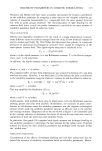
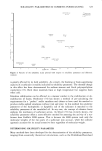
SOLUBILITY PARAMETERS IN COSMETIC FORMULATING 329 Table I Solubility Parameters of Some Cosmetic Materials CTFA Material Name Propellant 13 2.59* Methane 4.70* Cyclomethicone D5 5.77 Dimethicone 5.92* Cyclomethicone D4 5.99 Squalane 6.03 Propellant 12 6.11' Hexamethyldisiloxane 6.15 Squalene 6.19 Propane 6.21' Propellant 22 6.23 Neopentane 6.38 Isopentane 6.82 Pristane 6.85 C8-Isoparaffin 6.93 White Mineral Oil 7.09* Sperm Oil 7.09* Pentane 7.10' Hexane 7.28 Linseed Oil 7.29* Petrolatum 7.33* Behenic Acid 7.35 Diethyl ether 7.37 Heptane 7.41 Octyl Palmitate 7.44 Propellant 11 7.49 Erucic Acid 7.57 Octane 7.58 Decane 7.62 C12-15 Alcohols Benzoate 7.63 Isobutyl Stearate 7.65 Butyl Stearate 7.68 Stearic Acid 7.74 Dioctyl Maleate 7.75 Isopropyl Palmirate 7.78 Oleth-3 7.83* Linolenic Acid 7.86 Olive Oil 7.87* Palmitic Acid 7.89 Oleic Acid 7.91 PEG-4 Stearate 7.92* Isopropyl Myristate 8.02 Turpentine (pinerie) 8.03 Methyl Oleate 8.05 Cetyl Acetate 8.06 Isostearic Acid 8.09 Myristic Acid 8.10 Melissy! Alcohol 8.22 Glyceryl Stearate (mono) 8.31' Lauric Acid 8.46 Diisopropyl Adipate 8.46 Polyethylene 8.50* Diisopropyl Amine 8.51'
Purchased for the exclusive use of nofirst nolast (unknown)
From: SCC Media Library & Resource Center (library.scconline.org)