326 JOURNAL OF THE SOCIETY OF COSMETIC CHEMISTS equation, to totally empirical correlations, such as the Kauri-Butanol number conver- sion published by Sevestre (36). Siddiqui made a comparison of several methods uti- lizing structural group contributions to the solubility parameter of n-propyl acetate (37). These are methods where portions of a molecule are given values which contribute to the total solubility parameter of the whole molecule. Hildebrand's method was chosen for computation of solubility parameters in this paper because this method is widely accepted and easily applied. It relies on molecular weight, boiling point, and density data which are commonly available for many materials and yields values which are usually within the range of other treatments. Moreover, the conversion from the calculated heat of vaporization (AHv) is the standard because this is the value originally defined by Hildebrand as the solubility parameter. This method is also preferred because it uses physical properties determined at the same ambient conditions under which many predictions may be desired. Sometimes the boiling point and density or molecular weight are not available for a material of interest, and so some alternate methods drawn from the literature have been included although the accuracy of these alternatives may be limited. From heat of vaporization (AHv) (Scatchard) (38): 8 = (AHv) •/2 From boiling point (Hildebrand) (39): 8 = [23.7T•3 + .02T• 2 - 2950 - 1.986Kø/(MW/Density)] 1/2 where T•3 = boiling point @ 760 mm and K ø = density measurement temperature Kelvin. From thermal expansion (Burrell) (40): 8 = (aT/B) •/2 where B = compressibility, a = coefficient of thermal expansion, and T = temper- ature of liquid. From surface tension (Lee) (41): 8 = 4.1 (•t/V•/•) 0'43 where •/ = surface tension and V = molecular weight/density. From refractive index (Lawson): (42) • = [C(n 2 - 1)/(n 2 + 2)]•/2 where n is the refractive index and C is a constant. From gas law correction constants (Van der Waals) (40): 8 = 1.2 al/2/V where a = Van der Waals constant and V = molecular weight/density. From aniline point-ASTM D611 (Francis) (43): 8 = 10.6 - [(4R/1.8)(A + 460/V + 91.1)] •/2 where A = aniline point and R = Boltzmann constant.

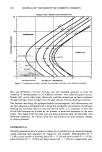
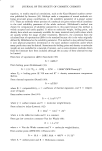
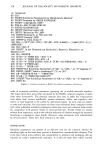
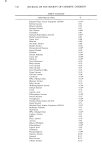
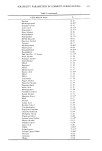
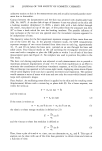
SOLUBILITY PARAMETERS IN COSMETIC FORMULATING 327 From Kauri-Butanol point (KB)-ASTM D1133 (Sevestre) (36): 8 = .O2 KB + 7.O for KB 35. From GLC activity coefficients (Alessi) (13): lnX = V/RT[(SDS - 8D) 2 + (1 - 2m)(Sps -- 8p) 2] q- [(lnV/Vs + (1 - V/Vs)] where X = activity coefficient, m = structural constant, and S indicates solvent. From HLB (Beerbower) (33): 8 = [118/(54 - HLB)] + 6.0 CALCULATIONS AND TABLES In the past, solubility parameters have not been commonly used in the cosmetics and toiletries industry for reasons of expedience. Using solubility parameters is a compar- ative technique. Ideally, when one would like to know the solubility or compatibility of two materials, one most easily compares their solubility parameters. A difference of 2.0 usually indicates mutual solubility, although polar forces and hydrogen bonding are known to greatly affect this span. A mathematical model has recently been published by Kamlet and Taft (44) which uses the solubility parameter combined with measures of polarity and hydrogen bonding as was graphically demonstrated herein. They call their approach "solvatochromic" and achieve excellent predictive results however, their method requires prior determination of solubility parameter, polarity, and strength of hydrogen bonding. This is admittedly a severe limitation. A practical approach is to make an estimate of solubility based on inspection of a table of solubility parameters or to use such a table to help determine appropriate solvents to use in a limited solubility study. This approach, made with an awareness of polar and hydrogen-bonding groups, can be expected to yield results more accurate and more rapid than the predominant rule-of-thumb, "Like dissolves like." In the past, the rule-of-thumb has predominated as a matter of practicality. Neither was a body of solubility parameter values for cosmetic materials available nor was there an easy method for determining the solubility param- eter from easily determined or readily available physical constants. Our work with solubility parameters addresses both the above needs. Below is a listing of a computer program which will operate on the IBM PC or the Apple Macintosh with Microsoft Basic or on the Radio Shack Color Computer. It will determine the total solubility parameter of any chemical material based on boiling point, molecular weight, and density at a given temperature. It uses Hildebrand's method, including the empirical adjustments for ketones, aldehydes, and alcohols. This is the most common method used in the literature. Boiling points must be converted from reduced pressure values to 760 mm before calculating. A convenient nomogram for this purpose may be found in many handbooks or you may consult the original reference (45). The computer program is written in BASIC. SOLUBILITY PARAMETERS OF COSMETIC MATERIALS The need for a body of calculated solubility parameters of cosmetic materials is addressed here. The following table of cosmetic chemicals is listed by CTFA nomenclature in
Purchased for the exclusive use of nofirst nolast (unknown)
From: SCC Media Library & Resource Center (library.scconline.org)