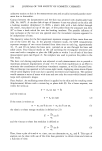
320 JOURNAL OF THE SOCIETY OF COSMETIC CHEMISTS in microelectronic computational costs provided the way to impart a new impetus to the field of solubility research, especially dealing with non-electrolytes in non-aqueous systems. This area of research has so far produced three 1985 American Chemical Society Divisional Awards for excellence (14-16). The use of computers (17) can improve the effectiveness and accuracy of the empirical method in all areas of formulation. THEORY The forces which cause materials to dissolve are the same forces which prevent a material from boiling away until a specific temperature is reached and which result in other physical characteristics we know such as viscosity. These forces are essentially magnetic in nature. Hildebrand defined the solubility parameter (8) as the sum of all the cohesive forces and the square root of the energy of vaporization. 8 = (AEv/V)V2 where V = molecular weight/density and AEv = heat of vaporization. It is not surprising that fluorocarbons give us both aerosol propellants (easy boiling) and Teflon © type (non-stick) surfaces, since both these attributes are a result of low cohesive forces. Cohesive forces are attractive forces that radiate from all matter. Materials with strong cohesive forces attract each other in preference to materials with weaker fields. Thus the salts, gums, humectants, and water in a lotion are attracted to each other and dissolve because they all have similarly strong cohesive forces. The emollient oils, however, have weak forces and cannot make the associations needed to dissolve. They coalesce to form discrete droplets separated from the water phase, providing a medium suitable for ingredients with similar weak forces such as fragrances, some preservatives, and the oil-soluble tails of the amphiphilic emulsifiers, the heads of which project back into the water phase from which the oils were excluded. NON-POLAR ATTRACTIONS The atomic attractions contributing to the solubility parameter are the Van der Waals forces (18). These forces were found to be caused by tiny magnetic fields produced when an electron orbits the nucleus of an atom. When atoms combine to form mole- cules, the atomic fields also combine to yield a molecular field. The non-polar com- ponent of this is named for London (19) who recognized that the sum of these atomic forces in a molecule is proportional to the square of the polarizability (a) and to the inverse of the sixth power of the separation (r). U = a2/r 6 Because these fields also cause the dispersion or bending of light as it passes through a substance, they became known as London dispersion forces. Their contribution to the solubility parameter is defined as: 8r) = 2.24 + 53X - 58X 2 + 22X 3 and X = (n 2 - 1)(n 2 + 2) where n = refractive index.

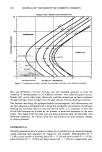
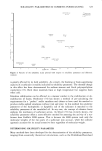
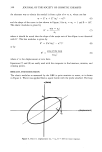
SOLUBILI•7¾ PARAMETERS IN COSMETIC FORMULATING 321 Prausnitz and Blanks (20) have more accurately determined the London contribution to the solubility parameter by assigning a value equal to the complete solubility pa- rameter of non-polar homomorphs (i.e. compounds with the same general structure but with no polar groups attached). The electrodynamics of light bending by the cohesive field forces is still too poorly understood to provide an accurate measure of solubility parameter based on refractive index. POLAR ATTRACTIONS Polarity was originally considered to be the result of a single phenomenon however, many different causes for polarity emerged from the study of how materials respond to electric charges and fields. By 1930 Debye had discovered that polarity in a molecule produced an additional electromagnetic attractive force caused by elongation of the more spheric London field. This dipole-dipole attraction is calculated to be: U• = - 2/3(u4/r6)(1/kT) where u is the dipole moment, k is the Boltzmann constant, T is the Kelvin temper- ature, and r is the separation. In addition, the dipole moment induces a polarization in its neighbors: Ui = - 2au2/r 6 where a, u, and r = as before. The combined effect of these field deformations was analyzed by Keesom (21) and they now bear his name. However, it was Boettcher (22) who defined the polar contribution to the solubility parameter using the dielectric constant (e) and the refractive index (n): •p = [12108(e - 1)(n 2 q- 2)u2/V2(2e q- n2)] •/2 where u and V = as before. This was simplified by Beerbower (23) to: 8p = 18.3u/(V)V2 where u and V = as before. Unfortunately, both methods have areas of imprecision, with the Beerbower equation showing greater precision with alcohols. Nonetheless, the inclusion of polar contri- butions in calculations using the solubility parameter was the singular technological advance which made the solubility parameter become an effective tool in the polymer and coatings industry. Diagrams such as the one shown in Figure 1 are commonly used in the coatings industry to determine the choice of solvent for any particular resin by comparison of both the polar and total solubility forces. In particular, this graph (24) compares both dipole moment and hydrogen bonding to the solubility parameter to determine the best solvents for the subject resin. Potential solvents are located by their solubility parameter and hydrogen bond strength within the "soluble area." ASSOCIATIVE ATTRACTIONS Consideration of the effects of hydrogen bonding and acid-base interactions has im- proved the accuracy of solubility estimations based on solubility parameters. Martin,
Purchased for the exclusive use of nofirst nolast (unknown)
From: SCC Media Library & Resource Center (library.scconline.org)