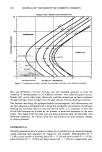
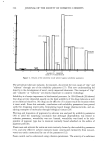
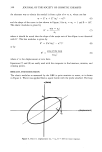
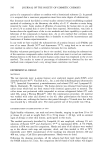
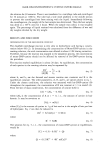
322 JOURNAL OF THE SOCIETY OF COSMETIC CHEMISTS 4O 3O z o z • 20 o 10 Carbopol Resin - Dodecyl Amine Solubility Curve 5 10 15 20 25 rim-dipole moment SOLUBILITY PARAMETER Figure 1. Comparison of dipole moment and hydrogen bonding to the solubility parameter. Wu, and Beerbower (25) have recently used this expanded approach to study the solubility of methylparaben in 35 different solvents, with relatively good success. Kamlet (26), on the other hand, claims that acid-base interactions are better explained through hydrogen bond strength than through classical electron-donating potentials. The formula describing the hydrogen-bonded electromagnetic field deformations has not been adequately developed from a theoretical standpoint, and estimates of hydrogen bonding are commonly based on infra-red spectral shifts. It is important to note that all the field formulas are divided by the distance of molecular separation to the sixth power. This makes both the polar and non-polar attractions drop off drastically with molecular separation. As a result, both heat and dilution can cause dramatic changes in solvent potential. EXPERIMENTAL Solubility parameters may be used to estimate the co-solubility of two materials through simply assessing their proximity by inspection. For example: Methylparaben (8 = 11.98) is quite soluble in butylene glycol (8 = 13.20) and hexyl alcohol (8 = 10.50), while Glycerin (8 = 16.26) and butyl stearate (8 = 7.68) are comparatively poor

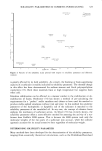
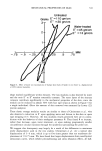
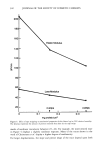
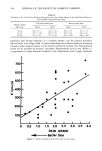
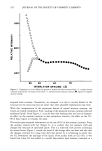
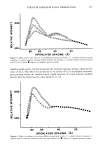
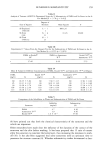
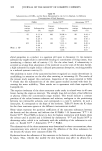
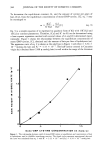
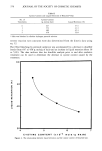
SOLUBILITY PARAMETERS IN COSEMTIC FORMULATING 323 solvents. Co-solubilizers may be identified by the medial location of their solubility parameters between two relatively immiscible materials. In this way isopropyl myristate (8 = 8.02) functions as a well known coupling agent in wax systems, like lipsticks, which incorporate normally immiscible mineral oil/castor oil (8 = 7.09/8.90) com- binations. Truly, some creative combinations of non-solvents have been produced which together exhibit good solvency, while being ineffectual alone. One common example of this "synergism" is the ethyl ether/ethanol (8 = 7.37/12.55) solvent combination for nitrocellulose (8 = 11.25). Individually these two solvents exhibit poor solvency for nitrocellulose. On the other hand, reverse synergism is also recognized where solvent mixtures interact with each other. The solubility of benzalphthalide was evaluated as an example of using solubility pa- rameters to determine the best choice of solvent and to demonstrate both the value and limitations of the solubility parameter for this purpose. Benzalphthalide is a new UV absorber of interest as a potential sunscreen. It is polar enough to demonstrate the separate solubility effects of the solubility parameter and the field deformations caused by inductive polarization and/or hydrogen bonding. It was the test material of choice because its manufacturer (VanDyk & Co.) describes it as a material with "limited solubility." The majority of cosmetic materials are less polar than benzalphthalide and their solubilities may be determined primarily from the solubility parameter. As ma- terials become more polar or more hydrogen bonded, the polar and hydrogen bonding forces expectedly contribute more to the solubility of that material. Two methods were used to determine the levels of solubility in the subject solvents. For volatile solvents, excess benzalphthalide was stirred and then allowed to stand isothermally at 25 degrees C. overnight before the supernatent was dried to constant weight. For solvents of lower volatility, incremental additions of solute were stirred isothermally until saturation was observed. Figure 2 represents the results of the solubility study plotted against solubility param- eter. Figure 3 shows the same results plotted with respect to solubility parameter and di- electric constant. Hydrogen bonding is believed to be responsible for any anomalous results in this plot. The dependence of solubility on the value of the solubility parameter is apparent from both graphs. However, the contribution of the polarity provides increased precision to estimates of solubility in other solvents and to evaluation of the solvating forces surrounding benzalphthalide. One may also determine the solubility parameter of benzalphthalide to be about 10.9 from these results. Solubility studies like this are the ultimate empirical method for determining a solubility parameter. Among the non-polar majority of cosmetic materials, the overwhelming contibutor to effects of solubility is the solubility parameter. APPLICATIONS OF THE SOLUBILITY PARAMETER The solubility parameter has been applied successfully in fields other than cosmetics and toiletries, yielding practical solutions to many problems. These solutions have, in turn, been used to develop new products and processes and to improve on old tech- nology. All of the methods reviewed below may be applied to cosmetic systems without modification.
Purchased for the exclusive use of nofirst nolast (unknown)
From: SCC Media Library & Resource Center (library.scconline.org)