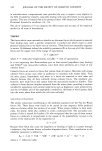
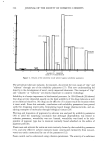
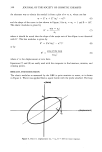
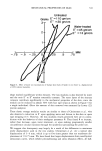
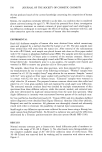
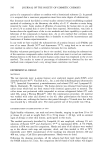
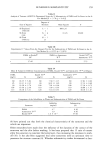
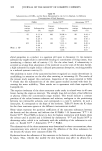
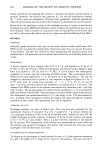
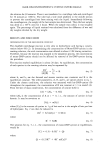
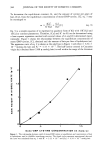
MECHANICAL PROPERTIES OF SKIN 345 Grams 10 Grade 3.75 Grade 1 : MM 2 -10 Figure 8. Stress-strain loops for soft and stiff skin (lower leg). (1-9) above to the fundamental component (23). The presence of higher odd harmonics, when not accounted for in this way, will result in large errors in measurement of the loss modulus and probably much smaller errors in the storage modulus. It was not necessary to use harmonic analysis for the range of displacements encountered in the studies presented here. We believe that nonlinear viscoelastic response may indicate a stronger dermal contribution to the measurement than is present during linear visco- elastic response (4, 5). The elastic modulus is linear with respect to the diameter of the tape disk as is shown in Figure 6 for two different subjects. This seems odd at first, since the elastic modulus is defined in such a way as to be independent of sample dimensions. This functional dependence of E' on disk diameter is a consequence of the fact that we have no control over the dimensions of the skin that are involved in the movement of the probe. In fact, the E' we measure is not equivalent with but only analogous to an elastic modulus, since the area cannot be defined in vivo for a formal definition of the applied stress. Therefore we report E' in units of force (gm) per unit displacement (cm). The linear dependence seems intuitively to be due to the fact that only the stratum corneum around the circumference of the disk is being stretched along the projection of motion. The stratum corneum attached to the tape is not being stretched and does not contribute to the measurement. The non-zero intercept reflects to some degree the contribution from the surrounding skin or underlying tissue. The mechanical properties are not very sensitive to the angle between the probe and the leg, but abrupt changes in the stress-strain loop can be observed and easily identified

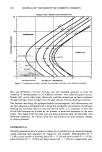
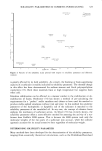
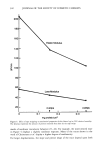
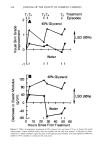
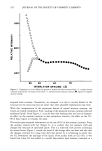
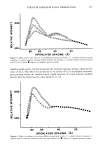
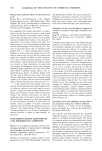
346 JOURNAL OF THE SOCIETY OF COSMETIC CHEMISTS T1 T2 2 • ,-E (/3O 0 T3 T4 T5 Treatment t i i Episodes 40% Glycerol Water I I I I LSD (95%) 120 '• 8o o 40 • 0 • -40 • -80 B, 40% Glycerol Water I I I I 10 20 30 40 50 60 Hours Since First Treatment LSD (95%) Figure 9. Effect of progressive treatments of 40% glycerol (/•) and water (V]) on: a) Visual skin grade improvement. Larger numbers imply that skin appears less dry and more normal. b) Decrease in elastic modulus E 1. Larger numbers imply that skin is less tight and more flexible. The least significant difference (LSD) for 95% confidence is indicated for each panel.
Purchased for the exclusive use of nofirst nolast (unknown)
From: SCC Media Library & Resource Center (library.scconline.org)