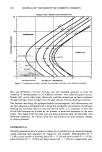
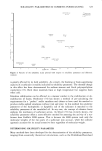
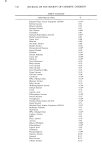
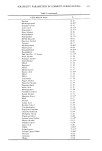
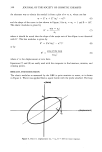
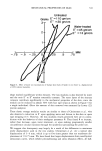
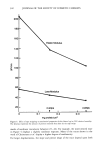
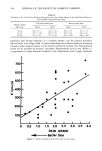
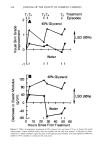
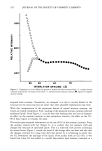
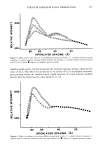
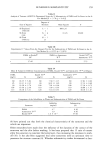
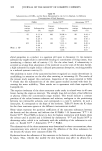
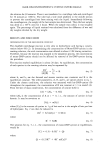
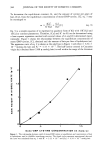
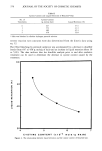
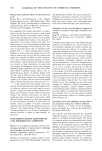
MECHANICAL PROPERTIES OF SKIN 347 if the probe alignment becomes too poor. As one progresses down the outer leg (below the knee), the elastic modulus generally increases even as much as a factor of two (Table II). (One also observes that the skin condition becomes poorer further down the leg.) Sizable differences in elasticity can be observed for distances as close as 3 cm. A comparison between skin grade and elastic modulus is shown in Figure 7, where one observes that increasing skin grade usually corresponds to stiffer skin or increasing elastic modulus. The correlation coefficient is r = 0.59 with p = 0.001, where p is the probability of observing that large of a sample correlation coefficient if, in fact, the true correlation is zero. Although the probe was attached at approximately the same relative position on each panelist, some of the differences may be due to differences in position. All of the 28 subjects were female and ranged in age from 25-55, except for one subject who was five years old. Her stress-strain loop for grade 1 is compared in Figure 8 with an adult's skin of average grade 3.75. The contrast is rather dramatic. The effect of glycerol treatment on the visual appearance and elastic properties of lower leg skin is shown in Figure 9. Plotted are the mean decrease in visual skin grade and in E1 relative to the first measurement. The data exhibit that glycerol softens skin (lowering the elastic modulus El) while providing a visual benefit relative to water treatment. During the first 24 hours, the visual benefit appears not to last as long as the softening benefit. Much of the visual benefit is lost 18 hours after the second treatment (24 hour time point), whereas the GBE detects a significant difference in skin softness at this same time (99% confidence level). Beyond the 28-hour time point, the visual and mechanical measurements follow roughly similar patterns for each treat- ment. In fact, the absolute visual grade and E1 values for this experiment correlate well with each other (r = 0.65 with p = 0.02), lending support to the notion that similar benefits are being measured by the two techniques. CONCLUSION The results of the studies presented in this paper indicate that dry skin is generally stiffer than normal skin. Hydration of the skin results in a decrease of both the elastic and loss moduli to the same degree. Tape stripping shows that the outer few layers of the stratum corneum can contribute significantly to the mechanical properties of the stratum corneum, a conclusion also reached by Christensen et al. (1). Although the GBE does not measure fundamental mechanical properties of stratum corneum, it can be used to demonstrate that treatment of the skin with agents such as glycerol can result in softer skin. It was also observed that stratum corneum stiffness increases as the measurement site is moved down in position-on the lower leg. REFERENCES (1) J. D. Middleton, The effect of temperature on extensibility of isolated comeurn and its relation to skin chapping, Br.J. Dermatol., 81, 717-721 (1969). (2) A. C. Park and C. B. Baddiel, Rheology of stratum corneum. I. A molecular interpretation of the stress-strain curve, J. Soc. Cosmet. Chem., 23, 3-12 (1972). (3) P. F. F. Wijn, A. J. M. Brakkee, G. J. M. Stienen, and A. J. H. Vendrik, "Mechanical Properties of the Human Skin In Vivo for Small Deformations A Comparison of Uniaxial Strain and Torsion

348 JOURNAL OF THE SOCIETY OF COSMETIC CHEMISTS (7) (8) (9) (10) (11) (12) (13) (14) (15) (16) (17) (18) (19) (20) (21) (22) (23) (24) (25) Measurements," in Be&ore Biomechanics, J. M. Cowden and J. T. Scales, Eds. (Macmillan Ltd., London, 1976) pp 103-108. (4) J. Ferguson and J. C. Barbenel, "Skin Surface Patterns and the Directional Mechanical Properties of the Dermis," in Bioengineering and the Skin, R. Marks, Ed. (MTP Press, Lancaster, 1981), pp 83- 92. (5) P. F. F. Wijn, A. J. M. Brakee, J.P. Kuiper, and A. J. H. Vendrik, "The Alinear Viscoelastic Properties of Human Skin In Vivo Related to Sex and Age," Ibid., pp 135-145. (6) S. Dikstein and A. Hartzshtark, "In Vivo Measurement of Some Elastic Properties of Human Skin," Ibid., pp 45- 53. A. Tosti, G. Compagno, M. L. Fazzini, and S. Villardita, A ballistometer for the study of the plastoelastic properties of skin, J. Invest. Dermatol., 69, 315-317 (1977). R. Grahame and P. J. L. Holt, The influence of aging on the in vivo elasticity of human skin, Gerontol., 15, 121-139 (1969). H. Alexander and T. H. Cook, Accounting for natural tension in the mechanical testing of human skin, J. Invest. Dermatol, 69, 310-314 (1977). S. Dikstein, A. Hartzshtark, and P. Bercovici, The dependence of low-pressure indentation, slackness, and surface pH on age in forehead skin of women, J. Soc. Cosmet. Chem., 35, 221-228 (1984). H. Alexander and T. Cook, "Variations With Age in the Mechanical Properties of Human Skin In Vivo," reference 3, pp 109-117. D. E. Thompson, H. Mg. Hussen, and R. Q. Perritt, "Point Independence Characterization of Soft Tissues In Vivo," reference 4, pp 103-111. R. M. Dahlgren and W. H. Elsnau, Measurement of skin condition by sonic velocity,J. Soc. Cosmet. Chem., 35, 1-19 (1984). R. O. Potts, D. A. Chrisman, Jr., and E. M. Buras, Jr., The dynamic mechanical properties of human skin in vivo, J. Biomech., 16, 365-372 (1983). R. O. Potts, E. M. Buras, Jr., and D. A. Chrisman, Jr., Changes with age in the moisture content of human skin, J. Invest. Dermatol., 82, 97-100 (1984). J. De Rigal and J-L. Leveque, In vivo measurement of the stratum corneum elasticity, Bioeng. Skin, 1, 13-23 (1985). M. S. Christensen, C. W. Hargens III, S. Nacht, and E. H. Gans, Visco-elastic properties of intact human skin: Instrumentation, hydration effects, and the contribution of the stratum corneum, J. Invest. Dermatol., 69, 282 (1977). C. W. Hargens, III, "The Gas Bearing Electrodynamometer (GBE) Applied to Measuring Mechanical Changes in Skin and Other Tissues," in Bioengineering and the Skin, R. Marks and P. A. Payne, Eds. (MTP Press, Hingham, MA, 1981), pp 113-122. M. S. Christensen, S. Nacht, and E. W. Packman, Facial oiliness and dryness: Correlation between instrumental measurements and self-assessment, J. Soc. Cosmet. Chem. 34, 241 (1983). D. Maes, J. Short, B. A. Turek, and J. A. Reinstein, In vivo measuring of skin softness using the gas bearing electrodynamometer, Intern. J. Cosmet. Sci., 5, 189 (1983). J. D. Ferry, Viscoelastic Properties of Polymers, 3rd ed. (Wiley, New York, 1980), pp 11-12. O. H. Lowry, N. J. Rosenbrough, A. L. Farr, and R. J. Randall, Protein measurement with the folin phenol reagent, J. Biol. Chem., 193, 265 (1951). S. Onogi, T. Masuda, and T. Matsumoto, Non-linear behavior of viscoelastic materials. I. Disperse systems of polystyrene solution and carbon black, Trans. Soc. Rheol., 14, 275-294 (1970). W. Philippoff, Vibrational measurements with large amplitudes, Ibid., 10, 317-334 (1966). M. Kobayashi, S. Ishikawa, and M. Samejima, Application of nonlinear viscoelastic analysis by the oscillation method to some pharmaceutical ointments in the Japanese pharmacopea, Chem. Pharm. Bull. Jpn., 30, 4468-4478 (1982). (26) P. Drout, A. Rochefort, C. Oytana, and P. Agache, In vitro stress relaxation tests of human stratum corneum, Bioeng. Skin 1, 141-156 (1985).
Purchased for the exclusive use of nofirst nolast (unknown)
From: SCC Media Library & Resource Center (library.scconline.org)